Within Caithness UFOs
Why Caithness Lights Can Look So Strange
Caithness's dark northern horizons make aurora, satellites, meteors and distant lights unusually easy to misread as something stranger.
On this page
- Aurora over the north coast
- Starlink, satellites and meteors
- How distance and darkness distort judgement
Page outline Jump by section
Introduction
Caithness is one of the easiest places in mainland Britain to understand why honest sky reports can become UFO reports. Its northern coast, low-lying ground, dark rural skies and wide sea horizons make aurora, satellites, meteors and distant lights unusually visible — but not always easy to judge. A pale glow over Dunnet Head, a line of Starlink satellites after sunset, or a bright fireball over the Pentland Firth can look strange enough to be reported as something unknown, especially when there is no nearby city glow to give scale.
That does not mean every Caithness sighting is automatically explained. The point is narrower and more useful: several of the most plausible explanations for “strange lights” in Caithness are sky-based rather than craft-based. The county’s documented UFO record is thin, and its clearest Ministry of Defence entry — two bright white lights “near Wick” in February 2000 — lacks the detail needed to confirm any single cause. But the mechanisms that can make lights look uncanny here are well understood, and they matter for how Caithness UFO claims should be read.
Aurora over the north coast
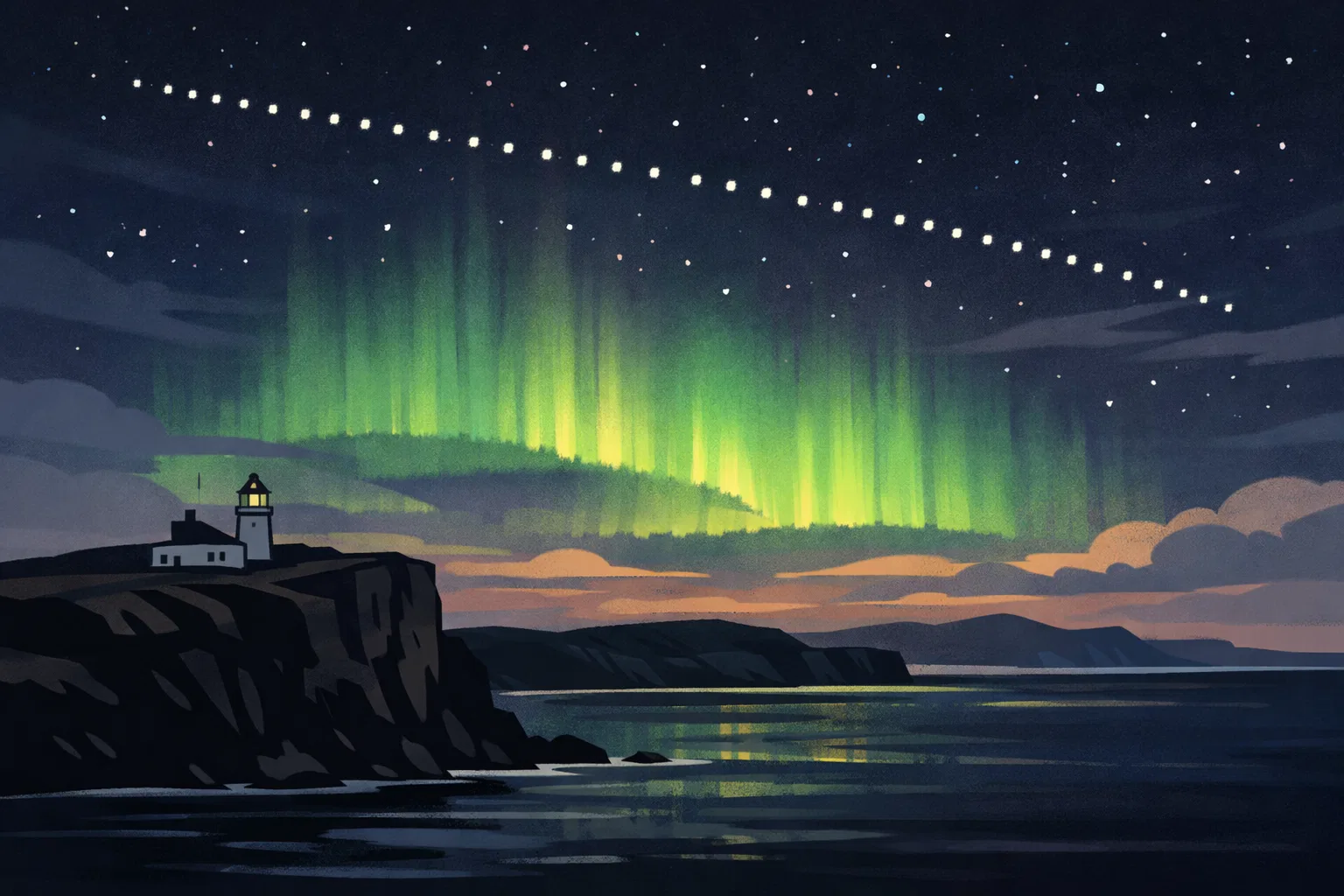
The aurora is not a fringe explanation in Caithness; it is part of the county’s real night-sky environment. Caithness is the northernmost historic county of mainland Great Britain, with Dunnet Head forming the northernmost point of the British mainland and the county bounded by the Pentland Firth, the North Sea and Sutherland. That geography gives observers broad, dark horizons to the north and north-east — exactly the kind of view that helps faint auroral light become visible.[Wikishire]wikishire.co.ukOpen source on wikishire.co.uk.
The Met Office explains that the UK sits south of the usual auroral belt, so strong geomagnetic activity is normally needed before aurora becomes visible from Britain. During moderate to strong storms, aurora may not be overhead in Scotland but can still be seen from the UK because it occurs high in the atmosphere; during severe storms it may extend much farther south.[Met Office]weather.metoffice.gov.ukOpen source on metoffice.gov.uk. This is particularly relevant to Caithness because a low northern horizon can turn a distant auroral arc into a mysterious glow, band, curtain or patch of colour rather than the dramatic overhead display shown in many photographs.
Local tourism and astronomy sources treat aurora watching as a normal part of the North Highlands sky. Venture North describes Caithness and Sutherland as places with very low light pollution, wide horizons and good aurora-viewing prospects, naming Dunnet Head and north-coast harbours among the useful viewing locations. It also notes that the best season is roughly late September to mid-April, when the nights are long and dark.[Venture North]venture-north.co.ukVenture North Aurora and Dark SkiesVenture North Aurora and Dark Skies
For UFO interpretation, the important detail is that the aurora often does not look like the postcard version. A faint aurora may appear as a grey-green glow, a pale band, a reddish wash, a shifting haze or a vertical curtain. Cameras can make it look brighter and more colourful than it seemed to the eye, while cloud gaps and sea mist can break it into separate patches. A witness looking north from Thurso, Dunnet, John o’ Groats or the coast near Wick may therefore report “lights”, “beams”, “mist”, “glowing clouds” or “searchlight-like” effects without having seen a structured object at all.
The May 2024 geomagnetic storm shows why this explanation has become more important, not less. The Met Office reported that geomagnetic activity on 10 May 2024 was the highest recorded in the UK since 2003 and produced vivid aurora sightings across the country, with visibility extending far beyond Scotland.[Met Office]metoffice.gov.ukwarm for many with a change on the waywarm for many with a change on the way A rare national display does not explain an older Caithness sighting by itself, but it reminds readers that aurora can be bright, widespread and surprising even to people who know the sky.
Starlink, satellites and meteors
Satellites are another strong explanation for some Caithness “strange light” reports, especially modern ones. A satellite does not need to have lights of its own to be visible; it can reflect sunlight while the observer on the ground is already in darkness. The best viewing times are usually shortly after sunset or before sunrise, when the sky is dark for the observer but the satellite is still sunlit.[skymaps.com]skymaps.comOpen source on skymaps.com. In Caithness, where dark skies and open horizons make small moving lights easier to pick out, that can produce a surprisingly vivid sight.
Starlink has changed the public pattern of satellite sightings. The first large batch of 60 Starlink satellites was launched in May 2019, and newly deployed satellites can appear as a close, bright line or “train” of lights before they spread out into their operational orbits.[Space]space.comStarlink satellites: Facts, tracking and impact on astronomyStarlink satellites: Facts, tracking and impact on astronomy That makes Starlink a poor explanation for the February 2000 Wick-area MoD entry, but a strong candidate for more recent social-media-era reports of evenly spaced lights moving together across the Caithness sky.
This matters because “formation” is often treated by witnesses as evidence of control. A row of bright lights crossing the sky at steady speed can look artificial in the dramatic sense — like a craft, convoy or coordinated display — when it is actually artificial in the ordinary spaceflight sense. The fact that Starlink trains are widely mistaken for UFOs is not a dismissal of witnesses; it is a recognition that the sight is genuinely odd when seen without warning.[Space]space.comstarlink satellite train how to see and track itstarlink satellite train how to see and track it
Meteors and fireballs produce a different kind of confusion. They are usually brief, fast and dramatic rather than slow and steady. The National Space Centre describes meteors as quick flashes caused by space rocks burning up in the atmosphere, while the American Meteor Society defines a fireball as a very bright meteor, roughly brighter than Venus.[National Space Centre]spacecentre.co.ukwhat was that bright light in the skywhat was that bright light in the sky A fireball seen over the sea or moorland may appear to descend behind a headland, break into pieces, change colour, or leave a glowing trail. Without a precise direction, duration and comparison to known stars or aircraft, it can easily enter the local memory as an unidentified light.
Satellite re-entry sits between these categories. It can look like a slow, fragmenting fireball and may be confused with a meteor or a controlled object. The Aerospace Corporation’s orbital-debris specialists note that natural meteors and human-made re-entries can look similar enough to cause confusion, while the National Archives’ UFO guidance records satellite re-entries among explanations for large numbers of British UFO reports.[The Aerospace Corporation]aerospace.orgOpen source on aerospace.org. For Caithness, with sea horizons in several directions, a re-entry far away could still look locally significant.
The Wick report and why sky explanations fit — but do not close the case
The key official Caithness example is the Ministry of Defence’s 11 February 2000 entry for “Near Wick, Caithness”. It records two white, bright lights at 18:00, with the lower one looking like a searchlight and both described as “very high”.[GOV.UK]assets.publishing.service.gov.ukOpen source on service.gov.uk. That wording is useful because it contains no craft shape, no sound, no close approach and no physical trace. It is a lights-in-the-sky report, which is exactly the kind of report where aurora, satellites, aircraft, bright planets, meteors and atmospheric effects have to be considered before anything more exotic.
Aurora is plausible as a class of explanation because the report mentions height, whiteness, brightness and a searchlight-like lower light. A weak auroral ray, patch of illuminated haze or cloud interacting with distant light could create a beam-like impression. But the public MoD line does not give the sighting direction, duration, weather, cloud cover, geomagnetic conditions or whether the lights moved. Without those details, it would be overconfident to call the Wick report “the aurora”.
A satellite explanation is also possible in a broad sense, though not specifically Starlink. Ordinary satellites were visible long before 2000, and a pair of bright moving lights could be two separate satellites or a satellite and another object seen together. However, the report does not say whether the lights crossed the sky, faded, remained fixed, or changed relative position. That missing movement data is crucial because satellites normally move steadily across the sky and then fade as they enter Earth’s shadow.
Meteors are a weaker fit for the Wick wording if the lights were observed for more than a few seconds, because meteors are normally brief. But if the report was compressed by the MoD summary, a bright fireball or re-entry could still have been remembered as “very high” lights. The safest conclusion is that the Wick entry remains unidentified from the public record, while belonging to a category of report for which ordinary sky explanations are strong contenders.
How distance and darkness distort judgement
Caithness does not need a famous UFO flap to be interesting. Its value is that it shows how place changes perception. The county is largely open, coastal and low-lying, with Wick, Thurso, John o’ Groats, Dunnet Head and the north coast offering long sightlines over sea and moor.[Wikishire]wikishire.co.ukOpen source on wikishire.co.uk. That gives people excellent sky access, but it also removes many of the visual cues that help a witness judge distance, height and speed.
A light over the Pentland Firth might be close and low, or distant and high. A glow over the horizon might be aurora, cloud, a vessel, a lighthouse, aircraft activity, or reflected light. A moving point might be a satellite, aircraft, drone, meteor, or distant vehicle on rising ground. In a city, buildings and streetlights provide scale; on a dark Caithness headland, the eye has fewer anchors.
This is why local dark-sky culture matters to UFO interpretation. Castlehill Heritage Centre at Castletown is listed as a Dark Sky Discovery Site, and Caithness Astronomy Group runs observing events there.[Go Stargazing]gostargazing.co.ukOpen source on gostargazing.co.uk. The same conditions that make the area good for stargazing also increase the chance that ordinary astronomical phenomena will be noticed by people who were not expecting them.
There is also a psychological trap in clear northern skies: brightness can be mistaken for nearness. Venus, Jupiter, a satellite flare, an aircraft landing light, or a bright meteor can look “too bright” to be ordinary. Once a witness has no sound, no visible wings, no obvious direction and no sense of scale, the report can become more mysterious in the telling even when the underlying event was natural or human-made.
A practical reading of Caithness light reports
A careful Caithness UFO reading should not start by asking whether a report is “real” or “fake”. Most reports are real in the basic sense that someone saw something. The better question is what kind of light was described and whether the conditions match a known sky mechanism.
A useful first split is between stationary glow, steady movement and brief flash. A stationary or slowly shifting northern glow points towards aurora, cloud illumination or distant ground/sea lights. A steady point or line crossing the sky after dusk or before dawn points towards satellites, including Starlink for post-2019 reports. A sudden streak, burst, fragmentation or coloured trail points towards a meteor, fireball or re-entry. A hovering or approaching white light could be aircraft seen head-on, especially near Wick’s aviation routes, but that belongs more to the aviation side of the Caithness UFO story.
The details that would strengthen a report are straightforward: exact time, viewing direction, duration, movement, weather, photographs with original timestamps, comparison with stars or landmarks, and whether others saw the same thing from different places. The details that weaken a dramatic interpretation are equally clear: no direction, no duration, no independent witness, no image metadata, and wording that only says “bright lights” or “searchlight” without describing behaviour.
On that standard, aurora and satellites do not “debunk Caithness”. They give the county’s UFO history a more realistic frame. Caithness is a place where the northern sky is active, dark and open enough to surprise people. Some sightings may remain unresolved because the record is too thin. Many others are likely to be ordinary lights seen under unusually good — and unusually deceptive — viewing conditions.
eBay marketplace picks
Marketplace Samples
Example marketplace items related to this page. Use the search link to explore similar finds on eBay.
Endnotes
1.
Source: weather.metoffice.gov.uk
Link:https://weather.metoffice.gov.uk/learn-about/space-weather/auroras
2.
Source: metoffice.gov.uk
Title: warm for many with a change on the way
Link:https://www.metoffice.gov.uk/about-us/news-and-media/media-centre/weather-and-climate-news/2024/warm-for-many-with-a-change-on-the-way
3.
Source: skymaps.com
Link:https://skymaps.com/articles/n0012.html
4.
Source: space.com
Title: Starlink satellites: Facts, tracking and impact on astronomy
Link:https://www.space.com/spacex-starlink-satellites.html
5.
Source: space.com
Title: starlink satellite train how to see and track it
Link:https://www.space.com/starlink-satellite-train-how-to-see-and-track-it
6.
Source: aerospace.org
Link:https://aerospace.org/node/44081/printable/print
7.
Source: nationalarchives.gov.uk
Link:https://www.nationalarchives.gov.uk/explore-the-collection/explore-by-time-period/postwar/ufo-reports/
8.
Source: assets.publishing.service.gov.uk
Link:https://assets.publishing.service.gov.uk/media/5a78cd1d40f0b6324769a45e/UFOReport2000.pdf
9.
Source: assets.publishing.service.gov.uk
Link:https://assets.publishing.service.gov.uk/media/5a79dfc9ed915d042206ba86/UFOReport2001.pdf
10.
Source: assets.publishing.service.gov.uk
Link:https://assets.publishing.service.gov.uk/media/5a79bcace5274a684690bbc2/UFOReport1999.pdf
11.
Source: metoffice.gov.uk
Title: how to see the northern lights uk january 2026
Link:https://www.metoffice.gov.uk/syndication/syndicated-articles/msn-news/2026/january/how-to-see-the-northern-lights-uk-january-2026
Published: january 2026
12.
Source: metoffice.gov.uk
Title: how to see the aurora in the uk tonight
Link:https://www.metoffice.gov.uk/syndication/syndicated-articles/msn-news/2025/november/how-to-see-the-aurora-in-the-uk-tonight
13.
Source: metoffice.gov.uk
Title: review of 2024 multiple records broken in a year of mixed weather
Link:https://www.metoffice.gov.uk/blog/2024/review-of-2024-multiple-records-broken-in-a-year-of-mixed-weather
14.
Source: metoffice.gov.uk
Link:https://www.metoffice.gov.uk/about-us/news-and-media/media-centre/weather-and-climate-news/2026/a-wet-and-windy-week-with-the-potential-for-cooler-more-settled-conditions-next-week
15.
Source: metoffice.gov.uk
Link:https://www.metoffice.gov.uk/binaries/content/assets/metofficegovuk/pdf/research/library-and-archive/library/publications/corporate/barometer-issue-35.pdf
16.
Source: digital.nmla.metoffice.gov.uk
Link:https://digital.nmla.metoffice.gov.uk/download/file/IO_fe671b89-5fa3-4df8-babb-8751cd58e205
17.
Source: n-somerset.gov.uk
Link:https://n-somerset.gov.uk/sites/default/files/2022-06/L2%20-%20Night%20Blight%20%E2%80%93%20mapping%20England%E2%80%99s%20light%20pollution%20and%20dark%20skies.pdf
18.
Source: southdowns.gov.uk
Link:https://www.southdowns.gov.uk/dark-skies-hub/astronomy-groups-in-the-national-park/
19.
Source: space.com
Link:https://www.space.com/stargazing/meteor-showers/fireball-sightings-are-surging-across-the-us-heres-whats-really-going-on
20.
Source: space.com
Title: x starlink astronomy observations
Link:https://www.space.com/spacex-starlink-astronomy-observations.html
21.
Source: news.sky.com
Title: starlink satellites leads to ufo reports 12297446
Link:https://news.sky.com/video/starlink-satellites-leads-to-ufo-reports-12297446
22.
Source: youtube.com
Title: Met Office explains the Northern Lights
Link:https://www.youtube.com/watch?v=tICC8ltH8G0
Source snippet
Solved: Mile-Long Mothership UFO (Starlink)...
23.
Source: wikishire.co.uk
Link:https://wikishire.co.uk/wiki/Caithness
24.
Source: venture-north.co.uk
Title: Venture North Aurora and Dark Skies
Link:https://www.venture-north.co.uk/things-to-do/aurora-and-dark-skies/
25.
Source: syfy.com
Title: spacex satellites are now being mistaken for ufos and making astronomers rage
Link:https://www.syfy.com/syfy-wire/spacex-satellites-are-now-being-mistaken-for-ufos-and-making-astronomers-rage
26.
Source: spacecentre.co.uk
Title: what was that bright light in the sky
Link:https://www.spacecentre.co.uk/news/space-now-blog/what-was-that-bright-light-in-the-sky/
27.
Source: gostargazing.co.uk
Link:https://gostargazing.co.uk/events/locations/castlehill-heritage-centre/
28.
Source: spanglefish.com
Link:https://www.spanglefish.com/caithnessastronomygroup/index.asp?pageid=725016
29.
Source: Wikipedia
Link:https://en.wikipedia.org/wiki/Caithness
30.
Source: Wikipedia
Link:https://en.wikipedia.org/wiki/Starlink
31.
Source: spanglefish.com
Link:https://www.spanglefish.com/caithnessastronomygroup/index.asp?pageid=510597
32.
Source: realcounties.com
Link:https://realcounties.com/county/caithness/
33.
Source: forbes.com
Title: spacex launches first starlink satellites in space internet battle
Link:https://www.forbes.com/sites/jonathanocallaghan/2019/05/23/spacex-launches-first-starlink-satellites-in-space-internet-battle/
34.
Source: hiddenscotland.com
Link:https://hiddenscotland.com/articles/caithness-discovering-the-nooks-%26-crannies
35.
Source: britannica.com
Link:https://www.britannica.com/place/Caithness
36.
Source: satellitemap.space
Link:https://satellitemap.space/constellation/starlink
37.
Source: spacex.com
Title: Space X
Link:https://www.spacex.com/launches
38.
Source: spacewatch.lpl.arizona.edu
Title: i saw something moving across sky last night what was it
Link:https://spacewatch.lpl.arizona.edu/faq/i-saw-something-moving-across-sky-last-night-what-was-it
Additional References
39.
Source: youtube.com
Title: Satellites Mistaken for UFOs
Link:https://www.youtube.com/watch?v=Vxk7WQus6ws
Source snippet
Caithness Northern Lights Aurora Borealis Scotland The Northern Lights | Highlands - Scotland's Wild Heart BBC Scottish Comedy...
40.
Source: youtube.com
Title: How to see the Northern Lights (aurora borealis) in the UK
Link:https://www.youtube.com/watch?v=NMyG3UXuNiU
Source snippet
How To Hunt The Northern Lights In Scotland...
41.
Source: facebook.com
Link:https://www.facebook.com/eveningtele/posts/a-photo-of-an-alleged-perthshire-ufo-sighting-has-been-revealed-after-32-years/5313705302011840/
42.
Source: facebook.com
Link:https://www.facebook.com/SpaceLaneInfo/posts/a-recent-photograph-circulating-online-claims-to-show-one-of-the-clearest-ufo-si/995727426756966/
43.
Source: instagram.com
Link:https://www.instagram.com/reel/DZbTvTjAVA3/
44.
Source: reddit.com
Link:https://www.reddit.com/r/UFOs/comments/1o95xoi/alright_lets_cut_the_crap_who_here_has_actually/
45.
Source: reddit.com
Link:https://www.reddit.com/r/NoStupidQuestions/comments/1e5ua92/are_certain_satellites_visible_during_night/
46.
Source: abcounties.com
Link:https://abcounties.com/counties/county-profiles/caithness/
47.
Source: reddit.com
Link:https://www.reddit.com/r/SpaceXLounge/comments/erkk9j/astronomer_complains_about_starlink_satellites/
48.
Source: facebook.com
Link:https://www.facebook.com/wbaltv11/posts/being-mistaken-for-ufos-isnt-the-only-way-theyre-impacting-our-view-of-the-night/590750443098554/
Topic Tree