Within Gloucestershire UFOs
The RAF Case That Put Gloucestershire on the UFO Map
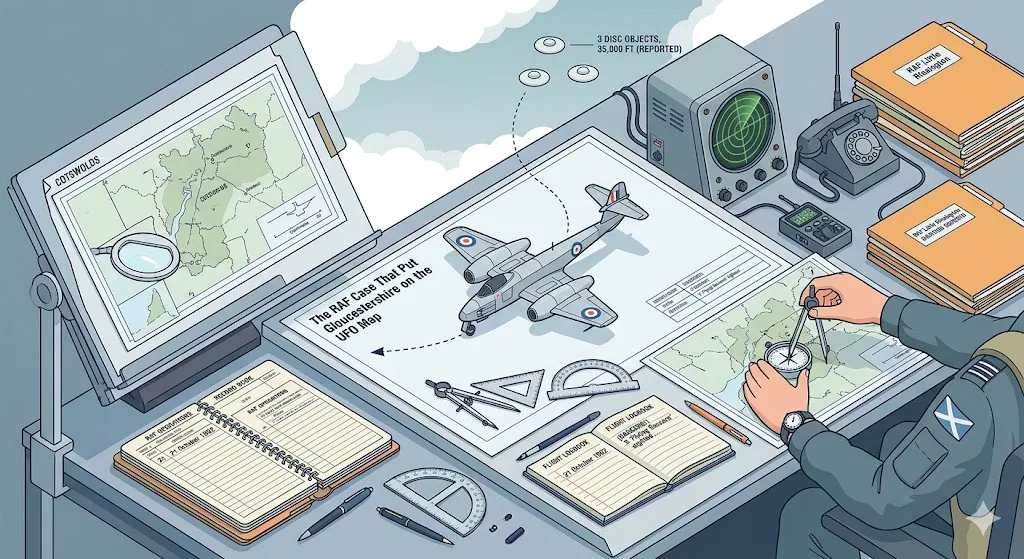
The 1952 Little Rissington case remains Gloucestershire's strongest UFO story because trained aircrew reported disc-like objects from an RAF Meteor.
On this page
- What Swiney and Crofts reported
- Why radar and RAF context matter
- What the evidence still cannot prove
Page outline Jump by section
Introduction
The Little Rissington pilot sighting of 21 October 1952 is Gloucestershire’s strongest UFO case because it combines three features rarely found together: trained military aircrew, a jet aircraft in flight, and an official evidence trail that includes radar claims and a surviving RAF operations record. Flight Lieutenant Michael Swiney, an RAF instructor, and Lieutenant David Crofts, a Royal Navy student pilot, reported seeing three unusual disc-like objects while flying a Gloster Meteor from RAF Little Rissington over Gloucestershire. The case matters less because it “proves” an extraordinary craft, and more because the witnesses, setting and surviving records make it unusually hard to dismiss as a simple casual mistake. The evidence is still incomplete: the original witness statements appear to have been destroyed, the radar data itself has not survived in public files, and later accounts depend partly on memory and reconstruction. But within Gloucestershire UFO history, this remains the central RAF-linked incident against which weaker local reports are usually measured.[National Archives]cdn.nationalarchives.gov.ukNational Archives Layout 1National Archives Layout 1
What Swiney and Crofts reported
The incident took place during a high-level navigation exercise from RAF Little Rissington, then home to the RAF’s Central Flying School. That setting is important. The RAF Museum records that the Central Flying School was re-established at Little Rissington in 1946 and became the RAF’s school for training flying instructors, so this was not an incidental sighting from an untrained observer on the ground. Swiney was a staff instructor; Crofts, seated behind him in the Meteor trainer, was a Royal Navy student pilot.[RAF Museum]rafmuseum.org.ukOpen source on rafmuseum.org.uk.
The basic reported sequence is fairly consistent across the strongest public accounts. The Meteor climbed through cloud at about 12,000 feet. Above the cloud, the crew saw three objects, described as circular, plate-like, saucer-shaped or elliptical. The National Archives extract from David Clarke’s The UFO Files says Swiney first thought they might be parachutes, while Crofts later described them as iridescent, like circular pieces of glass reflecting sunlight. The objects were said to be at about 35,000 feet, though the distance and size could not be reliably judged from the cockpit.[National Archives]cdn.nationalarchives.gov.ukNational Archives Layout 1National Archives Layout 1
That uncertainty matters. A pilot can be an excellent witness to aircraft handling, relative movement, weather and cockpit procedure, yet still face the same visual problem as anyone else when looking at unknown objects in open sky: without a known size or distance, speed and altitude estimates can be fragile. What strengthens the Little Rissington case is not that the descriptions are mathematically precise. It is that two aircrew saw the objects, discussed them in real time, and treated the sighting as serious enough to abandon the training exercise.[Dr. David Clarke]drdavidclarke.co.ukOperation Mainbrace UFOs |…
Swiney’s later recollection was emphatic but not sensationalist. He said he had seen reflections, refractions and other odd visual effects in years of flying, but did not think this sighting fitted those categories. Crofts’ remembered reaction was more practical: he considered pursuing the objects, but Swiney decided against turning the training sortie into a chase and called the sighting in. Clarke’s account says the objects remained visible for around ten minutes before they disappeared from view.[Dr. David Clarke]drdavidclarke.co.ukOperation Mainbrace UFOs |…
Why radar and RAF context matter
The reason Little Rissington stands out from most county-level UFO reports is the radar trail. In the best public reconstruction, Swiney’s report did not remain a private cockpit anecdote. The sighting was passed through RAF and air traffic channels, and later accounts say unidentified radar targets were being tracked by RAF Sopley, by the RAF Southern Sector system at Rudloe Manor near Bath, and by Air Traffic Control Centre Gloucester. Clarke’s account says the Little Rissington tower contacted Fighter Command, and Meteors on Quick Reaction Alert from RAF Tangmere were scrambled towards the radar target but made no contact.[Dr. David Clarke]drdavidclarke.co.ukOperation Mainbrace UFOs |…
This does not make the case automatically conclusive. Radar in the early 1950s could produce misleading returns. The National Archives extract explicitly places the case in a wider discussion of “angel” and “ghost” echoes that troubled RAF radar operators during the period. Such returns could resemble small aircraft on radar screens, especially under unusual atmospheric conditions. That means the radar element is both the case’s main strength and one of its main interpretive problems: it suggests there was more than a cockpit impression, but it also sits inside a radar environment known to generate puzzling false or ambiguous tracks.[National Archives]cdn.nationalarchives.gov.ukNational Archives Layout 1National Archives Layout 1
The surviving RAF operations record is the most important hard document in the public evidence trail. Clarke reports that the Central Flying School Operations Record Book for 21 October 1952 recorded Swiney and Crofts sighting three “saucer-shaped objects” travelling at high speed at about 35,000 feet during a high-level navigation exercise in a Meteor VII. The same entry said ATCC Gloucester later reported radar plots that appeared to confirm the sighting, while the Air Ministry discounted any possibility of extraterrestrial objects.[Dr. David Clarke]drdavidclarke.co.ukOperation Mainbrace UFOs |…
That wording is striking because it shows two things at once. First, the RAF record did not merely say two pilots had made an odd report; it preserved a note that radar plots had apparently supported it. Secondly, the Air Ministry’s rejection of “extra terrestrial objects” was not the same as a full public explanation of what the objects were. In other words, the official posture was not “we have identified these as X”, but rather “we do not accept the most exotic interpretation”. For readers, that distinction is crucial.[Dr. David Clarke]drdavidclarke.co.ukOperation Mainbrace UFOs |…
The broader Cold War setting also matters. Clarke links the incident to a year in which British official interest in UFO reports sharpened after major American radar-visual incidents and after NATO Exercise Mainbrace sightings. He is careful to note in a later comment that the Little Rissington event itself was on 21 October 1952, not during Mainbrace in September; nevertheless, the same autumn wave formed the institutional backdrop.[Dr. David Clarke]drdavidclarke.co.ukOperation Mainbrace UFOs |…
The evidence trail: strong witnesses, thin surviving files
The Little Rissington case is often described as an “official” UFO case, but that word needs careful handling. The strongest surviving evidence is not a complete investigation file. It is a chain of partial evidence: the pilots’ later interviews, Swiney’s logbook note, the Central Flying School Operations Record Book entry, and accounts of radar and Air Ministry follow-up. The National Archives states more generally that the Ministry of Defence retained UFO records from the 1960s onwards, but that earlier UFO material was destroyed after five years before later public interest changed retention practice.[The National Archives]nationalarchives.gov.ukThe National Archives UFO reportsThe National Archives UFO reports
That explains why the case is both compelling and frustrating. According to Clarke and the National Archives extract, Swiney later tried to locate his original report but was told that many pre-1962 UFO records had been routinely shredded. The extract says the men’s statements appear to have been destroyed, leaving the operations record book entry as the main surviving contemporary official reference.[National Archives]cdn.nationalarchives.gov.ukNational Archives Layout 1National Archives Layout 1
Swiney’s own flying logbook adds a personal documentary anchor. Clarke reports that the logbook entry for 21 October 1952 reads: “(SAUCERS!) 3 ‘Flying Saucers’ sighted at height. Confirmed by G.C.I.” GCI means Ground Controlled Interception, the radar-based system used to guide fighter aircraft towards targets. A logbook note is not a scientific measurement, but it is valuable because it appears to have been made close to the event by one of the witnesses and records the radar-confirmation claim as part of his flying record.[Dr. David Clarke]drdavidclarke.co.ukOperation Mainbrace UFOs |…
The Air Ministry response also forms part of the evidence trail. Crofts later remembered being separated and debriefed after landing, with officers asking him to describe and draw what he had seen. He also recalled being told that checks had been made with countries likely to have aircraft in the area, and that no explanation had been found from that route. This is second-hand recollection from decades later, so it should not be over-weighted, but it supports the impression that the report was treated as operationally sensitive rather than as a routine oddity.[Dr. David Clarke]drdavidclarke.co.ukOperation Mainbrace UFOs |…

What the case can and cannot prove
The case is strongest on witness quality and institutional reaction. Swiney and Crofts were not anonymous members of the public; they were military aircrew flying from a major RAF training station. Their report was serious enough to interrupt a training sortie, prompt post-flight questioning, and enter the Central Flying School’s operations record. The surviving record explicitly connects the sighting to radar plots reported by Gloucester air traffic control.[Dr. David Clarke]drdavidclarke.co.ukOperation Mainbrace UFOs |…
It is weaker on physical proof. There is no publicly available photograph, no recovered object, no surviving raw radar trace, and no complete Air Ministry case file. The most detailed public story depends on later interviews conducted around 2001–2004, nearly half a century after the event. Those interviews are valuable, especially because both principal witnesses were identified and their accounts can be compared with the operations record, but memory is not the same as a contemporaneous technical dossier.[Dr. David Clarke]drdavidclarke.co.ukOperation Mainbrace UFOs |…
The radar evidence also remains ambiguous. If the radar plots were truly independent and simultaneous, they greatly strengthen the case. But without the raw plots, operator logs and technical conditions, later readers cannot test whether the returns matched the objects seen by the pilots or resulted from atmospheric effects, equipment behaviour, miscorrelation with known aircraft, or another ordinary cause. The National Archives extract’s discussion of “angel” and “ghost” echoes is a reminder that unexplained radar is not automatically extraordinary radar.[National Archives]cdn.nationalarchives.gov.ukNational Archives Layout 1National Archives Layout 1
The strongest balanced judgement is therefore: unresolved, unusually well-witnessed, and historically important, but not proven to be an exotic craft. Swiney himself did not turn the case into a claim about aliens. Clarke quotes him as saying he was open-minded, did not expect “little green men”, but knew that he and Crofts saw something unusual which he could not explain. That restrained position is one reason the case has retained credibility among researchers who would reject more dramatic but poorly sourced stories.[Dr. David Clarke]drdavidclarke.co.ukOperation Mainbrace UFOs |…
Why Little Rissington belongs at the centre of Gloucestershire’s UFO map
For a Gloucestershire UFO history, Little Rissington is more than a colourful anecdote. It links the county to national Cold War air defence, RAF training, radar interpretation, Ministry of Defence record-keeping and the wider 1952 flying saucer wave. It also has a clear local anchor: RAF Little Rissington in the east of Gloucestershire, near the Oxfordshire boundary, with the former station and nearby villages sitting in a landscape where aviation history is part of local memory. Aviation heritage sources note that Little Rissington lay primarily in Gloucestershire while extending across the county edge, a useful reminder that airfields and flight paths rarely fit neatly inside modern administrative borders.[Airfields of Britain Conservation Trust]abct.org.ukOpen source on abct.org.uk.
That local aviation setting changes how the case should be read. In many modern county UFO reports, the most likely explanations include aircraft, satellites, drones, lanterns, meteors, reflections and misjudged lights. At Little Rissington, the witnesses were already inside the aviation system. They were not unfamiliar with aircraft, cockpit reflections or training activity. That does not make them infallible, but it raises the evidential bar for any simple dismissal.[Dr. David Clarke]drdavidclarke.co.ukOperation Mainbrace UFOs |…
The case also helps separate Gloucestershire’s serious evidence trail from later, looser UFO folklore. A strong county case is not simply the most spectacular-sounding one; it is the one with named witnesses, a date, a place, an institutional record, and competing interpretations that can be weighed. Little Rissington has all of those, even though the crucial original file trail is damaged by record loss.[The National Archives]nationalarchives.gov.ukThe National Archives UFO reportsThe National Archives UFO reports
Later reporting strengthened the story, but not enough to close it
Later research strengthened the case by bringing together witnesses, documents and institutional context. The public story developed significantly when Clarke and colleagues interviewed Swiney and Crofts, found the operations record book entry, and connected the sighting to RAF radar and Air Ministry procedures. The National Archives later published an extract from Clarke’s The UFO Files that summarised the case and placed it within the post-war official UFO record.[National Archives]cdn.nationalarchives.gov.ukNational Archives Layout 1National Archives Layout 1
However, later reporting also reveals the limits of the evidence. The more one follows the trail, the more obvious the missing pieces become: no full original witness statements, no surviving final Air Ministry report, no released radar data, and no definitive explanation. The case has been strengthened as a historical incident — it is clear that something was reported, taken seriously, and recorded — but it has not been strengthened into proof of an extraordinary vehicle.[National Archives]cdn.nationalarchives.gov.ukNational Archives Layout 1National Archives Layout 1
For Gloucestershire, that is enough to make Little Rissington the county’s landmark UFO case. It remains a rare RAF pilot sighting with a named crew and a surviving official paper trail. Its best evidence points to a real unresolved report, not to a confirmed extraterrestrial event. Its main doubts arise from missing records, uncertain radar interpretation, and the difficulty of judging unknown objects in open sky. Those tensions are exactly why the case still matters: it is neither a simple debunked light in the sky nor a solved mystery, but a disciplined example of how strong UFO claims depend on the evidence trail as much as on the sighting itself.
Amazon book picks
Further Reading
Books and field guides related to The RAF Case That Put Gloucestershire on the UFO Map. Use these as the next step if you want deeper reading beyond the article.

UFOs : Generals, Pilots, and Government Officials Go on the R...
Emphasizes trained witnesses, radar evidence, and official records, matching the themes of the RAF case.
In Plain Sight
Examines military sightings, official secrecy claims, and the continuing debate over unexplained aerial phenomena.
The Report on Unidentified Flying Objects
Covers the early 1950s military UFO wave and the official investigative context surrounding cases like the Little Rissington incident.
The UFO Experience
Explores methods for assessing UFO reports, witness reliability, and evidential limitations relevant to the case.
eBay marketplace picks
Marketplace Samples
Live-tested eBay searches with available results related to this page.



Endnotes
1.
Source: cdn.nationalarchives.gov.uk
Title: National Archives Layout 1
Link:https://cdn.nationalarchives.gov.uk/documents/the-ufo-files-extract.pdf
2.
Source: drdavidclarke.co.uk
Title: Dr. David Clarke
Link:https://drdavidclarke.co.uk/secret-files/operation-mainbrace-ufos/
Source snippet
Operation Mainbrace UFOs |...
3.
Source: rafmuseum.org.uk
Link:https://www.rafmuseum.org.uk/research/online-exhibitions/taking-flight/historical-periods/central-flying-school/
4.
Source: nationalarchives.gov.uk
Title: The National Archives UFO reports
Link:https://www.nationalarchives.gov.uk/explore-the-collection/explore-by-time-period/postwar/ufo-reports/
5.
Source: abct.org.uk
Link:https://www.abct.org.uk/airfields/little-rissington/
6.
Source: Wikipedia
Title: Central Flying School
Link:https://en.wikipedia.org/wiki/Central_Flying_School
7.
Source: Wikipedia
Title: Little Rissington
Link:https://en.wikipedia.org/wiki/Little_Rissington
8.
Source: genuki.org.uk
Title: Little Rissington
Link:https://www.genuki.org.uk/big/eng/GLS/LittleRissington
9.
Source: nationalarchives.gov.uk
Link:https://www.nationalarchives.gov.uk/search/results/?_q=ufo
10.
Source: images.nationalarchives.gov.uk
Link:https://images.nationalarchives.gov.uk/asset/74261/
11.
Source: wikishire.co.uk
Title: RAF Little Rissington
Link:https://wikishire.co.uk/wiki/RAF_Little_Rissington
12.
Source: cotswold.gov.uk
Link:https://www.cotswold.gov.uk/media/epzmmcdb/little-rissington-conservation-area-map.pdf
13.
Source: catalogue.gloucestershire.gov.uk
Link:https://catalogue.gloucestershire.gov.uk/records/P269
14.
Source: catalogue.gloucestershire.gov.uk
Link:https://catalogue.gloucestershire.gov.uk/records/GDR/20/1/148
15.
Source: assets.publishing.service.gov.uk
Link:https://assets.publishing.service.gov.uk/media/5a79bcace5274a684690bbc2/UFOReport1999.pdf
16.
Source: assets.publishing.service.gov.uk
Link:https://assets.publishing.service.gov.uk/media/5a75c656e5274a545822e1ea/UFOReports2003WholeoftheUK.pdf
17.
Source: upperrissington-pc.gov.uk
Link:https://upperrissington-pc.gov.uk/history/
Additional References
18.
Source: cia.gov
Link:https://www.cia.gov/readingroom/document/cia-rdp81r00560r000100010001-0
19.
Source: youtube.com
Title: Real-life X Files: Britain’s classified UFO files released
Link:https://www.youtube.com/watch?v=XXJ-ALkavKU
Source snippet
UFO file release May 2008 Part 1 (audio with slides)...
Published: May 2008
20.
Source: britainschoice.uk
Link:https://www.britainschoice.uk/
21.
Source: itv.com
Link:https://www.itv.com/britainsgottalent
22.
Source: britainsworld.org.uk
Link:https://www.britainsworld.org.uk/
23.
Source: alamy.com
Link:https://www.alamy.com/stock-photo/central-flying-school.html
24.
Source: archiuk.com
Link:https://www.archiuk.com/cgi-bin/build_nls_historic_map.pl?latitude=51.869287&longitude=-1.739976&password=freesearch%40freesearch.com&search_location=%2C+Little+Rissington%2C+Gloucestershire
25.
Source: facebook.com
Link:https://www.facebook.com/groups/45919558418/posts/10159125804483419/
26.
Source: maryevans.com
Link:https://www.maryevans.com/contributors/ras/gloster-meteor-t7s-central-flying-school-48041832.html
27.
Source: gazetteer.org.uk
Link:https://gazetteer.org.uk/place/Great_Rissington%2C_Gloucestershire_18707
Topic Tree