Within Suffolk UFOs
Suffolk's Radar Mystery Before Rendlesham
The 1956 radar-visual case matters because it joined military radar reports, aircraft interception and unresolved Cold War questions.
On this page
- The August 1956 reports
- Radar, pilots and the Venom interception
- Meteors, radar effects and missing records
Page outline Jump by section
Introduction
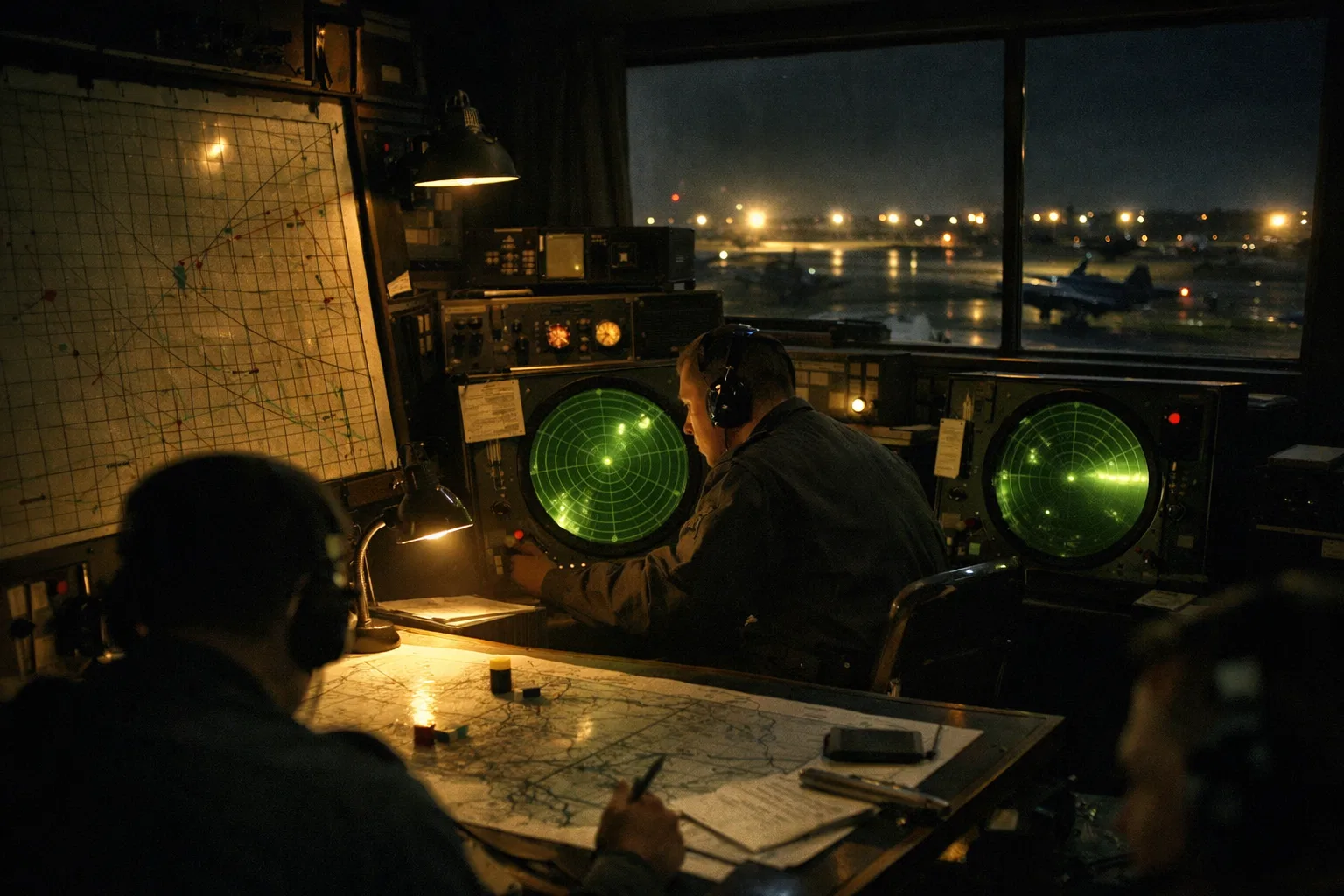
The Lakenheath-Bentwaters radar case is Suffolk’s major UFO mystery before Rendlesham. On the night of 13–14 August 1956, radar operators at RAF Bentwaters and RAF Lakenheath reported fast and unusual targets, ground observers reported bright white lights, and RAF Venom night fighters were sent to investigate. The case matters because it was not just a local sky story: it involved USAF-run RAF bases in Suffolk, British air-defence radar control from RAF Neatishead in Norfolk, and later scrutiny by Project Blue Book and the University of Colorado’s UFO study. It does not prove an extraterrestrial craft. Its importance lies in a harder question: what did several military radar systems and trained air-defence personnel think they were tracking over East Anglia, and why has the record remained contested rather than neatly explained?[ncas.org]files.ncas.orgFiles Condon Report, Case 2: USAF/RAF Radar SightingFiles Condon Report, Case 2: USAF/RAF Radar Sighting
Why this Suffolk case still stands out
Lakenheath-Bentwaters sits in the west-and-east military geography of Suffolk. RAF Bentwaters, near Woodbridge, was one of the USAF’s Cold War bases in the county; RAF Lakenheath, in west Suffolk, was also an RAF station used by the United States. The case also reached beyond Suffolk because the fighter-control element involved RAF Neatishead in Norfolk and Venom night fighters from RAF Waterbeach in Cambridgeshire. That cross-county pattern is important: the incident belongs to Suffolk’s UFO history because the named bases and radar reports centre on Bentwaters and Lakenheath, but the air-defence system watching the sky was regional.[ncas.org]files.ncas.orgFiles Condon Report, Case 2: USAF/RAF Radar SightingFiles Condon Report, Case 2: USAF/RAF Radar Sighting
The case is stronger than many ordinary UFO reports because it contains several kinds of evidence: radar reports, ground visual reports, an attempted fighter interception, and later official or semi-official analysis. It is weaker than the most dramatic retellings suggest because the surviving record is incomplete, the timings are difficult, the pilots’ later recollections do not always match the controllers’ accounts, and several ordinary mechanisms could explain parts of the night without explaining all of it. That tension is why the case has lasted.
It is also easy to overstate the official angle. Project Blue Book, the US Air Force’s UFO investigation programme, is now declassified and held by the US National Archives; the Air Force later summarised Blue Book as having received 12,618 sightings from 1947 to 1969, with 701 left “Unidentified”, while saying it had found no evidence of extraterrestrial vehicles or threats to national security. The Lakenheath-Bentwaters case was investigated within that US system, but the strongest “unexplained” language came later from the University of Colorado study, not from a simple official admission that an alien craft had been chased over Suffolk.[National Archives]archives.govNational Archives Project BLUE BOOKNational Archives Project BLUE BOOK

The August 1956 reports
The incident unfolded on a clear August night, close to the Perseid meteor shower, a detail that later became central to sceptical explanations. The University of Colorado case summary described “at least one UFO” tracked by air traffic-control radar at two USAF-RAF stations, with apparently corresponding visual sightings of rapidly moving white objects, and an attempted RAF fighter interception. That summary is striking, but it is still a summary of reports, not proof of what the object was.[NCAS Files]files.ncas.orgFiles Condon Report, Case 2: USAF/RAF Radar SightingFiles Condon Report, Case 2: USAF/RAF Radar Sighting
The first phase was at Bentwaters. According to the later technical reconstruction by Gordon D. Thayer, drawing on Project Blue Book material, Bentwaters Ground Controlled Approach radar reported several unidentified radar echoes. One was said to have crossed the radar scope at thousands of miles per hour; another involved a group of 12 to 15 returns moving more slowly before apparently merging into a much larger return; another rapid east-west target was reported later. These speeds should be treated cautiously. Radar displays of the period were not modern digital tracks, and some figures came from estimates based on sweep intervals rather than precise measurement.[NICAP]nicap.orgThe Lakenheath CaseThe Lakenheath Case
The most important Bentwaters moment came at about 22:55 GMT. The Condon Report’s reproduced account says Bentwaters GCA saw an object about 30 miles east of the station moving westward at 2,000–4,000 mph. Tower personnel reportedly saw a bright light pass over the field at terrific speed at about 4,000 feet, and an aircraft at about the same altitude over the station reported a bright light passing underneath it. This is the part of the case that gives the story its “radar-visual” weight: the reported light and the radar return were not merely similar in theme, but close in time and place.[NCAS Files]files.ncas.orgFiles Condon Report, Case 2: USAF/RAF Radar SightingFiles Condon Report, Case 2: USAF/RAF Radar Sighting
Lakenheath then became involved after Bentwaters contacted the station. The Lakenheath watch supervisor’s account, reproduced by the Colorado project, said controllers began scanning their radar scopes and found an unusual target 20 to 25 miles south-west of the station. It was described as stationary despite the use of moving-target indication, then as moving at 400–600 mph without gradual acceleration, stopping, changing course and moving again. Another Lakenheath radar unit was reportedly asked to confirm the same target in the same general position.[NCAS Files]files.ncas.orgFiles Condon Report, Case 2: USAF/RAF Radar SightingFiles Condon Report, Case 2: USAF/RAF Radar Sighting
Radar, pilots and the Venom interception
The fighter interception is the most famous and most disputed part of the case. In the classic account, an RAF de Havilland Venom night fighter was vectored towards a radar target. The pilot allegedly obtained airborne radar contact or radar “gunlock”, then the target appeared to move behind the aircraft and follow it while the pilot tried to shake it off. The Condon Report records the first pilot as saying it was the “clearest target” he had seen on radar, and says a second Venom was scrambled but did not establish contact before returning because of a malfunction.[NCAS Files]files.ncas.orgFiles Condon Report, Case 2: USAF/RAF Radar SightingFiles Condon Report, Case 2: USAF/RAF Radar Sighting
The National Archives’ later public summary of released Ministry of Defence UFO files gives a similar version through the account of retired RAF Fighter Controller Freddie Wimbledon. Wimbledon said he had been on duty at RAF Neatishead when USAF personnel reported a fast-moving blip at Lakenheath; he said the object was seen on RAF radar and that Fighter Command ordered a Venom interception. In that version, the Venom pilot called “Contact”, then “Judy”, meaning the radar/navigator had the target on airborne radar, before losing it and being told the target was behind him.[National Archives]cdn.nationalarchives.gov.ukNational ArchivesNational Archives
This is also where the air-defence puzzle becomes a records puzzle. Wimbledon’s account says those involved were later questioned by a senior Fighter Command officer and warned to keep the matter secret. The National Archives transcript says that when Dr David Clarke asked the MoD about the incident in 2001, an archive search found that the records of the incident had been lost or destroyed. That does not prove a cover-up; military records from the period are often incomplete. But it does mean the British side of the record cannot be checked in the way a reader would want.[National Archives]cdn.nationalarchives.gov.ukNational Archives
Later research complicated the fighter story further. Modern summaries of the Lakenheath Collaboration research describe interviews with surviving Venom aircrew that did not fully support the dramatic “tail-chase” version. In that later account, the pilots and navigators remembered the radar contacts as much less impressive, with no strong recollection of a target intelligently manoeuvring behind the aircraft. That does not erase the contemporary teletype and controller accounts, but it does weaken the simplest popular version: “RAF pilot chased by UFO over Suffolk” is too neat for the evidence.[The Cold File]thecoldfile.com1956 lakenheath bentwaters1956 lakenheath bentwaters
Meteors, radar effects and missing records
The most common natural explanation begins with the Perseids. The night was clear, and witnesses themselves noted an unusual number of shooting stars. Some brief visual sightings could certainly have been meteors, especially if observers were primed by radar reports and base rumours. But the Condon Report also noted J. Allen Hynek’s objection: if observers were already aware of many shooting stars, that could imply they were distinguishing the reported objects from ordinary meteors. Meteors also do not normally stop, reverse, merge, or appear to track a fighter on radar.[NCAS Files]files.ncas.orgFiles Condon Report, Case 2: USAF/RAF Radar SightingFiles Condon Report, Case 2: USAF/RAF Radar Sighting
Radar effects are the stronger sceptical line. Anomalous propagation occurs when atmospheric layers bend radar beams and create false or displaced returns. The Condon analysis accepted that some details, including a target apparently disappearing near Bentwaters and reappearing on the other side, were suggestive of anomalous propagation. It also noted that clear weather could favour atmospheric stratification. However, the same analysis found the overall radar behaviour difficult to explain that way, especially the continuous and consistent Lakenheath movements and the reported target that followed the interceptor before stopping again.[NCAS Files]files.ncas.orgFiles Condon Report, Case 2: USAF/RAF Radar SightingFiles Condon Report, Case 2: USAF/RAF Radar Sighting
A related explanation is equipment fault, especially involving Lakenheath’s moving-target indication system. Sceptics such as Philip J. Klass argued that a radar malfunction, combined with Perseid meteors and misperception, could account for the case. The problem is that a single faulty radar set does not easily explain the full chain: Bentwaters GCA, Lakenheath GCA, Lakenheath radar traffic control, ground witnesses, and the claimed airborne radar contact. The pro-UFO problem is the mirror image: if the later aircrew interviews are trusted over the controller narrative, the most dramatic part of the case becomes much less robust.[NICAP]nicap.orgThe Lakenheath CaseThe Lakenheath Case
This leaves the case in an awkward but honest category: unresolved, not proven extraordinary. The Condon Report concluded that conventional or natural explanations could not be ruled out, but seemed unlikely, and that the probability of at least one “genuine UFO” appeared fairly high. Thayer later clarified in the AIAA-linked discussion that “genuine UFO” meant a material flying object that remained unidentified, not necessarily an extraterrestrial vehicle. That distinction matters for a public Suffolk history page: the case is a serious air-defence anomaly, not a confirmed alien encounter.[NCAS Files]files.ncas.orgFiles Condon Report, Case 2: USAF/RAF Radar SightingFiles Condon Report, Case 2: USAF/RAF Radar Sighting
What the case changed in Suffolk’s UFO story
Lakenheath-Bentwaters gave Suffolk a UFO case with a different character from Rendlesham. Rendlesham is remembered through forest patrols, ground traces, witness statements and later public controversy. Lakenheath-Bentwaters is colder and more technical: radar scopes, air-traffic controllers, fighter vectors, missing files and later arguments over whether radar returns were physical targets or artefacts. Together, the two cases explain why Suffolk occupies such an outsized place in British UFO history, but they should not be blended into one legend.
The 1956 case also shows why military UFO reports are both valuable and treacherous. Trained observers can describe procedures, radar settings and aircraft movements in useful detail. At the same time, military environments create pressure, rumour, secrecy, imperfect handovers and fragmented paperwork. A radar return is not automatically an aircraft; a pilot report is not automatically complete; an unexplained file is not automatically evidence of concealment.
For readers trying to judge the case today, the most defensible position is this: something unusual was reported by multiple military channels over Suffolk and nearby East Anglia on 13–14 August 1956; the strongest official-era analysis did not find a satisfactory ordinary explanation; later sceptical explanations account for some but not all elements; and later witness research weakened the most dramatic version of the Venom chase. That is why the Lakenheath-Bentwaters case remains one of Britain’s most important radar-linked UFO reports, and also why it should be read as an unresolved air-defence puzzle rather than as a solved mystery.
Amazon book picks
Further Reading
Books and field guides related to Suffolk's Radar Mystery Before Rendlesham. Use these as the next step if you want deeper reading beyond the article.
UFOs
Focuses on military and aviation witnesses, closely matching the radar and interceptor aspects of the case.
The Report on Unidentified Flying Objects
Provides essential background on official investigations into cases such as the 1956 Suffolk radar mystery.
The Hynek UFO Report
Examines notable UFO reports and the challenges of interpreting radar and witness evidence.
Encounter in Rendlesham Forest
Places the earlier Lakenheath-Bentwaters incident within Suffolk’s wider UFO history.
eBay marketplace picks
Marketplace Samples
Live-tested eBay searches with available results related to this page.


Endnotes
1.
Source: files.ncas.org
Title: Files Condon Report, Case 2: USAF/RAF Radar Sighting
Link:https://files.ncas.org/condon/text/case02.htm
2.
Source: cdn.nationalarchives.gov.uk
Title: National Archives
Link:https://cdn.nationalarchives.gov.uk/documents/podcast-transcript.pdf
3.
Source: archives.gov
Title: National Archives Project BLUE BOOK
Link:https://www.archives.gov/research/military/air-force/ufos
4.
Source: nicap.org
Title: UFO Report
Link:https://www.nicap.org/560813bentwaters_dir.htm
5.
Source: nicap.org
Title: The Lakenheath Case
Link:https://www.nicap.org/reports/laken.htm
6.
Source: war.gov
Title: Open(“UFO cncoun1cr II
Link:https://www.war.gov/medialink/ufo/release_1/255_413270_ufo%27s_and_defense_what_should_we_prepare_for.pdf
7.
Source: heritage.norfolk.gov.uk
Title: Norfolk Heritage Explorer RAF-Neatishead-radar-station
Link:https://www.heritage.norfolk.gov.uk/record-details?MNF31218-RAF-Neatishead-radar-station=
8.
Source: thecoldfile.com
Title: 1956 lakenheath bentwaters
Link:https://www.thecoldfile.com/articles/1956-lakenheath-bentwaters/
9.
Source: Wikipedia
Title: RAF Bentwaters
Link:https://en.wikipedia.org/wiki/RAF_Bentwaters
10.
Source: Wikipedia
Title: RAF Lakenheath
Link:https://en.wikipedia.org/wiki/RAF_Lakenheath
11.
Source: nationalarchives.gov.uk
Link:https://www.nationalarchives.gov.uk/explore-the-collection/explore-by-time-period/postwar/ufo-reports/
12.
Source: cdn.nationalarchives.gov.uk
Link:https://cdn.nationalarchives.gov.uk/documents/the-ufo-files-extract.pdf
13.
Source: naa.gov.au
Link:https://www.naa.gov.au/
14.
Source: cnduk.org
Link:https://cnduk.org/wp-content/uploads/2022/05/Lakenheath.pdf
15.
Source: framlinghamtown.gov.uk
Title: bentwaters cold war museum
Link:https://www.framlinghamtown.gov.uk/bentwaters-cold-war-museum
Additional References
16.
Source: youtube.com
Title: Rendlesham Forest UFO sighting: Eyewitness Colonel Charles Halt
Link:https://www.youtube.com/watch?v=-JBwH6yHEDo
Source snippet
Rendlesham Forest: Lt. Col. Charles Halt responds to Larry Warren's 'lying' claims | Reality Check...
17.
Source: youtube.com
Title: Top 10 Concerning UFO Evidence The Pentagon Is Hiding From Us
Link:https://www.youtube.com/watch?v=1NYCy6YFLp8
Source snippet
Rendlesham Forest UFO sighting: Eyewitness Colonel Charles Halt...
18.
Source: youtube.com
Title: Legendary British Alien Sighting | History’s Greatest Mysteries (S6)
Link:https://www.youtube.com/watch?v=mLqXp90GTX8
Source snippet
What happens at RAF Bentwaters & Cold War Museum?...
19.
Source: youtube.com
Title: What happens at RAF Bentwaters & Cold War Museum?
Link:https://www.youtube.com/watch?v=viEi0F5GyVQ
Source snippet
Top 10 Concerning UFO Evidence The Pentagon Is Hiding From Us - Part 3...
20.
Source: academia.edu
Link:https://www.academia.edu/90805219/RAF_Bentwaters_Lakenheath_Air_visual_Radar_UFO_Observation_13_14_August_1956
21.
Source: tripadvisor.com
Link:https://www.tripadvisor.com/Attraction_Review-g186387-d3295231-Reviews-Bentwaters_Cold_War_Museum-Woodbridge_Suffolk_East_Anglia_England.html
22.
Source: facebook.com
Link:https://www.facebook.com/Bentwaters-Cold-War-Museum-159480594091625/?locale=es_ES
23.
Source: bsb-muenchen.de
Link:https://www.bsb-muenchen.de/mikro/lit20b.pdf
24.
Source: radarmuseum.co.uk
Link:https://www.radarmuseum.co.uk/history/
25.
Source: martinshough.com
Link:https://martinshough.com/aerialphenomena/Lakenheath/background.htm
Topic Tree