Within Rutland UFOs
What Do Rutland's UFO Records Really Prove?
Rutland shows how official UFO tables can document a sighting while still leaving the cause unresolved and weakly evidenced.
On this page
- What the Mo D tables record
- Why short entries are easy to overread
- What stronger evidence would require
Page outline Jump by section
Introduction
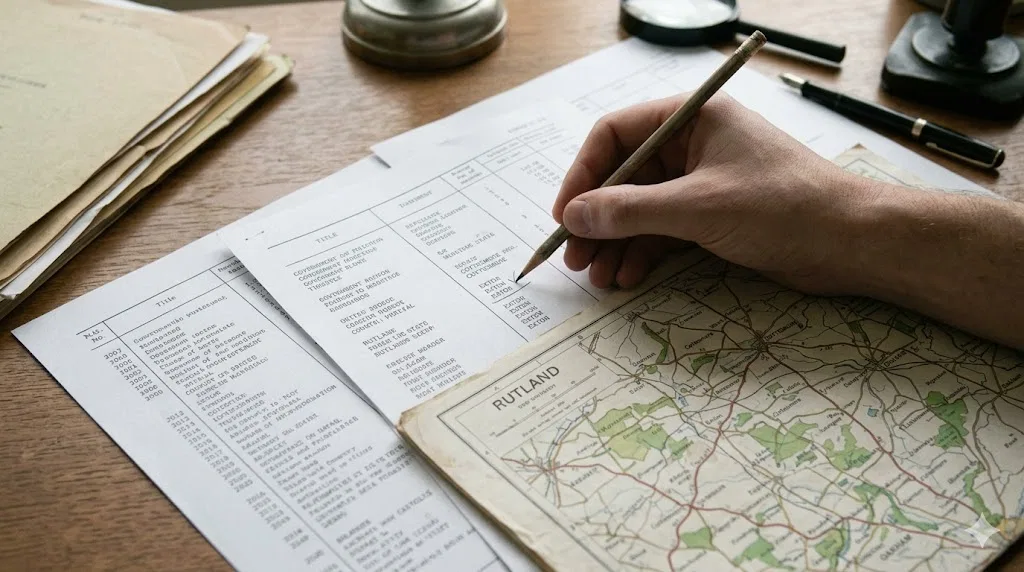
Rutland’s public UFO record shows the value and the limits of the Ministry of Defence tables. The county is not represented by a thick case file or a celebrated close encounter. The main modern entry is a short MoD listing for Exton on 20 March 2009: at 18:50, a large bright light was seen east of the village, moving south to north at high speed, and was first mistaken for a planet. That is evidence that a report was received and logged, not proof that the object was extraordinary. The important lesson is that official does not mean complete. The MoD tables preserve a date, place and brief description, but they do not provide the detail needed to test the sighting against aircraft, astronomy, weather, satellites or witness-position data.[GOV.UK Assets]assets.publishing.service.gov.ukufo report 2009ufo report 2009
Rutland is a useful county for this kind of close reading precisely because the record is so sparse. In a small rural county with notable military connections, a single short entry can easily become overinterpreted. The better approach is to ask what the document actually says, what it omits, and what evidence would be needed before the Exton report could be treated as more than a thin unresolved sighting.
What the MoD tables record
The MoD’s public 1997–2009 UFO report tables were designed as lists, not full investigations. GOV.UK describes the release as showing “dates and times, location and a brief description of the sighting”, which is exactly what appears in the Rutland entry. The Exton row gives the date, time, village, county and a compact description of a bright light moving south to north, but it does not include the witness’s name, exact viewing point, duration, angular height, weather, aircraft checks, astronomical checks or any conclusion.[GOV.UK]GOV.UKufo reports in the ukufo reports in the uk
That matters because the same table page shows how compressed these records are. Nearby entries from March 2009 include “a red fire ball”, “two very bright glowing orange lights”, a “constant light travelling West to East”, and a later report that “looked like a satellite crashing or a star”. These are not case narratives. They are short summaries of incoming reports, written in a form that keeps the public log searchable but strips away most of the diagnostic material an investigator would need.[GOV.UK Assets]assets.publishing.service.gov.ukufo report 2009ufo report 2009
The Rutland entry’s wording is especially revealing because it contains its own uncertainty. “At first mistaken for a planet” suggests that the object’s brightness or appearance initially fitted an ordinary sky object. The reported high-speed south-to-north movement then made the witness, or the person summarising the report, treat it as something different. Both parts matter. A planet can look startlingly bright in twilight, but it cannot cross the sky at high speed. A meteor, aircraft light, satellite, lantern or misjudged moving light might fit movement better, but the entry does not say how long it was seen or how high above the horizon it appeared.
The official status of the entry therefore proves only a modest point: someone reported something unusual over or near Exton, and the MoD logged it before its UFO reporting function ended. It does not prove that the object was unknown after investigation, nor does it prove that any defence-sensitive incident occurred.
Why short entries are easy to overread
A common mistake with local UFO records is to treat “unidentified” as though it means “unexplainable”. In the Rutland case, the published evidence supports a much narrower reading: the cause is not identified in the public table. That is a documentation gap, not a finding that ordinary explanations were eliminated.
The history of the MoD UFO desk reinforces that caution. The final tranche of UFO files released by The National Archives explained that the desk closed after reports trebled in 2009 and officials judged that the work served no defence purpose. The same release states that, over more than 50 years, no reported UFO sighting had revealed evidence of an extraterrestrial presence or military threat to the UK.[National Archives]cdn.nationalarchives.gov.ukNational Archives
This wider policy context is relevant to Rutland because it shows what the tables were, and what they were not. They were a public-facing record of reports received by a government department. They were not a county-by-county scientific catalogue of confirmed anomalies. The National Archives’ 2013 highlights guide also notes that 643 reports had been logged by 30 November 2009 and that the surge was partly linked to the public visibility of UFO file releases and to misidentified Chinese lanterns, especially formations of orange lights.[National Archives]cdn.nationalarchives.gov.ukufo highlights guide 2013ufo highlights guide 2013
The Exton sighting does not sound like a classic lantern report, because it was described as a bright light moving quickly rather than a slow orange formation. But the lantern example is still useful: it shows how strongly the 2008–2009 reporting environment could shape what reached the MoD. More reports do not automatically mean more unusual events in the sky. They can also mean more public awareness, easier reporting, local press interest and greater willingness to label an unfamiliar light as a UFO.
Rutland’s military setting can also tempt overreading. The county has real defence associations: RAF Cottesmore opened in 1938, RAF North Luffenham in 1940, and both later became important Cold War sites; the former Cottesmore site is now Kendrew Barracks. Rutland County Council also describes a significant present-day armed forces community connected with local barracks and nearby bases.[Rutland County Council]rutland.gov.ukRutland County Council
Those facts make aviation-related explanations plausible, but they do not make the Exton entry dramatic by itself. Military geography can explain why aircraft, training lights, approach paths or service personnel might enter a local UFO story. It cannot turn a one-line report into a radar case, a pilot case or a confirmed military incident unless the record contains that evidence. The Rutland table entry does not.
What is missing from Rutland’s public record
The most important missing detail is duration. A bright object seen for two or three seconds points towards a meteor or fireball; a steady light crossing the sky over several minutes may suggest a satellite or aircraft; a light that seems fixed for a while and then “moves” may involve a planet, changing viewing angle, cloud movement or observer motion. The Exton entry gives none of this.
The second missing detail is geometry. To reconstruct a sighting, an investigator needs the observer’s exact position, the direction first seen, direction last seen, angle above the horizon and whether the witness was stationary or travelling. “East of Exton” and “south to north” are useful but too broad. From a village setting, a light beyond the eastern horizon could be over Rutland, Lincolnshire, Leicestershire or farther away, depending on altitude and line of sight.
The third missing detail is independent checking. A stronger file would record whether anyone checked aircraft movements, satellite passes, meteor reports, weather conditions, cloud cover, local events, lantern releases or other witnesses. Earlier MoD reporting forms were far more detailed than the public table. A National Archives briefing guide describes a proforma that asked for date, time, duration, description, exact observer position, direction first seen, angle of sight, distance, movement, meteorological conditions, nearby objects, where the report was made, witness details and whether there were other witnesses.[National Archives]cdn.nationalarchives.gov.ukbriefing guidebriefing guide
That list is a useful benchmark for Rutland. The Exton table entry contains only a fraction of the information that the MoD’s own reporting tradition recognised as important. Without those missing fields, the case cannot be robustly tested.
There is also a records-history issue. The National Archives notes that, before the 1960s, the MoD destroyed UFO material after five years, and later surviving files were preserved in different series.[The National Archives]nationalarchives.gov.ukufo reportsufo reports For Rutland’s modern 2009 entry, the public table survives, but the public-facing version still leaves the reader with a summary rather than a full investigative trail. The absence of detail is therefore not unusual; it is part of the way many official UFO records reached the public.

What stronger evidence would require
A stronger Rutland UFO case would not need sensational claims. It would need ordinary, testable detail. For the Exton report, the most useful upgrade would be a fuller witness account giving the exact location, viewing direction, height in the sky, duration, colour, sound, apparent size, whether the light changed brightness, and whether the observer was indoors, outdoors, driving or stationary.
Corroboration would matter even more. A second independent witness from another village could help triangulate direction and distance. A timed photograph or video would help, but only if the original file preserved metadata and the location was known. Police logs, local newspaper notices, aviation records, weather records or astronomical reconstructions could also strengthen or weaken the case. In a county close to former RAF sites and cross-county air activity, checking aircraft and training activity would be essential before calling the event truly unexplained.
The test is not whether an explanation can be imagined after the fact. Almost any short UFO entry can be made to fit several possibilities if enough detail is missing. The better test is whether the surviving evidence rules possibilities out. The Exton entry does not rule out enough. It keeps the sighting in the category of “reported and unresolved in the public record”, not “investigated and unexplained”.
What the Rutland record really proves
Rutland’s MoD record proves less than a dramatic UFO reading would like, but more than a dismissive reading might allow. It proves that a sighting report from Exton was officially logged in 2009. It shows that even England’s smallest historic county can appear in the national UFO reporting system. It also shows how an official record can preserve a local mystery while withholding the very detail needed to solve it.
This is why Rutland matters within a county-by-county UFO history. It is not a hotspot story. It is a cautionary example. The Exton entry reminds readers that official UFO tables are evidence of reporting, not automatic evidence of extraordinary objects. In Rutland’s case, the missing detail is the main finding: the public record is real, but too thin to carry a stronger claim.
Amazon book picks
Further Reading
Books and field guides related to What Do Rutland's UFO Records Really Prove?. Use these as the next step if you want deeper reading beyond the article.

UFOs : Generals, Pilots, and Government Officials Go on the R...
Focuses on evaluating official records, witness reports, and evidential standards rather than sensational claims.
In Plain Sight
Examines what official documents and testimony can and cannot establish.
The Demon-Haunted World
Rating: 4.5/5 from 43 Google Books ratings
Provides a framework for evaluating extraordinary claims and evidence.
Escaping the Rabbit Hole
Helps readers assess evidence quality and avoid overinterpreting limited information.
eBay marketplace picks
Marketplace Samples
Live-tested eBay searches with available results related to this page.




Endnotes
1.
Source: assets.publishing.service.gov.uk
Title: ufo report 2009
Link:https://assets.publishing.service.gov.uk/media/5a7582c440f0b6397f35efcb/ufo_report_2009.pdf
2.
Source: GOV.UK
Title: ufo reports in the uk
Link:https://www.gov.uk/government/publications/ufo-reports-in-the-uk
3.
Source: cdn.nationalarchives.gov.uk
Title: National Archives
Link:https://cdn.nationalarchives.gov.uk/documents/final-tranche-of-UFO-files-released.pdf
4.
Source: cdn.nationalarchives.gov.uk
Title: ufo highlights guide 2013
Link:https://cdn.nationalarchives.gov.uk/documents/ufo-highlights-guide-2013.pdf
5.
Source: rutland.gov.uk
Title: Rutland County Council
Link:https://www.rutland.gov.uk/armed-forces/introduction
6.
Source: cdn.nationalarchives.gov.uk
Title: briefing guide 12 07 12
Link:https://cdn.nationalarchives.gov.uk/documents/briefing-guide-12-07-12.pdf
7.
Source: nationalarchives.gov.uk
Title: ufo reports
Link:https://www.nationalarchives.gov.uk/explore-the-collection/explore-by-time-period/postwar/ufo-reports/
8.
Source: moderngov.southkesteven.gov.uk
Title: Public reports pack 25th Sep 2009 10.30 Planning Committee
Link:https://moderngov.southkesteven.gov.uk/documents/g2404/Public%20reports%20pack%2025th-Sep-2009%2010.30%20Planning%20Committee.pdf?T=10
9.
Source: cdn.nationalarchives.gov.uk
Link:https://cdn.nationalarchives.gov.uk/documents/ufo-files-reveal-behind-the-scenes-of-the-ufo-desk.pdf
10.
Source: cdn.nationalarchives.gov.uk
Link:https://cdn.nationalarchives.gov.uk/documents/aug-2009-research-guide.pdf
11.
Source: cdn.nationalarchives.gov.uk
Link:https://cdn.nationalarchives.gov.uk/documents/the-ufo-files-extract.pdf
12.
Source: nationalarchives.gov.uk
Title: new-chat Archives
Link:https://www.nationalarchives.gov.uk/category/new-chat/
13.
Source: nationalarchives.gov.uk
Link:https://www.nationalarchives.gov.uk/help-with-your-research/research-guides/intelligence-and-security-services/
14.
Source: nationalarchives.gov.uk
Link:https://www.nationalarchives.gov.uk/category/records-2/page/2/
15.
Source: cdn.nationalarchives.gov.uk
Title: nationalarchives.gov.ukchapter 1
Link:https://cdn.nationalarchives.gov.uk/documents/bsi-0004.pdf
16.
Source: nationalarchives.gov.uk
Link:https://www.nationalarchives.gov.uk/category/records-2/page/17/
17.
Source: nationalarchives.gov.uk
Title: Help with your research Archives
Link:https://www.nationalarchives.gov.uk/category/records-2/page/21/
18.
Source: news.sky.com
Title: ufo desk why mod shut real life x files 10442364
Link:https://news.sky.com/story/ufo-desk-why-mod-shut-real-life-x-files-10442364
19.
Source: space.blog.gov.uk
Title: blog.gov.uk The night sky in March
Link:https://space.blog.gov.uk/2023/03/03/the-night-sky-in-march-3/
20.
Source: Wikipedia
Title: RAF Cottesmore
Link:https://en.wikipedia.org/wiki/RAF_Cottesmore
21.
Source: Wikipedia
Link:https://en.wikipedia.org/wiki/Rutland
22.
Source: iwm.org.uk
Link:https://www.iwm.org.uk/collections/item/object/205214261
23.
Source: abct.org.uk
Link:https://www.abct.org.uk/airfields/cottesmore/
Additional References
24.
Source: facebook.com
Link:https://www.facebook.com/WLEngland/posts/welcome-to-exton-in-rutland-rutland-is-englands-smallest-county-known-for-its-pi/1042827020544849/
25.
Source: timeanddate.com
Link:https://www.timeanddate.com/astronomy/night/%402648147
26.
Source: abcounties.com
Link:https://abcounties.com/counties/county-profiles/rutland/
27.
Source: gazetteer.org.uk
Link:https://gazetteer.org.uk/place/Rutland
28.
Source: discover-rutland.co.uk
Link:https://discover-rutland.co.uk/englands-smallest-county-with-timeless-charm/
29.
Source: facebook.com
Link:https://www.facebook.com/TheCelestialForest/videos/that-brilliant-light-in-the-western-sky-tonight-rotates-backwards-venus-the-brig/1507754017555172/
30.
Source: facebook.com
Link:https://www.facebook.com/RealCounties/posts/the-county-of-rutland-is-a-small-landlocked-shire-of-the-midlandsrutland-is-the-/741605471456356/
31.
Source: facebook.com
Link:https://www.facebook.com/GatewayArchNPS/posts/the-planet-venus-is-becoming-increasingly-visible-in-our-night-skies-learn-about/987031950125683/
32.
Source: theskylive.com
Link:https://theskylive.com/venus-info
33.
Source: earthsky.org
Link:https://earthsky.org/astronomy-essentials/visible-planets-tonight-mars-jupiter-venus-saturn-mercury/
Topic Tree