Within Shropshire UFOs
Was the Main UFO a Falling Rocket?
A decaying Russian rocket body probably explains the main sighting wave, while leaving some witness details open to question.
On this page
- What a rocket re entry would have looked like
- Why timing and geography support the explanation
- Which parts of the case remain less tidy
Page outline Jump by section
Introduction
The main “Cosford/Shawbury” UFO wave of 30–31 March 1993 is best understood as a Shropshire-linked case with a wider sky track: the strongest explanation for the central burst of reports is the atmospheric re-entry of a Russian rocket body associated with the launch of the Cosmos 2238 satellite. That does not make every witness detail neat, and it does not by itself explain the later RAF Shawbury account of a low, humming object with red lights and a searchlight-like beam. It does, however, account well for the most important part of the wave: bright lights seen across western Britain in the early hours, including reports connected with RAF Cosford in Shropshire. The Ministry of Defence later described the majority of sightings as caused by the rocket re-entry, while satellite-re-entry catalogues and later case reviews place the Cosmos 2238 rocket body on a matching path and time.[nationalarchives.gov.uk]cdn.nationalarchives.gov.ukNational ArchivesNational Archives
The point of the rocket theory is not to dismiss the case as silly. It is to explain why a dramatic, multi-county UFO flap could be generated by a real, unusual, high-altitude event that trained and untrained witnesses could honestly misread. For Shropshire, that distinction matters: the county’s most famous UFO episode remains important, but its importance lies in how evidence, timing, geography and witness interpretation collided, not in proof of a structured unknown craft over RAF bases.
What a rocket re-entry would have looked like
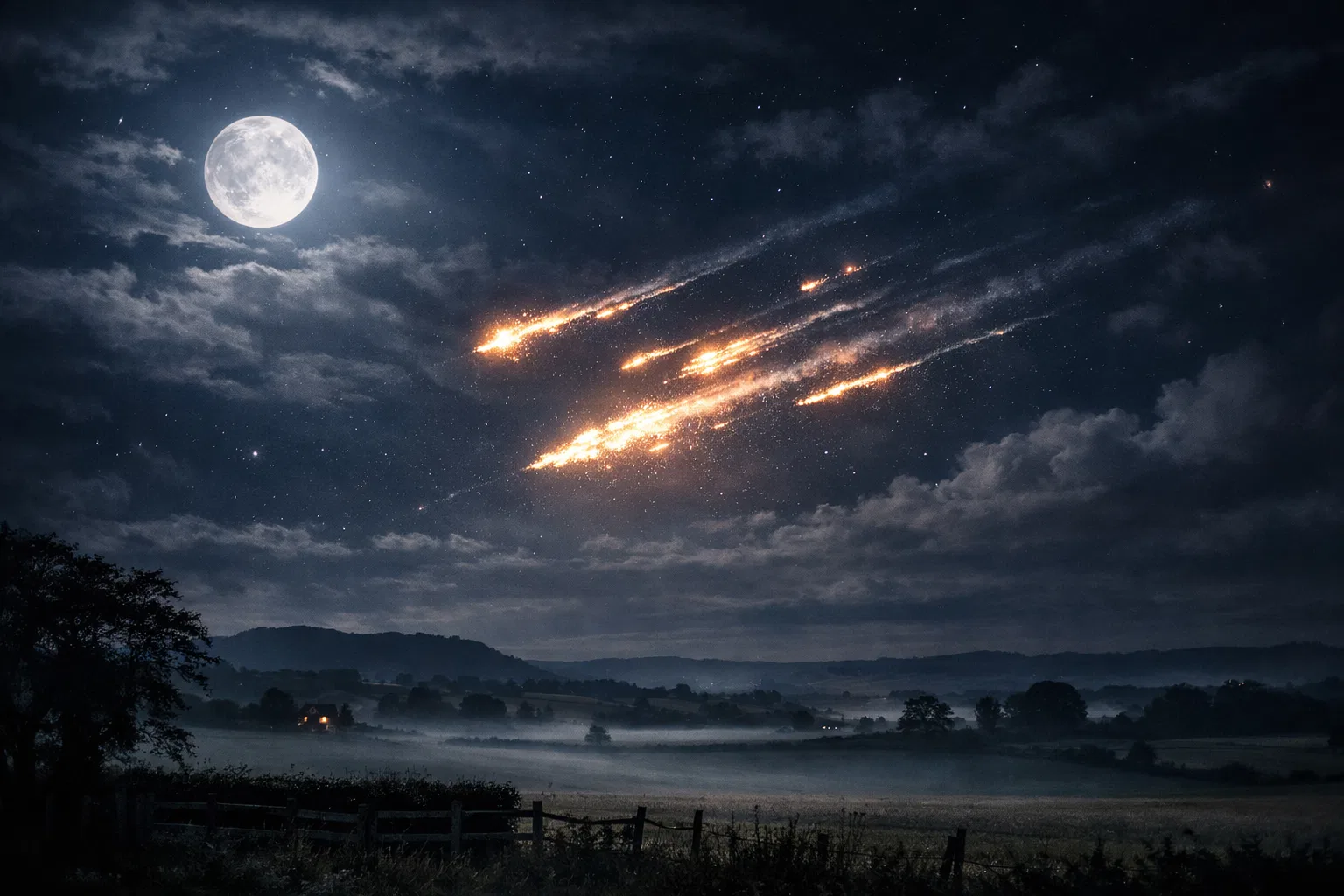
A decaying rocket body entering the atmosphere is not like a single aircraft light, and it is not quite like the quick “shooting star” many people expect from a meteor. Human-made re-entries tend to move broadly parallel to the ground, can last tens of seconds, and often break into multiple bright fragments with glowing trails. The Aerospace Corporation’s guide to re-entry sightings notes that space debris is human-made material from Earth orbit, usually moving roughly parallel to the ground at orbital speed, and that re-entries can show a bright body, a long tail and numerous fragments; it gives a useful rule of thumb that meteors often last only a few seconds, while human-made re-entries can last roughly 20 to 90 seconds or more.[The Aerospace Corporation]aerospace.orgOpen source on aerospace.org.
That description fits the kind of confusion seen in the 1993 wave. A cluster of burning fragments can be perceived as separate lights, a single object with lights attached to it, or a large silent craft. If the fragments keep the same general formation while moving across the sky, the human eye and brain may connect them into a triangular or structured shape. David Clarke’s later review of the Cosford case makes exactly this point: debris high in the atmosphere can seem much closer than it is, and formations of lights can encourage witnesses to “fill in” a structure that is not physically present.[Dr. Clarke's Substack]drclarke.substack.comDr. Clarke's Substack Case Closed: 30th anniversary of the Cosford UFO flapDr. Clarke's Substack Case Closed: 30th anniversary of the Cosford UFO flap
The physics also explains why a re-entry can appear more spectacular than an ordinary satellite pass. NASA’s Orbital Debris Program Office says spacecraft re-entering from orbital decay or controlled entry usually break up at altitudes of about 84 to 72 kilometres, with 78 kilometres treated as a nominal breakup altitude; after breakup, fragments continue to heat and either burn up or, for tougher components, survive lower into the atmosphere.[Orbital Debris Program Office]orbitaldebris.jsc.nasa.govOpen source on nasa.gov. At those heights, the object is far above aircraft traffic, but bright enough to be visible over a very wide area. ESA similarly describes re-entering satellites, rocket stages and fragments as objects entering denser layers of the atmosphere at very high speed, where heating and deceleration normally destroy them.[European Space Agency]esa.intEuropean Space Agency ESAEuropean Space Agency ESA
This is why the “rocket” explanation is stronger than a vague “it was probably a light in the sky” dismissal. It provides a mechanism that naturally produces several features reported in such cases: brightness, multiple lights, a long apparent track, silence, unusual apparent shape, and visibility from many counties at roughly the same time.
Why timing and geography support the rocket explanation
The core sighting wave falls into a pattern that is hard for a low-flying craft to satisfy but natural for space debris. The National Archives’ 2009 transcript says that during about six hours more than 30 sightings were reported to the MoD across the south and west of the British Isles, including police and military witnesses and a police patrol at RAF Cosford. It also says the RAF replayed radar tapes and found nothing unusual, and that the majority of sightings were soon linked to the re-entry of the Russian rocket that launched Cosmos 2238.[National Archives]cdn.nationalarchives.gov.ukNational Archives
The satellite-re-entry record is unusually concrete. A current “Visually Observed Natural Re-entries of Earth Satellites” catalogue compiled by Ted Molczan lists the event at 00:10 UTC on 31 March 1993 as object 1993-018B, catalogue number 22586, a Russian Cosmos 2238 rocket body, with a mass entry of 4,800 kg. Its listed sighting locations include Ireland, west and south Wales, Staffordshire, Cornwall, Devon, Somerset, Bristol, Hampshire, parts of France and Catalonia in Spain.[Satellites Above]satobs.orgSatellites Above Observed re-entries #22.xlsxSatellites Above Observed re-entries #22.xlsx That broad west-to-south-east spread is exactly the sort of footprint expected from a high-altitude re-entry, and much less like a single low aircraft operating around Shropshire.
Later reconstruction sharpened the timing. Clarke reports that the civilian UFO organisation BUFORA identified the Cosmos 2238 rocket body early, and that a US Space Command/NASA simulation obtained by BUFORA’s astronomer Gary Anthony showed the object transiting over Ireland at about 1.07 am British Summer Time, then moving towards south-west England at imminent re-entry height. Clarke’s summary places burning debris over Devon and Cornwall between about 1.10 and 1.15 am BST.[Dr. Clarke's Substack]drclarke.substack.comDr. Clarke's Substack Case Closed: 30th anniversary of the Cosford UFO flapDr. Clarke's Substack Case Closed: 30th anniversary of the Cosford UFO flap
This also helps untangle a common source of confusion in the case: clock time. Britain had moved to British Summer Time on 28 March 1993, only a few days before the sightings. Some official and observational records used GMT or “Zulu” time, while later public accounts often used local BST. Clarke notes that RAF Fylingdales initially gave a time that appeared not to match the main sighting cluster, but later information placed the decay within the relevant window; he concludes that the catalogue time was in fact about 1.15 am local time for the main decay.[Dr. Clarke's Substack]drclarke.substack.comDr. Clarke's Substack Case Closed: 30th anniversary of the Cosford UFO flapDr. Clarke's Substack Case Closed: 30th anniversary of the Cosford UFO flap
For Shropshire, the geography matters because RAF Cosford became the local anchor for a much bigger event. The rocket body did not need to be physically “over” RAF Cosford at low level to be seen from there or reported through military channels. A high-altitude re-entry can be visible across a huge region. That is why Shropshire can be central to the story’s reporting and investigation, while the cause itself belongs to a sky track stretching far beyond the county.
Why the MoD took it seriously before it became an identified object
The rocket explanation is sometimes presented as though it simply replaced a confused story with an easy answer. The records suggest a more interesting sequence. The MoD did not ignore the reports: the National Archives summary says the UFO desk was concerned enough to ask for RAF radar tapes to be replayed, though nothing unusual was detected.[National Archives]cdn.nationalarchives.gov.ukNational Archives The Guardian’s report on the released files noted that the head of the UFO section briefed senior RAF leadership that, given the quality of the witnesses, the sightings could not just be written off; the same report says the MoD eventually established that the object was a Russian rocket re-entering after launching a Cosmos satellite.[The Guardian]theguardian.comOpen source on theguardian.com.
That sequence is important for public understanding. A sighting can be sincerely reported, operationally checked, and later explained without implying that witnesses were dishonest or that officials were gullible. Police officers, RAF personnel and experienced observers can be very good at recognising aircraft, helicopters and ordinary lights, while still being poor at judging the height, range and nature of an unfamiliar event high in the atmosphere. Clarke’s later review stresses that even trained observers can make large errors when estimating the direction, height or distance of lights in a dark sky with few reference points.[Dr. Clarke's Substack]drclarke.substack.comDr. Clarke's Substack Case Closed: 30th anniversary of the Cosford UFO flapDr. Clarke's Substack Case Closed: 30th anniversary of the Cosford UFO flap
The lack of an unusual radar return also fits the rocket explanation better than some more exotic readings. The object was not a conventional aircraft manoeuvring at low altitude inside UK airspace. It was decaying space hardware moving at orbital speed, breaking up high in the atmosphere. Radar checks were still sensible because witnesses had raised a possible air-defence question, but the absence of a matching aircraft-like return weakens the idea of a large, low, structured craft moving around Shropshire.
Which parts of the case remain less tidy
The rocket theory is strongest for the main 1.10–1.15 am wave. It is weaker when applied too broadly to every detail later attached to the Cosford/Shawbury story. The most awkward part is the RAF Shawbury meteorological observer account, because it appears to describe something lower, slower, closer and later than the rocket debris.
Clarke’s review identifies the Shawbury observer as Wayne Elliott and explains that the timing in the Met Office log was recorded in GMT, not local BST. On that reading, Elliott’s own observation occurred at about 2.40 am BST, roughly an hour and a half after the rocket decay. Clarke therefore argues that the Shawbury sighting “wasn’t the Russian Tsyklon rocket”.[Dr. Clarke's Substack]drclarke.substack.comDr. Clarke's Substack Case Closed: 30th anniversary of the Cosford UFO flapDr. Clarke's Substack Case Closed: 30th anniversary of the Cosford UFO flap That is a crucial distinction: accepting the rocket explanation for the main wave does not require forcing the Shawbury report into the same mechanism.
The content of the Shawbury account also points away from a high-altitude re-entry. Later retellings included three red lights, a low humming noise, and a beam of white light apparently scanning the ground. Clarke notes that an article in the Met Office magazine Mercury described lights that seemed to move erratically, become stationary north of the airfield, and use a beam that swept across nearby countryside.[Dr. Clarke's Substack]drclarke.substack.comDr. Clarke's Substack Case Closed: 30th anniversary of the Cosford UFO flapDr. Clarke's Substack Case Closed: 30th anniversary of the Cosford UFO flap Those details are not what a burning rocket body at tens of kilometres altitude would produce.
The leading mundane explanation for the Shawbury element is therefore different: a police helicopter using a searchlight. Clarke reports that a later account from an RAF Shawbury airman identified the object as a Dyfed-Powys police helicopter following a stolen car near the A5 and using a NiteSun searchlight, while also noting that flight logs were no longer available, so the claim cannot be conclusively established from surviving records.[Dr. Clarke's Substack]drclarke.substack.comDr. Clarke's Substack Case Closed: 30th anniversary of the Cosford UFO flapDr. Clarke's Substack Case Closed: 30th anniversary of the Cosford UFO flap That leaves the Shawbury account less tidy than the main rocket wave: plausible, but not nailed down in the same way.
This matters because many popular summaries blend the 1.15 am rocket event and the later Shawbury report into one dramatic “black triangle” narrative. The evidence is cleaner if they are separated. The main wave is strongly explained by Cosmos 2238 rocket debris. The later Shawbury sighting may have been a helicopter, but the surviving evidence is thinner, partly because the relevant operational records were not preserved long enough to settle it.
What the rocket theory changes about the Shropshire case
The rocket explanation shifts the Shropshire story from “unknown craft over RAF bases” to a more subtle case about how extraordinary reports form. The trigger was real: a Russian rocket body really did re-enter, and it was visible over a wide area. The witnesses were not simply inventing lights. The official concern was not fake either: the MoD received enough reports from credible people to check radar and pursue the matter. But the best-supported mechanism for the main wave is still ordinary in the sense that it belongs to known space activity, not unknown technology.[National Archives]cdn.nationalarchives.gov.ukNational Archives
It also shows why Shropshire’s military landscape shaped the story. RAF Cosford and RAF Shawbury gave the incident authority, visibility and a route into official files. A similar re-entry seen only by scattered members of the public might have become a short-lived local-news curiosity. Because this one intersected with police and RAF reporting channels, it became a named case, a file, and later a touchstone in British UFO debate.
The theory does not remove all interest from the case. In fact, it makes the case more useful. It shows how a known astronomical or spaceflight event can produce reports of structured objects, low altitude, hovering, formation lights and apparent size. It also shows how a second, different local event can become fused with the first if witnesses, investigators and later writers treat the night as one continuous mystery rather than a sequence of separate reports.
For readers approaching Shropshire’s UFO history, the balanced position is therefore clear. The main Cosford-linked wave was very probably the Cosmos 2238 rocket body burning up in the atmosphere. The later Shawbury account should not be used as proof that the rocket explanation fails, because it appears to have occurred later and may involve a different object altogether. The remaining uncertainty is real, but it sits around the margins of the night, not at the centre of the main sighting wave.

Amazon book picks
Further Reading
Books and field guides related to Was the Main UFO a Falling Rocket?. Use these as the next step if you want deeper reading beyond the article.

UFOs : Generals, Pilots, and Government Officials Go on the R...
Provides context for major UFO cases and official investigations, useful for readers comparing extraordinary claims with evidence.
Bad UFOs
Closely matches the article's emphasis on conventional explanations, witness interpretation, and critical evaluation.
The UFO Experience
Helps readers understand how unusual aerial events are investigated and misidentified, matching the article's focus on interpretation ver...
The UFO Enigma
Examines how physical and observational evidence should be assessed when evaluating UFO reports.
eBay marketplace picks
Marketplace Samples
Live-tested eBay searches with available results related to this page.




Endnotes
1.
Source: cdn.nationalarchives.gov.uk
Title: National Archives
Link:https://cdn.nationalarchives.gov.uk/documents/ufo-transcript-aug-09.pdf
2.
Source: drclarke.substack.com
Title: Dr. Clarke’s Substack Case Closed: 30th anniversary of the Cosford UFO flap
Link:https://drclarke.substack.com/p/case-closed-30th-anniversary-of-the
3.
Source: aerospace.org
Link:https://aerospace.org/article/what-does-reentry-look-like
4.
Source: orbitaldebris.jsc.nasa.gov
Link:https://orbitaldebris.jsc.nasa.gov/reentry/
5.
Source: esa.int
Title: European Space Agency ESA
Link:https://www.esa.int/Space_Safety/Space_Debris/Reentry_and_collision_avoidance
6.
Source: blogs.esa.int
Title: reentry prediction soviet era venera venus lander cosmos 482 descent craft
Link:https://blogs.esa.int/rocketscience/2025/05/07/reentry-prediction-soviet-era-venera-venus-lander-cosmos-482-descent-craft/
7.
Source: esa.int
Title: ESA Space Environment Report 2025
Link:https://www.esa.int/Space_Safety/Space_Debris/ESA_Space_Environment_Report_2025
8.
Source: conference.sdo.esoc.esa.int
Title: SDC4 paper44
Link:https://conference.sdo.esoc.esa.int/proceedings/sdc4/paper/44/SDC4-paper44.pdf
9.
Source: esa.int
Link:https://www.esa.int/ESA_Multimedia/Videos/2021/09/Fireball_camera_spots_rocket_reentry_burn
10.
Source: orbitaldebris.jsc.nasa.gov
Title: HOOSF 16e
Link:https://orbitaldebris.jsc.nasa.gov/library/HOOSF_16e.pdf
11.
Source: science.nasa.gov
Title: great balls of fire
Link:https://science.nasa.gov/earth/earth-observatory/great-balls-of-fire/
12.
Source: aerospace.org
Link:https://aerospace.org/article/space-debris-101
13.
Source: space.com
Link:https://www.space.com/space-exploration/international-space-station/it-was-quite-a-light-show-nasa-astronaut-spies-dramatic-fireball-from-the-international-space-station-photos
14.
Source: satobs.org
Title: Satellites Above Observed re-entries #22.xlsx
Link:https://www.satobs.org/reentry/Visually_Observed_Natural_Re-entries_latest_draft.pdf
15.
Source: theguardian.com
Link:https://www.theguardian.com/uk/2009/aug/17/mod-report-ufo-sightings
16.
Source: cdn.nationalarchives.gov.uk
Title: aug 2009 highlights guide
Link:https://cdn.nationalarchives.gov.uk/documents/aug-2009-highlights-guide.pdf
17.
Source: cdn.nationalarchives.gov.uk
Title: mar 2009 highlights guide
Link:https://cdn.nationalarchives.gov.uk/documents/mar-2009-highlights-guide.pdf
18.
Source: cdn.nationalarchives.gov.uk
Title: aug 2011 research guide
Link:https://cdn.nationalarchives.gov.uk/documents/aug-2011-research-guide.pdf
19.
Source: satobs.org
Link:https://www.satobs.org/seesat_ref/misc/hawaii_mothership_FINAL_1A.pdf
20.
Source: n2yo.com
Link:https://www.n2yo.com/satellite/?s=22585
21.
Source: theguardian.com
Title: ufo sightings x files
Link:https://www.theguardian.com/news/datablog/2009/aug/17/ufo-sightings-x-files
22.
Source: assets.publishing.service.gov.uk
Title: ufo report 2009
Link:https://assets.publishing.service.gov.uk/media/5a7582c440f0b6397f35efcb/ufo_report_2009.pdf
23.
Source: mithrand.karoo.net
Link:https://www.mithrand.karoo.net/index.htm/cosford.htm
24.
Source: GOV.UK
Title: ufo reports in the uk
Link:https://www.gov.uk/government/publications/ufo-reports-in-the-uk
Additional References
25.
Source: youtube.com
Title: Yesterday | UFOs Declassified: Ep1 Preview
Link:https://www.youtube.com/watch?v=jsmNvuzaL-s
Source snippet
Britain's Strangest UFO Sighting - The Cosford Incident | UFO Expert Reacts...
26.
Source: youtube.com
Title: Britain’s Strangest UFO Sighting
Link:https://www.youtube.com/watch?v=lDAH35KR0Bs
Source snippet
Dr. David Clarke - The 1993 Cosford Incident...
27.
Source: youtube.com
Title: Rocket re-entering atmosphere results in impressive light show
Link:https://www.youtube.com/watch?v=XrITRQc9tJg
Source snippet
Cosford UFO Incident & Mike Debardeleben - Creepy Mysteries...
28.
Source: youtube.com
Title: Dr. David Clarke
Link:https://www.youtube.com/watch?v=bf1YqJUqAIs
Source snippet
Rocket re-entering atmosphere results in impressive light show...
29.
Source: eucass.eu
Link:https://www.eucass.eu/component/docindexer/?id=7435&task=download
30.
Source: facebook.com
Link:https://www.facebook.com/dailymirror/posts/britain-is-considered-to-be-one-of-the-most-active-ufo-hotspots-in-the-world-des/1307300864778328/
31.
Source: spaceacademy.net.au
Link:https://www.spaceacademy.net.au/watch/debris/reentryhaz.htm
32.
Source: nutritionmodels.com
Link:https://www.nutritionmodels.com/tedeschi/download/mar-2011-highlights-guide.pdf
33.
Source: iaaspace.org
Link:https://iaaspace.org/wp-content/uploads/iaa/Scientific%20Activity/debris6.pdf
34.
Source: unoosa.org
Link:https://www.unoosa.org/pdf/pres/stsc2012/tech-39E.pdf
Topic Tree