Within Armagh UFOs
Could Armagh's UFOs Be Sky Mistakes?
Armagh's observatory gives local UFO research a useful anchor for checking lights, planets, meteors, satellites, and sky conditions.
On this page
- Why local sky literacy matters
- Astronomy checks for common sightings
- Where explanation still needs evidence
Page outline Jump by section
Introduction
County Armagh’s UFO history is best understood with Armagh Observatory and Planetarium close at hand. The county has recorded reports of odd lights — including eighteen lights over Portadown in 2005 and three orange lights in a triangular formation reported from Abbey Park in Armagh in 2025 — but these are exactly the kinds of sightings that need practical sky checks before they can be treated as unexplained. The Observatory does not turn every local report into a solved case. Its value is more careful than that: it gives Armagh a long-established astronomy institution, public education centre, fireball reporting route, and weather-record archive that can help separate “unidentified at first glance” from “unidentified after proper checking”. Armagh Observatory and Planetarium+3GOV.UK+3echo live[assets.publishing.service.gov.uk]assets.publishing.service.gov.ukOpen source on service.gov.uk.
That matters because many UFO reports begin with sincere observation rather than fantasy. A bright planet low in the sky, a meteor, satellite train, drone, lantern, aurora, aircraft light or patchy cloud can all look stranger than expected when seen briefly, through glass, from a moving car, or without a fixed reference point. In County Armagh, the useful question is not whether astronomy “debunks” every case, but whether the most ordinary sky explanations have been tested before a sighting is promoted as a mystery.
Why local sky literacy matters
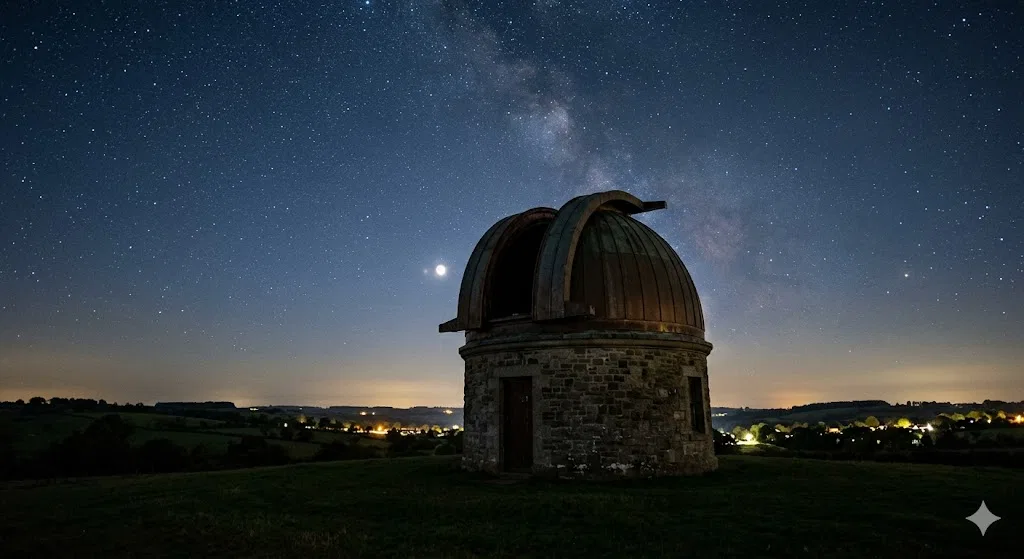
Armagh Observatory was established in 1790 and is described by Armagh Observatory and Planetarium as the oldest scientific institution in Northern Ireland and the longest continuously operating astronomical research institute in the United Kingdom and Ireland. The Planetarium, founded in 1968, added a public-facing education role to that research base.[Armagh Observatory and Planetarium]armagh.spaceabout aopabout aop For UFO research in County Armagh, that combination is important: the county is not only a place where people report lights in the sky, but also a place with a recognised institution devoted to explaining what the sky normally does.
The point is not that a local observatory automatically has records of every unusual light seen over the county. Most casual UFO reports are too vague for that. A witness may remember “late evening”, “towards Portadown”, or “orange lights”, but not the exact time, direction, elevation, duration, weather, or whether the object made sound. Without those details, even a strong astronomical explanation can remain only plausible rather than proven. The Observatory’s practical contribution is therefore methodological: it shows what information has to be collected before a sighting can be assessed properly.
Armagh also has a rare weather-observation tradition. The Observatory’s meteorological records began in the 1790s, with an unbroken record from July 1795; rainfall has been continuously recorded since 1836, dry and wet bulb temperatures from 1838, wind from 1843, and daily maximum and minimum temperatures from 1844.[Armagh Observatory and Planetarium]armagh.spaceOpen source on armagh.space. The Met Office describes the Armagh record as the longest run of meteorological data in Northern Ireland and one of the longest daily records in the UK and Northern Ireland.[Met Office]weather.metoffice.gov.ukOpen source on metoffice.gov.uk. For UFO interpretation, weather matters because low cloud, haze, fog, drizzle, moonlight, reflections and visibility can change an ordinary light into something ambiguous.
This is especially relevant to the two local examples already sitting in County Armagh’s UFO record. The 2005 Portadown entry in the Ministry of Defence list says only that “eighteen lights” were moving across the sky at 23:10 on 24 January 2005.[GOV.UK]assets.publishing.service.gov.ukOpen source on service.gov.uk. The 2025 Abbey Park report, released through PSNI reporting and covered by the Press Association, described “three orange lights in the sky in a perfect triangle which moved then dispersed”.[echo live]echolive.iearid 41768375arid 41768375 Those descriptions are memorable, but they are not enough on their own to distinguish aircraft, lanterns, satellites, drones, meteors, reflections or an unresolved aerial object.
Astronomy checks for common sightings
A good Armagh sky check starts with the simplest question: was the reported object actually in the sky in the way the witness thought it was? Bright planets are a frequent source of confusion because Venus, Jupiter, Mars, Saturn and Mercury are all visible without a telescope under the right conditions, and planets can appear brighter and steadier than stars. NASA’s skywatching guidance notes that five planets are easily visible with the unaided eye, and that planets tend to glow more steadily than twinkling stars.[NASA Science]science.nasa.govOpen source on nasa.gov. A low bright planet seen through thin cloud, near trees, above rooftops or from a moving vehicle can seem to hover, pulse, change colour, or follow the observer.
Meteors and fireballs are another key category. Armagh Observatory and Planetarium has a dedicated “Report a Fireball” route and explains that a fireball is an exceptionally bright meteor, bright enough to be seen over a wide area.[Armagh Observatory and Planetarium]armagh.spaceOpen source on armagh.space. That is highly relevant to UFO accounts because a fireball may be spectacular, silent, coloured, fragmenting, and over in seconds. A witness who sees only the end of the event may describe a falling object, a green or blue flash, a glowing trail, or something “breaking up” in the sky. If several people across Northern Ireland, the border counties or the Irish Sea region report the same brief event, a fireball explanation becomes more testable.
Satellites have become a much larger source of unusual-light reports than they were in older UFO eras. Starlink satellites can appear as a “train” or string of bright lights moving across the night sky, especially shortly after launch before they spread out into their operational orbits.[Space]space.comStarlink satellites: Facts, tracking and impact on astronomyStarlink satellites: Facts, tracking and impact on astronomy The Royal Astronomical Society has warned about the effect of large satellite constellations on the night sky and astronomical research, which underlines that these objects are not fringe explanations but a real, growing feature of modern skywatching.[The Royal Astronomical Society]ras.ac.ukras statement starlink satellite constellationras statement starlink satellite constellation In a County Armagh context, a line or cluster of moving lights should therefore be checked against satellite predictions before being treated as a local UFO mystery.
There are also short-lived satellite flashes and glints. These can be especially misleading because the object may brighten dramatically, fade, and appear to vanish. Older Iridium flares were famous for this, but other satellites and space debris can still reflect sunlight in ways that surprise observers. The key practical test is direction, timing and duration: satellite sightings are usually silent, cross the sky steadily, and are often most visible after sunset or before sunrise when the ground is dark but the satellite is still sunlit.
Orange-light reports need particular caution. The Abbey Park report’s “three orange lights” in a triangle is interesting because orange lights arranged in formation are visually striking, but colour and formation are not proof of structure. Three separate lights can look like one triangular object if the sky is dark and there are no visible connecting edges. Lanterns, aircraft seen at different distances, drones, or satellites can all create apparent geometry. The Ministry of Defence’s own released UFO-file commentary noted a period when many reports described orange ball-shaped phenomena, often in clusters moving silently and in formation, with media reporting encouraging further accounts.[National Archives]cdn.nationalarchives.gov.ukOpen source on nationalarchives.gov.uk.
Drones now add a modern complication. UK Civil Aviation Authority guidance says drones and model aircraft flown at night in the Open Category must have a green flashing light turned on, making them easier for people and aircraft to spot.[CAA]caa.co.ukflying at night in the open categoryflying at night in the open category In practice, drones may hover, move slowly, change direction sharply, or hold position near houses, parks and event spaces. That behaviour can look more “intelligent” than a planet or satellite, but it is also exactly how a piloted drone can appear to a ground observer.
How an Armagh sighting should be checked
A practical sighting check does not begin by asking whether the witness is “believable”. It begins by reconstructing the sky. For an Armagh report, the minimum useful details are the exact date, time, viewing location, direction faced, height above the horizon, duration, colour, sound, weather, movement, and whether the observer took a photograph or video. Without those details, a case may remain interesting but weak.
The first check should be astronomical. Was Venus, Jupiter or another bright planet in that part of the sky? Was the Moon nearby, behind cloud, or bright enough to create reflections? Was there a meteor shower active? Did fireball networks, Armagh’s fireball reporting route, or other observers record a bright meteor at the same time? Armagh Observatory and Planetarium’s public education work, including its focus on planets, meteorite impacts and current astronomical phenomena, is directly relevant here because these are the ordinary categories that can generate extraordinary reports.[Charity Commission NI]charitycommissionni.org.ukOpen source on charitycommissionni.org.uk.
The second check should be human-made objects. Satellite trackers can test whether Starlink, the International Space Station or other bright satellites crossed the sky at the reported time. Flight paths can be checked against aviation data where the time is precise enough. Drone possibility should be considered for low, local, hovering or manoeuvring lights, especially near parks, housing estates, event venues, emergency-service activity or commercial premises. The test is not “could a drone explain anything?” but whether the observed height, duration, movement, colour and sound fit a drone better than an astronomical source.
The third check is weather and visibility. Armagh’s long meteorological record is not a magic answer to a single modern sighting, but weather data can show whether cloud, fog, rain, wind, haze or unusually clear conditions were present. The Observatory’s weather portal now gives access to digitised archives stretching back nearly 200 years, and the site also points users to current and historic weather observations.[weather.armagh.space]weather.armagh.spaceOpen source on armagh.space. For a local UFO report, cloud level and wind direction can be decisive: lanterns drift with wind, aircraft lights disappear into cloud, and bright planets can seem to move when clouds pass in front of them.
The fourth check is corroboration. A strong case should have independent witnesses from different locations, consistent timing, a direction that triangulates sensibly, and ideally original photographs, videos or logs rather than retellings. The 2005 Portadown listing is useful as a recorded MoD entry, but its released form is too brief to test deeply. The 2025 Abbey Park report is useful because it preserves the wording of the police call, but PSNI said the 2025 reports were noted for information only, with no ongoing action and no lines of inquiry identified at the time.[GOV.UK]assets.publishing.service.gov.ukOpen source on service.gov.uk. In both cases, the public record is a starting point, not a completed investigation.
Where explanation still needs evidence
A sky explanation should not be treated as proven just because it sounds plausible. Saying “probably satellites” or “probably lanterns” is not the same as matching a specific satellite pass, wind direction, launch event, flight track or fireball report. This distinction matters in County Armagh because the local UFO record is thin enough that overconfident scepticism can distort it just as easily as overexcited belief.
The Portadown report from 2005 illustrates the problem. Eighteen lights moving across the sky could suggest a satellite train by today’s standards, but Starlink did not exist in 2005. Other explanations — aircraft, lanterns, military activity, meteor fragments, searchlights, or a group of separate lights misread as one event — remain possible, but the released MoD entry does not provide enough detail to decide.[GOV.UK]assets.publishing.service.gov.ukOpen source on service.gov.uk. The best conclusion is therefore modest: it is a documented multiple-light report whose cause is not established from the available summary.
The Abbey Park report presents a different problem. Three orange lights in a “perfect triangle” that moved and dispersed could be read as a classic triangular UFO. It could also be three independent lights temporarily forming a triangle, especially if they were lanterns, drones or aircraft seen from one angle. Because the PSNI record was noted for information only and no line of inquiry was opened, there is no public evidence of a structured follow-up: no triangulation, no sky chart, no weather reconstruction, no aviation check and no photographic analysis in the report as published.[echo live]echolive.iearid 41768375arid 41768375 That does not make the witness wrong; it means the evidence is too limited for a firm claim.
Armagh Observatory’s role is therefore best seen as a local standard-setter for better questions. A strong explanation should be specific enough to be falsifiable: “Venus was in the south-west at that time”, “a Starlink train crossed that part of the sky”, “a fireball was reported across Ireland at the same minute”, “wind would have carried lanterns in the observed direction”, or “CAA-compliant drone lights could account for the colour and motion”. Weak explanations are vague: “it was probably something ordinary” or “astronomers would have seen it”. The Observatory helps most when it encourages the first kind of answer.
What Armagh Observatory changes for County Armagh UFO research
Armagh is not unique because every UFO report there has an astronomical answer. It is distinctive because the county has a serious astronomy institution embedded in the same local landscape as the sightings. That gives County Armagh UFO research a practical anchor: before a report becomes folklore, it can be checked against known sky behaviour, current astronomical events, fireball reporting, weather conditions and public education resources.
This changes how local cases should be written up. Instead of treating “unidentified” as a dramatic label, County Armagh reports should be sorted into clearer categories: probably astronomical, probably aviation or drone-related, probably weather or reflection-related, insufficient information, and still unresolved after checks. A sighting can remain meaningful even if it is explained, because it teaches readers what the night sky looks like from Armagh when planets, meteors, satellites, aurorae, cloud and human-made lights overlap.
The result is a more honest local UFO history. Armagh Observatory and Planetarium does not remove mystery from the county’s skies; it provides the tools for deciding which mysteries are real evidential problems and which are sky mistakes made under understandable conditions. For Portadown, Abbey Park and any future County Armagh reports, that distinction is the difference between a story that merely sounds strange and a case that has actually been tested.
Amazon book picks
Further Reading
Books and field guides related to Could Armagh's UFOs Be Sky Mistakes?. Use these as the next step if you want deeper reading beyond the article.
NightWatch
Helps readers identify planets, meteors and other common UFO misidentifications.
eBay marketplace picks
Marketplace Samples
Example marketplace items related to this page. Use the search link to explore similar finds on eBay.


Endnotes
1.
Source: assets.publishing.service.gov.uk
Link:https://assets.publishing.service.gov.uk/media/5a789a0140f0b63247698ae6/UFOReports2005WholeoftheUK.pdf
2.
Source: armagh.space
Title: about aop
Link:https://armagh.space/corporate/about-aop
3.
Source: armagh.space
Link:https://armagh.space/site/report-a-fireball
4.
Source: armagh.space
Link:https://armagh.space/weather/meteorological-record
5.
Source: armagh.space
Title: meteorological archive
Link:https://armagh.space/weather/meteorological-archive
6.
Source: weather.metoffice.gov.uk
Link:https://weather.metoffice.gov.uk/learn-about/how-forecasts-are-made/observations/recording-observations-for-over-100-years
7.
Source: science.nasa.gov
Link:https://science.nasa.gov/skywatching/
8.
Source: space.com
Title: Starlink satellites: Facts, tracking and impact on astronomy
Link:https://www.space.com/spacex-starlink-satellites.html
9.
Source: cdn.nationalarchives.gov.uk
Link:https://cdn.nationalarchives.gov.uk/documents/ufo-video-transcript.pdf
10.
Source: caa.co.uk
Title: flying at night in the open category
Link:https://www.caa.co.uk/drones/open-category/getting-started-with-drones-and-model-aircraft/flying-at-night-in-the-open-category/
11.
Source: caa.co.uk
Link:https://www.caa.co.uk/drones/open-category/getting-started-with-drones-and-model-aircraft/where-you-can-fly/
12.
Source: charitycommissionni.org.uk
Link:https://www.charitycommissionni.org.uk/charity-search/charity-details-page/?regId=103948&subId=0
13.
Source: weather.armagh.space
Link:https://weather.armagh.space/
14.
Source: armagh.space
Link:https://armagh.space/site/weather
15.
Source: armagh.space
Link:https://armagh.space/
16.
Source: armagh.space
Link:https://armagh.space/heritage/armagh-observatory/history
17.
Source: armagh.space
Link:https://armagh.space/weather/publications
18.
Source: weather.metoffice.gov.uk
Link:https://weather.metoffice.gov.uk/forecast/gcem0tkwp
19.
Source: weather.metoffice.gov.uk
Link:https://weather.metoffice.gov.uk/maps-and-charts/cloud-cover-map
20.
Source: weather.metoffice.gov.uk
Link:https://weather.metoffice.gov.uk/forecast/gcem0my0e
21.
Source: metoffice.gov.uk
Link:https://www.metoffice.gov.uk/
22.
Source: weather.metoffice.gov.uk
Link:https://weather.metoffice.gov.uk/forecast/gcehx7wem
23.
Source: weather.metoffice.gov.uk
Link:https://weather.metoffice.gov.uk/forecast/gcemzffe1
24.
Source: met.ie
Title: Armagh Weather
Link:https://www.met.ie/weather-forecast/armagh
25.
Source: space.com
Title: 6898 reflections space spot iridium flares
Link:https://www.space.com/6898-reflections-space-spot-iridium-flares.html
26.
Source: space.com
Title: starlink satellite train how to see and track it
Link:https://www.space.com/starlink-satellite-train-how-to-see-and-track-it
27.
Source: in-the-sky.org
Link:https://in-the-sky.org/
28.
Source: spaceplace.nasa.gov
Link:https://spaceplace.nasa.gov/aurora/
29.
Source: planetarium.dk
Link:https://www.planetarium.dk/en/articles/polarlys
30.
Source: bom.gov.au
Link:https://www.bom.gov.au/climate/dwo/
31.
Source: youtube.com
Title: AOP Science at Home: Armagh Astrobytes
Link:https://www.youtube.com/watch?v=yGM2LnYX1EM
Source snippet
Armagh Observatory and Planetarium Redevelopment - Expand Your Curiosity...
32.
Source: youtube.com
Title: Armagh Observatory and Planetarium Redevelopment
Link:https://www.youtube.com/watch?v=Hau62vafpAo
Source snippet
County Armagh: Ireland Explained...
33.
Source: echolive.ie
Title: arid 41768375
Link:https://www.echolive.ie/nationalnews/arid-41768375.html
34.
Source: ras.ac.uk
Title: ras statement starlink satellite constellation
Link:https://ras.ac.uk/news-and-press/news/ras-statement-starlink-satellite-constellation
35.
Source: discovernorthernireland.com
Title: armagh observatory and planetarium
Link:https://discovernorthernireland.com/listing/armagh-observatory-and-planetarium/67521101/
36.
Source: facebook.com
Link:https://www.facebook.com/armaghspace/posts/%F0%9D%90%80%F0%9D%90%A7%F0%9D%90%B2-%F0%9D%90%9A%F0%9D%90%A7%F0%9D%90%9D-%F0%9D%90%9A%F0%9D%90%A5%F0%9D%90%A5-%F0%9D%90%A9%F0%9D%90%A2%F0%9D%90%9C%F0%9D%90%AD%F0%9D%90%AE%F0%9D%90%AB%F0%9D%90%9E%F0%9D%90%AC-%F0%9D%90%A8%F0%9D%90%9F-%F0%9D%90%AD%F0%9D%90%A1%F0%9D%90%9E-%F0%9D%90%8D%F0%9D%90%A8%F0%9D%90%AB%F0%9D%90%AD%F0%9D%90%A1%F0%9D%90%9E%F0%9D%90%AB%F0%9D%90%A7-%F0%9D%90%8B%F0%9D%90%A2%F0%9D%90%A0%F0%9D%90%A1%F0%9D%90%AD%F0%9D%90%AC-did-anyone-see-the-northern-lights-o/1207760821565977/
37.
Source: rmg.co.uk
Title: space astronomy highlights 2026
Link:https://www.rmg.co.uk/stories/space-astronomy/space-astronomy-highlights-2026
38.
Source: syfy.com
Title: spacex satellites are now being mistaken for ufos and making astronomers rage
Link:https://www.syfy.com/syfy-wire/spacex-satellites-are-now-being-mistaken-for-ufos-and-making-astronomers-rage
39.
Source: dunsink.dias.ie
Link:https://www.dunsink.dias.ie/citizen-science/meteors/
40.
Source: hansard.parliament.uk
Link:https://hansard.parliament.uk/Lords/1995-06-06/debates/476c3d76-5baa-473b-889b-1c75d3bf9e67/ArmaghObservatoryAndPlanetarium%28NorthernIreland%29Order1995
41.
Source: boardroomapprentice.com
Title: armagh observatory and planetarium
Link:https://boardroomapprentice.com/armagh-observatory-and-planetarium/
42.
Source: futurism.com
Title: spacex starlink satellites ufos
Link:https://futurism.com/the-byte/spacex-starlink-satellites-ufos
Additional References
43.
Source: youtube.com
Title: Armagh Planetarium and Observatory with Armagh Astropark
Link:https://www.youtube.com/watch?v=hawp6wGrz6w
Source snippet
Sky at Night - Armagh's Flare for Astronomy - 1990...
44.
Source: youtube.com
Title: Sky at Night
Link:https://www.youtube.com/watch?v=zUwkUZUGHp8
Source snippet
AOP Science at Home: Armagh Astrobytes - The Realm of the Galaxies...
45.
Source: instagram.com
Link:https://www.instagram.com/p/DNEXCIxOopv/?hl=en
46.
Source: amazon.nl
Link:https://www.amazon.nl/100-Things-See-Night-Constellations/dp/1507205058?tag=searcht-20
47.
Source: niaas.co.uk
Link:https://niaas.co.uk/armagh-observatory-meteor-station/
48.
Source: reddit.com
Link:https://www.reddit.com/r/SpaceXLounge/comments/erkk9j/astronomer_complains_about_starlink_satellites/
49.
Source: armaghplanet.com
Link:https://armaghplanet.com/
50.
Source: facebook.com
Link:https://www.facebook.com/groups/903879063054302/posts/25845547301794133/
51.
Source: facebook.com
Link:https://www.facebook.com/groups/903879063054302/posts/25123648210650716/
52.
Source: researchgate.net
Link:https://www.researchgate.net/profile/David-Asher
Topic Tree