Within Hampshire UFOs
Did Portsmouth Spark Britain's Saucer Files?
The 1950 Portsmouth case shows why early pilot and radar reports became historically important without proving anything exotic.
On this page
- What was reported over Portsmouth
- Why pilot and radar details mattered
- What the surviving record can and cannot prove
Page outline Jump by section
Introduction
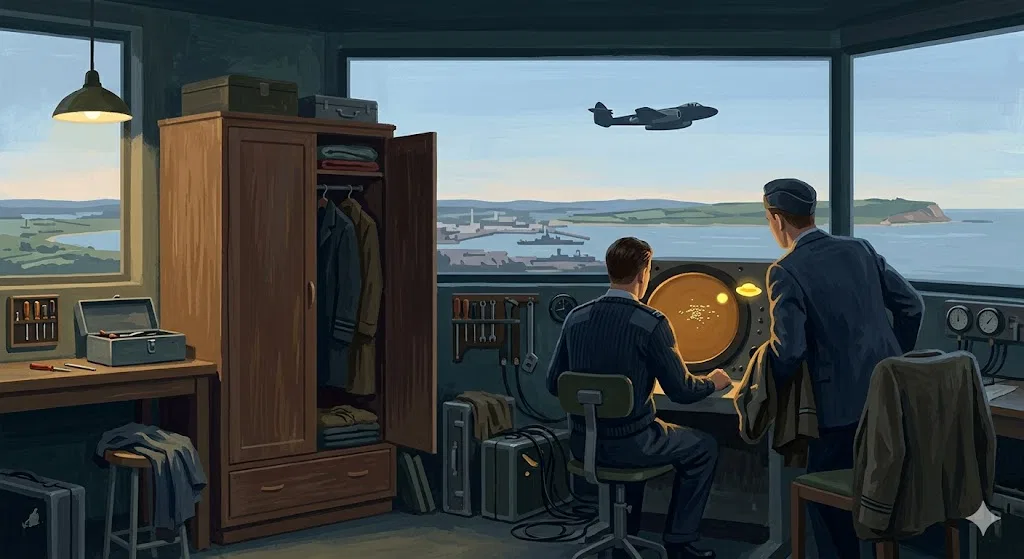
The 1 June 1950 Portsmouth pilot-and-radar case is important because it sits at the beginning of Britain’s official “flying saucer” era. A Gloster Meteor pilot from RAF Tangmere reportedly saw a bright, metallic, disc-like object at around 20,000 feet over the Portsmouth area, and radar personnel at RAF Wartling in Sussex were said to have recorded an unusual response at roughly the same time. That combination — trained aircrew plus radar near a major naval city — made the case harder for officials to ignore than an ordinary public sighting.
It did not, however, prove that something exotic flew over Hampshire. The strongest surviving interpretation inside the official material is more cautious: the visual report was treated seriously, but the radar return may have been caused by interference from another radar transmitter, possibly ship-borne in the Portsmouth–Isle of Wight area. The case therefore matters most as a hinge point in official British UFO history: it helped push the subject into secret assessment, while also showing how quickly impressive early evidence could become ambiguous when examined technically. drdavidclarke.co.uk+2The Black Vault Documents[drdavidclarke.co.uk]drdavidclarke.co.ukFlying Saucer Working PartyFlying Saucer Working Party
What was reported over Portsmouth
The basic story usually given in later summaries is simple. On the afternoon of 1 June 1950, an RAF Meteor fighter operating from Tangmere encountered a shining, revolving or disc-like object at high altitude, moving eastwards over the Portsmouth area. Tangmere then contacted RAF Wartling, a ground-controlled interception radar station near Eastbourne, to ask whether anything unusual had appeared on radar. Later accounts say Wartling operators had indeed seen an unusual response on their Plan Position Indicator screen.[Wikipedia]WikipediaUFO sightings in the United KingdomUFO sightings in the United Kingdom
The geography is part of the case. Portsmouth was not just any coastal city: in historic-county terms it belongs to Hampshire, and contemporary gazetteer sources describe it as a Hampshire city and the home of the Royal Navy, standing on Portsea Island facing the English Channel. That made any unexplained aerial report over the area more sensitive than a rural sighting, because the Solent, Spithead, the Isle of Wight approaches and the naval dockyard sat within a dense defence and maritime environment.[Gazetteer]gazetteer.org.ukOpen source on gazetteer.org.uk.
The aircraft involved also mattered. The Gloster Meteor was not a light civilian aircraft but Britain’s early jet fighter, and the RAF Museum notes that the Meteor F8 provided the backbone of Britain’s air defence capability between 1950 and 1955. Even if the precise Meteor mark in the Portsmouth report is not always clearly stated in accessible summaries, the aircraft type placed the witness within the RAF’s post-war fighter world rather than the casual-sighting category.[RAF Museum]rafmuseum.org.ukRAF Museum Gloster Meteor F8RAF Museum Gloster Meteor F8
The radar element came from Wartling, not from Portsmouth itself. Bexhill Museum’s history of RAF Wartling describes it as a Ground Controlled Interception station, with controllers using Plan Position Indicator displays and talking directly to fighter pilots to direct interceptions. During the Second World War it had formed part of the south-east air-defence system and remained open after nearby RAF Pevensey closed, one of the few remaining GCI stations in southern England. That background helps explain why a radar response from Wartling carried weight: this was a defence radar environment, not a casual observer with binoculars.[Bexhill Museum]bexhillmuseum.org.ukBexhill Museum Radar and RAF WartlingBexhill Museum Radar and RAF Wartling
Why pilot and radar details mattered
A pilot report alone could be dismissed as a mistake. A radar report alone could be dismissed as a false echo. Together, they created the kind of case that worried officials in 1950: a trained observer in a military aircraft, a possible instrument trace, and a location near important defence space.
The National Archives’ research guide explains that Britain did not begin an official UFO inquiry until 1950, after a wave of flying-saucer reports and newspaper interest made senior figures in government, defence and science take the subject more seriously. Sir Henry Tizard, the Ministry of Defence Chief Scientific Adviser and a key figure in wartime radar development, thought reports of flying saucers should not be dismissed without investigation. His influence helped lead to the creation of a small expert team under the Directorate of Scientific Intelligence and Joint Technical Intelligence Committee.[National Archives]cdn.nationalarchives.gov.ukNational Archives Research Notes 6National Archives Research Notes 6
That body became known as the Flying Saucer Working Party. The National Archives guide gives its terms of reference: to review available evidence, examine British reports attributed to flying saucers, report as necessary, and keep in touch with American cases and evaluations. It operated in secrecy, and its final report was later identified as DSI/JTIC Report No. 7, released through National Archives files including DEFE 44/119, DEFE 19/9 and DEFE 24/2050/1.[National Archives]cdn.nationalarchives.gov.ukNational Archives Research Notes 6National Archives Research Notes 6
David Clarke, a historian of British UFO records, summarises why the Portsmouth case stood out inside that official process. He writes that, after reviewing many reports, the Working Party regarded only three as coming from trustworthy sources and deserving further study; one was the June 1950 RAF Tangmere pilot report, with four RAF controllers at an air-defence radar station near Eastbourne reportedly tracking an unusual response at the same time.[drdavidclarke.co.uk]drdavidclarke.co.ukFlying Saucer Working PartyFlying Saucer Working Party
This is why the Portsmouth case has lasted in UFO history. It is not just a story about a disc in the sky. It is one of the early British cases where the official question became: what should be done when trained personnel and defence systems appear to report something unusual?
What the radar evidence can and cannot prove
The radar detail is the strongest-sounding part of the Portsmouth case, but also the part that most needs careful handling. In popular retellings, radar confirmation can sound like independent proof that a physical craft crossed the sky. The surviving official technical note is more restrained.
In the released Flying Saucer Working Party material, Appendix A is headed as a note on an unusual radar response. It refers specifically to the Wartling response of 1 June 1950 and suggests that the signal observed was received directly from another radar transmitter, possibly ship-borne, in the Portsmouth–Isle of Wight area. The note then explains how timing differences between the Wartling set and a “western” transmitter could make a received signal appear on the PPI display. It also states that drift between repetition rates could create an apparent displacement of the signal, interpreted as rapid movement of a target.[The Black Vault Documents]documents.theblackvault.comThe Black Vault Documents
That explanation does not prove the visual sighting was false. It does, however, weaken the claim that the radar trace independently confirmed the pilot’s object. The official hypothesis was not “nothing happened”, but “the radar effect may have been a radar artefact”. In plain terms, the screen may have shown a misleading return produced by another transmitter rather than a solid object flying at extraordinary speed.
This matters because radar in 1950 was powerful but not infallible. Wartling’s wartime role had been to detect and control interceptions, but radar displays could be affected by equipment behaviour, other transmitters, reflections and interpretation under pressure. The Working Party’s technical note shows that officials were not merely waving the radar evidence away; they were asking whether the appearance on the screen could be reproduced by known radar effects.[Bexhill Museum]bexhillmuseum.org.ukBexhill Museum Radar and RAF WartlingBexhill Museum Radar and RAF Wartling
The best evidence, then, is not a clean instrument record preserved with modern metadata, photographs and multiple calibrated sensors. It is a combination of later official summary, a pilot report, radar-operator testimony as filtered through official files, and a technical explanation that may account for the radar component. That is historically significant, but it is not the same as proof of an unknown aircraft.
Why the case helped shape Britain’s saucer files
The Portsmouth incident belongs to a short but important window in British official thinking. The National Archives guide notes that the Flying Saucer Working Party was established in August 1950 and produced its final report in June 1951. The report concluded that flying saucer sightings could be explained as misidentifications of ordinary objects or phenomena, optical illusions, psychological delusions or hoaxes, and recommended that no further investigation of mysterious aerial phenomena be undertaken unless material evidence became available.[National Archives]cdn.nationalarchives.gov.ukNational Archives Research Notes 6National Archives Research Notes 6
That recommendation is central to the Portsmouth case’s legacy. The Working Party was willing to treat selected reports from pilots and radar personnel as worthy of study, but it did not convert those reports into a continuing open-ended UFO programme. Instead, the lesson officials drew was almost the opposite: without physical evidence, coordinated observation, photographs, radar networks and sound locators, subjective reports were unlikely to produce firm results.[The Black Vault Documents]documents.theblackvault.comThe Black Vault Documents
The Portsmouth case therefore shows both sides of the early official attitude. On one side, it helped get the subject into the machinery of defence intelligence. On the other, it became part of the evidence base for a sceptical conclusion: reports might be sincere and still not justify prolonged investigation.
That tension continued through later British UFO policy. A 2005 Ministry of Defence response, preserved in released files, stated that the Working Party had been set up in 1950 at Tizard’s suggestion, dissolved in June 1951, and that its surviving papers were open at The National Archives. The same response explained that in later decades UFO reports were routed mainly to air-defence and defence-intelligence staff to check for possible airspace threats or useful intelligence on foreign technology, rather than to investigate extraterrestrial claims.[The Black Vault Documents]documents.theblackvault.comThe Black Vault Documents
What later reporting strengthened — and weakened
Later reporting has strengthened the Portsmouth case in one sense: it has placed it firmly within the early official record. The Flying Saucer Working Party is no longer merely folklore or rumour; National Archives material identifies its remit, secrecy, final report and release history. The connection between early 1950 reports, Tizard’s concern and the creation of a defence-intelligence review is well supported.[National Archives]cdn.nationalarchives.gov.ukNational Archives Research Notes 6National Archives Research Notes 6
What later reporting has not strengthened is the claim that the case proves an extraordinary craft. The released material actually adds caution, because the radar appendix offers a plausible technical explanation for the Wartling response. If the radar return can be explained as interference or direct reception from another transmitter in the Portsmouth–Isle of Wight area, the case loses its neat “pilot saw it and radar confirmed it” shape.[The Black Vault Documents]documents.theblackvault.comThe Black Vault Documents
There is also a documentation problem. Much of what a modern reader wants — the original pilot’s full statement, exact aircraft details, radar plots, timings, operator statements, weather data, shipping-radar context and a full chain of custody for the evidence — is not presented in one easily accessible, complete case file. The surviving public record is enough to show why officials cared, but not enough to reconstruct the event with the confidence expected in a modern aviation incident investigation.
This is why the Portsmouth case should be read neither as a debunked non-event nor as a confirmed unknown craft. The better judgement is narrower: it was a serious early report, involving credible military channels and a radar puzzle, later absorbed into Britain’s first secret official UFO review. The radar component was technically challenged from within the official record itself.
How to read the Portsmouth case today
For Hampshire’s UFO history, the 1950 Portsmouth case is a landmark because it links the county’s south-coast defence geography with the birth of Britain’s official saucer files. It belongs alongside later Hampshire and Solent reports not because it proves a pattern of exotic activity, but because it shows why the area was so likely to turn unusual aerial observations into defence questions.
The strongest reading is evidence-led:
- What is solid: a 1950 official context, RAF involvement, a Portsmouth-area pilot report, a Wartling radar issue, and later inclusion in the Flying Saucer Working Party’s work.
- What is suggestive: the combination of trained witness and radar response, especially near Portsmouth and the Solent.
- What is weak: the absence, in accessible public summaries, of a complete modern-style case packet with all raw statements, plots and environmental data.
- What is sceptically important: the official radar appendix suggesting a non-exotic technical explanation involving another radar transmitter, possibly ship-borne in the Portsmouth–Isle of Wight area.
- What remains unresolved: whether the pilot’s visual observation had the same cause as the radar response, or whether two separate things were combined into a more impressive narrative.
The case’s value is therefore historical rather than sensational. It shows how early Cold War Britain handled a report that had just enough military and technical substance to demand attention, but not enough hard evidence to support a dramatic conclusion. In that sense, Portsmouth did not prove Britain had flying saucers. It helped show why Britain felt compelled to open — and then quickly narrow — its saucer files.
Amazon book picks
Further Reading
Books and field guides related to Did Portsmouth Spark Britain's Saucer Files?. Use these as the next step if you want deeper reading beyond the article.
The Report on Unidentified Flying Objects
Captures the early Cold War period when radar and pilot cases shaped official UFO policy.

UFOs : Generals, Pilots, and Government Officials Go on the R...
Directly relevant to pilot and radar incidents like the 1950 Portsmouth case.
Need to Know
Covers defence, intelligence and official investigations similar to the Portsmouth story.
eBay marketplace picks
Marketplace Samples
Example marketplace items related to this page. Use the search link to explore similar finds on eBay.
Endnotes
1.
Source: drdavidclarke.co.uk
Title: Flying Saucer Working Party
Link:https://drdavidclarke.co.uk/national-archives-ufo-files-7/flying-saucer-working-party/
2.
Source: documents.theblackvault.com
Title: The Black Vault Documents
Link:https://documents.theblackvault.com/documents/ufos/UK/defe-24-2057-1.pdf
3.
Source: Wikipedia
Title: UFO sightings in the United Kingdom
Link:https://en.wikipedia.org/wiki/UFO_sightings_in_the_United_Kingdom
4.
Source: Wikipedia
Title: Flying Saucer Working Party
Link:https://en.wikipedia.org/wiki/Flying_Saucer_Working_Party
5.
Source: Wikipedia
Title: Gloster Meteor
Link:https://en.wikipedia.org/wiki/Gloster_Meteor
6.
Source: Wikipedia
Link:https://en.wikipedia.org/wiki/Hampshire
7.
Source: Wikipedia
Title: Historic counties of England
Link:https://en.wikipedia.org/wiki/Historic_counties_of_England
8.
Source: drdavidclarke.co.uk
Title: top 10 ufo documents at the national archives
Link:https://drdavidclarke.co.uk/2018/03/15/top-10-ufo-documents-at-the-national-archives/
9.
Source: archives.gov
Title: Project BLUE BOOK
Link:https://www.archives.gov/research/military/air-force/ufos
10.
Source: gazetteer.org.uk
Link:https://gazetteer.org.uk/place/Portsmouth%2C_Hampshire_36626
11.
Source: wikishire.co.uk
Link:https://wikishire.co.uk/wiki/Portsmouth
12.
Source: rafmuseum.org.uk
Title: RAF Museum Gloster Meteor F8
Link:https://www.rafmuseum.org.uk/research/collections/gloster-meteor-f8/
13.
Source: bexhillmuseum.org.uk
Title: Bexhill Museum Radar and RAF Wartling
Link:https://www.bexhillmuseum.org.uk/access-centre/second-world-war-2/raf-wartling/
14.
Source: cdn.nationalarchives.gov.uk
Title: National Archives Research Notes 6
Link:https://cdn.nationalarchives.gov.uk/documents/aug-2011-research-guide.pdf
15.
Source: ianridpath.com
Title: flying saucer working party
Link:https://www.ianridpath.com/ufo/flying%20saucer%20working%20party.pdf
16.
Source: wikishire.co.uk
Link:https://wikishire.co.uk/wiki/Hampshire
17.
Source: cdn.nationalarchives.gov.uk
Link:https://cdn.nationalarchives.gov.uk/documents/the-ufo-files-extract.pdf
18.
Source: nationalarchives.gov.uk
Link:https://www.nationalarchives.gov.uk/help-with-your-research/research-guides/ufos/
19.
Source: cdn.nationalarchives.gov.uk
Title: aug 2009 research guide
Link:https://cdn.nationalarchives.gov.uk/documents/aug-2009-research-guide.pdf
20.
Source: portsmouth.gov.uk
Title: lib portsmouth encyclopaedia 2011
Link:https://www.portsmouth.gov.uk/wp-content/uploads/2020/05/lib-portsmouth-encyclopaedia-2011.pdf
21.
Source: gazetteer.org.uk
Title: ABC Fact Sheet Historic Counties
Link:https://gazetteer.org.uk/ABC_Fact_Sheet_Historic_Counties_Introduction.pdf
22.
Source: eppingforestdc.gov.uk
Link:https://www.eppingforestdc.gov.uk/app/uploads/2024/01/spirit-of-north-weald-booklet-7.pdf
23.
Source: GOV.UK
Title: celebrating the historic counties of england
Link:https://www.gov.uk/government/publications/celebrating-the-historic-counties-of-england/celebrating-the-historic-counties-of-england
Additional References
24.
Source: youtube.com
Link:https://www.youtube.com/watch?v=NnbzXJSEg2s
Source snippet
UFOs Declassified: RAF Milton Torres Radar/Visual Case...
25.
Source: youtube.com
Link:https://www.youtube.com/watch?v=brgXlbkz5T8
Source snippet
Gloster Meteor Fighter Jets and Ground Control (1950s)...
26.
Source: abcounties.com
Link:https://abcounties.com/
27.
Source: facebook.com
Link:https://www.facebook.com/ITVCentral/posts/britains-first-fighter-jet-a-gloster-meteor-has-made-its-final-flight-in-the-mid/10156893049079035/
28.
Source: facebook.com
Link:https://www.facebook.com/BritishPowerboatRacingClub/posts/british-pathe-release-early-footage-of-a-ufo-seen-off-cowes-torquay-and-again-at/10157080527446961/
29.
Source: smithsonianmag.com
Link:https://www.smithsonianmag.com/air-space-magazine/department-of-flying-saucers-2294791/
30.
Source: abcounties.com
Link:https://abcounties.com/counties/county-profiles/hampshire/
31.
Source: historiccountiestrust.co.uk
Link:https://historiccountiestrust.co.uk/standard
32.
Source: realcounties.com
Link:https://realcounties.com/wp-content/uploads/2023/10/historic_counties_standard.pdf
33.
Source: facebook.com
Link:https://www.facebook.com/HistoricCounties/
Topic Tree