Within Perthshire UFOs
Were Perthshire's Orange Lights Really UFOs?
Perthshire's later UFO pattern is dominated by brief orange-light reports that often fit ordinary sky explanations.
On this page
- Blairgowrie, Callander and repeated orange light reports
- Lanterns, aircraft, fireworks and other likely checks
- What would make a light sighting stronger evidence
Page outline Jump by section
Introduction
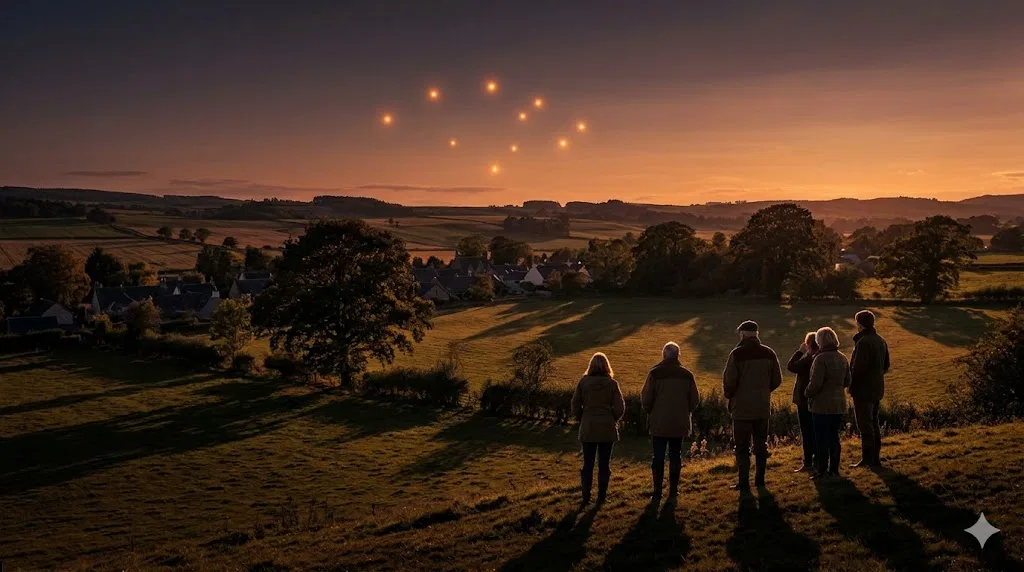
Perthshire’s weaker UFO pattern is not a run of close encounters, landed craft or radar-confirmed events. It is mostly a small set of brief light reports, especially orange lights seen in groups, drifting, hovering or fading out. The best-documented examples in the public Ministry of Defence lists are Blairgowrie on 1 January 2009, where “four bright orange lights in a group” were reported, and Callander on 7 November 2009, where “up to 20 individual orange lights” were described as static for about 15 seconds before tilting and moving off.[GOV.UK]assets.publishing.service.gov.ukufo report 2009ufo report 2009
That matters because these reports sit at the opposite end of Perthshire’s evidence scale from the Calvine photograph. They are interesting as a local pattern, but they are weak as UFO evidence: short duration, minimal witness detail, no images or instrument records in the public list, and descriptions that overlap strongly with lanterns, fireworks, aircraft lights, meteors and other ordinary sky events. The useful question is not whether every light was identified, but how much weight such reports can fairly carry.
Why orange-light reports became Perthshire’s quieter UFO pattern
The MoD’s published UFO report lists for 1997 to 2009 are deliberately brief: they give dates, times, locations and short descriptions rather than full case files or solved/unsolved verdicts. GOV.UK describes the series in exactly those terms, as UK UFO reports showing “dates and times, location and a brief description of the sighting”.[GOV.UK]GOV.UKUF O reports in the UKUF O reports in the UK For Perthshire, that format is important. It means the Blairgowrie and Callander entries are not full investigations; they are administrative snapshots of what was reported.
The Blairgowrie entry came just after midnight on New Year’s Day 2009. The description is short and plain: four bright orange lights in a group. There is no public note of photographs, radar, police confirmation, aviation follow-up, duration, altitude, direction, weather, or whether the sighting coincided with New Year celebrations.[GOV.UK]assets.publishing.service.gov.ukufo report 2009ufo report 2009 That does not make the witness wrong. It does mean the report cannot bear much interpretive weight on its own.
The Callander entry is more striking because of the number reported: up to 20 orange lights. The timing, 10 pm on 7 November 2009, also puts it close to the Bonfire Night period, when fireworks and sky lanterns are especially plausible checks. The MoD summary says the lights were individually orange, static for 15 seconds, then tilted and moved off.[GOV.UK]assets.publishing.service.gov.ukufo report 2009ufo report 2009 That is enough to make the report locally memorable, but not enough to distinguish between an unusual craft, multiple lanterns, fireworks-related effects, distant aircraft, or several separate objects being perceived as a single event.
Seen in the wider 2009 list, Perthshire’s orange lights do not look isolated. The same MoD document records many similar UK reports that year: orange lights in groups, orange balls, silent drifting lights, “fireball” descriptions, and witnesses explicitly saying “not fireworks” or “not Chinese lanterns”.[GOV.UK]assets.publishing.service.gov.ukufo report 2009ufo report 2009 That national pattern weakens a dramatic interpretation for Perthshire. If many places were reporting similar orange lights in the same period, the first working assumption should be a widespread reporting fashion or common sky stimulus, not a uniquely Perthshire phenomenon.
Blairgowrie, Callander and the problem of thin clusters
A “cluster” sounds stronger than a single report, but only if the reports are genuinely connected. Blairgowrie and Callander are both in the historic Perthshire frame used by this project, but they are separated by time, geography and detail: one was a small group of four lights in Blairgowrie on New Year’s Day; the other was a larger set near Callander in early November.[GOV.UK]assets.publishing.service.gov.ukufo report 2009ufo report 2009 That is not a flap in the strong sense of many mutually reinforcing reports around the same place and time. It is better described as a weak sighting family.
The boundary issue also matters. Perthshire is a historic county, while modern local government divides the area differently. Callander lies in the south-western part of historic Perthshire that later became part of the Stirling council area, while most of historic Perthshire is now within Perth and Kinross; Perth and Kinross also includes areas that were not historically Perthshire, such as Kinross-shire.[Wikipedia]WikipediaOpen source on wikipedia.org. For UFO research, that means a report can be “Perthshire” in the historic-county sense while appearing in modern media, police or council references under another administrative label.
The Blairgowrie entry is especially weak because the public record preserves almost no context. It does not say whether the lights rose, drifted with the wind, moved in formation, blinked, made sound, disappeared behind cloud, burned out, or changed colour.[GOV.UK]assets.publishing.service.gov.ukufo report 2009ufo report 2009 Without those details, the report remains a useful data point for local mapping but not a strong case.
The Callander report has more texture because of the claimed number and the brief behaviour: static, tilting, then moving off.[GOV.UK]assets.publishing.service.gov.ukufo report 2009ufo report 2009 Yet even this can mislead. A group of independent lights can appear coordinated when seen from a distance, especially if some are rising, fading, drifting behind cloud, or being viewed against a dark horizon without clear scale. A witness may honestly describe “tilting” or “moving off” when the underlying cause is changing perspective, wind drift, flame brightness, or several lights extinguishing in sequence.
This is why Perthshire’s orange-light cluster should be treated as a population-context pattern, not as a major incident. It tells us that local residents, like witnesses elsewhere in Britain, reported puzzling orange lights during the late MoD reporting period. It does not show a repeatable hotspot, a distinctive craft type, a military encounter, or an escalation beyond ordinary sky-observation uncertainty.
Lanterns, aircraft, fireworks and other likely checks
The first check for orange lights in 2009 is sky lanterns. The Civil Aviation Authority’s CAP 736 guidance covers directed light, fireworks, toy balloons and sky lanterns in UK airspace, noting that event information helps aviation users assess and reduce risks to flight safety.[Civil Aviation Authority]caa.co.ukOpen source on caa.co.uk. The National Fire Chiefs Council also warns that floating lanterns create fire and livestock risks and says police and coastguards can lose resources when lantern sightings are mistaken for distress flares or UFOs.[NFCC]nfcc.org.ukNFCCSky LanternsNFCCSky Lanterns That is directly relevant to the Perthshire pattern: orange, silent, drifting, grouped lights are exactly the kind of thing lanterns can produce.
Fireworks are another obvious check, especially for the Callander report on 7 November. The date does not prove a firework explanation, but it raises the baseline probability. Bonfire Night activity often spills across nearby weekends, and the MoD list around that date contains repeated witness claims that orange lights were “not fireworks” or “not Chinese lanterns”, showing that those explanations were already in play for similar reports.[GOV.UK]assets.publishing.service.gov.ukufo report 2009ufo report 2009 A witness saying “not fireworks” may be right; it may also mean only that the lights did not look like familiar exploding fireworks.
Aircraft remain a routine possibility, particularly where lights are seen briefly, at distance, or without clear altitude. Aircraft navigation and landing lights can appear oddly bright when pointed towards the observer, and distant aircraft can seem to hover if they are approaching head-on. The Perthshire summaries do not provide enough aviation detail to exclude this. They give no flight-path checks, no Civil Aviation Authority follow-up, no air-traffic data, and no independent timing from multiple locations.[GOV.UK]assets.publishing.service.gov.ukufo report 2009ufo report 2009
Meteors and fireballs are less likely for a long sequence of 20 lights, but they remain relevant to single orange “ball of fire” reports in the wider MoD list. The American Meteor Society defines a fireball as a very bright meteor and notes that meteor colour can vary, with slower meteors sometimes reported as red or orange.[American Meteor Society]amsmeteors.orgAmerican Meteor Society Fireball FAQsAmerican Meteor Society Fireball FAQs A meteor explanation is strongest where a light is brief, bright, moving in a steady path, and seen over a wide area by multiple witnesses at the same time. It is weaker where lights hover, recur, or drift slowly for minutes.
Satellites are another possible source for moving points of light, although traditional satellites tend to appear white rather than orange. The National Radio Astronomy Observatory explains that satellites often look like points of light moving relative to the background stars, shining by reflected sunlight.[National Radio Astronomy Observatory]public.nrao.eduOpen source on nrao.edu. In modern sightings, satellite trains can create repeated “string of lights” reports, but that explanation must be applied carefully to older 2009 cases and should not be used as a catch-all for orange drifting lights.
What would make a light sighting stronger evidence
Orange-light reports become stronger when they gain independent structure. A single brief account can be sincere but still weak. A stronger case would show that several witnesses in different places saw the same object at the same time, with consistent direction, elevation and duration. It would also include weather, wind direction, cloud height, astronomical checks, aviation traffic, local event listings and, ideally, photographs or video with verifiable metadata.
For Perthshire’s weak clusters, the key missing items are:
- Precise location and direction: “Over Blairgowrie” or “Callander” is not enough to reconstruct a path.
- Duration and sequence: A light lasting ten seconds, two minutes or half an hour points to different explanations.
- Angular position: Height above the horizon matters more than guessed altitude.
- Wind and weather: Lanterns, balloons and smoke-lit effects depend heavily on wind and cloud.
- Independent witnesses: Separate reports from different vantage points can turn a vague sighting into a triangulable event.
- Contemporaneous images: Even imperfect photos can preserve timing, background stars, horizon features and relative motion.
- Aviation and event checks: Nearby aircraft, fireworks displays, lantern releases and emergency activity should be ruled in or out before the word “unexplained” is used strongly.
This is not a sceptical trick designed to dismiss witnesses. It is the difference between a puzzling memory and usable evidence. A light in the sky has no built-in scale: a lantern nearby, an aircraft far away and a meteor high in the atmosphere can all be experienced as “a bright object moving silently”. Without context, the most honest classification is often “unidentified to the witness”, not “unidentifiable in principle”.
The MoD itself eventually moved away from collecting such reports. The National Archives’ release on the closure of the UFO desk says the final files covered the last two years of the desk, when reports rose sharply, and records the official view that the activity served no defence purpose and encouraged correspondence. It also says Defence Minister Bob Ainsworth was told that in more than 50 years no UFO report to the MoD had revealed anything suggesting an extraterrestrial presence or military threat to the UK.[National Archives]cdn.nationalarchives.gov.ukNational Archives The 2009 report list itself ends by noting that from 1 December 2009 the MoD no longer recorded or investigated UFO sighting reports.[GOV.UK]assets.publishing.service.gov.ukufo report 2009ufo report 2009
How these weak reports fit Perthshire’s UFO history
Perthshire’s orange lights matter because they stop the county’s UFO history being reduced to one famous photograph. They show the ordinary background against which a major case such as Calvine stands out: most reports are not dramatic, not well documented, and not especially resistant to mundane explanations. They are part of the social and observational history of UFO reporting, rather than strong evidence for exotic aircraft or non-human technology.
They also help calibrate the reader’s expectations. A county-level UFO map may show dots in Blairgowrie, Callander or nearby areas, but dots are not equal. One dot may represent a photograph with an argued chain of custody; another may represent a 20-word note about orange lights. Both belong in the archive, but they should not be treated as evidentially equivalent.
The fairest reading is that Perthshire has a small late-period pattern of orange-light reports, with Blairgowrie and Callander as the clearest public examples. Those reports are unresolved only in the limited sense that the public MoD summaries do not identify a cause. They are weak in the stronger evidential sense because ordinary explanations remain plausible and the surviving records lack the detail needed to test them.
That makes “Light Clusters” a useful local page precisely because it is not spectacular. It shows how many UFO histories are built: not from one decisive case, but from uneven records, short witness descriptions, repeated sky ambiguities and the slow work of separating unresolved cases from merely under-described ones.
Amazon book picks
Further Reading
Books and field guides related to Were Perthshire's Orange Lights Really UFOs?. Use these as the next step if you want deeper reading beyond the article.

UFOs : Generals, Pilots, and Government Officials Go on the R...
Provides context for separating stronger and weaker cases.
Open Skies, Closed Minds
Provides British examples of explainable and unexplained reports.
eBay marketplace picks
Marketplace Samples
Example marketplace items related to this page. Use the search link to explore similar finds on eBay.

Endnotes
1.
Source: assets.publishing.service.gov.uk
Title: ufo report 2009
Link:https://assets.publishing.service.gov.uk/media/5a7582c440f0b6397f35efcb/ufo_report_2009.pdf
2.
Source: GOV.UK
Title: UF O reports in the UK
Link:https://www.gov.uk/government/publications/ufo-reports-in-the-uk
3.
Source: Wikipedia
Link:https://en.wikipedia.org/wiki/Perthshire
4.
Source: nfcc.org.uk
Title: NFCCSky Lanterns
Link:https://nfcc.org.uk/our-services/building-safety/protection-building-safety/sky-lanterns/
5.
Source: cdn.nationalarchives.gov.uk
Title: National Archives
Link:https://cdn.nationalarchives.gov.uk/documents/final-tranche-of-UFO-files-released.pdf
6.
Source: assets.publishing.service.gov.uk
Link:https://assets.publishing.service.gov.uk/government/uploads/system/uploads/attachment_data/file/88202/Onshore_er_App4.pdf
7.
Source: assets.publishing.service.gov.uk
Title: ufo report 2008
Link:https://assets.publishing.service.gov.uk/media/5a789e38ed915d042206403a/ufo_report_2008.pdf
8.
Source: assets.publishing.service.gov.uk
Link:https://assets.publishing.service.gov.uk/media/5a7cba0fe5274a2f304efb63/3386.pdf
9.
Source: assets.publishing.service.gov.uk
Title: ufo report 2007
Link:https://assets.publishing.service.gov.uk/media/5a78a53fed915d04220643b2/ufo_report_2007.pdf
10.
Source: discovery.nationalarchives.gov.uk
Link:https://discovery.nationalarchives.gov.uk/details/a/A13530124
11.
Source: discovery.nationalarchives.gov.uk
Link:https://discovery.nationalarchives.gov.uk/details/a/A13530819
12.
Source: discovery.nationalarchives.gov.uk
Link:https://discovery.nationalarchives.gov.uk/details/r/16c987ae-54b2-47c5-85c8-656a7cfc10b5
13.
Source: cdn.nationalarchives.gov.uk
Link:https://cdn.nationalarchives.gov.uk/documents/cab-195-18-transcript.pdf
14.
Source: discovery.nationalarchives.gov.uk
Link:https://discovery.nationalarchives.gov.uk/details/a/A13532479
15.
Source: cdn.nationalarchives.gov.uk
Link:https://cdn.nationalarchives.gov.uk/documents/the-ufo-files-extract.pdf
16.
Source: cdn.nationalarchives.gov.uk
Link:https://cdn.nationalarchives.gov.uk/documents/aug-2009-research-guide.pdf
17.
Source: nationalarchives.gov.uk
Link:https://www.nationalarchives.gov.uk/explore-the-collection/explore-by-time-period/postwar/ufo-reports/
18.
Source: cdn.nationalarchives.gov.uk
Title: nationalarchives.gov.uk UF O files
Link:https://cdn.nationalarchives.gov.uk/documents/ufo-transcript-aug-09.pdf
19.
Source: cdn.nationalarchives.gov.uk
Link:https://cdn.nationalarchives.gov.uk/documents/briefing-guide-12-07-12.pdf
20.
Source: Wikipedia
Title: Calvine UFO photograph
Link:https://en.wikipedia.org/wiki/Calvine_UFO_photograph
21.
Source: Wikipedia
Title: UFO sightings in the United Kingdom
Link:https://en.wikipedia.org/wiki/UFO_sightings_in_the_United_Kingdom
22.
Source: Wikipedia
Title: Nick Pope (journalist)
Link:https://en.wikipedia.org/wiki/Nick_Pope_%28journalist%29
23.
Source: Wikipedia
Title: Counties of Scotland
Link:https://en.wikipedia.org/wiki/Counties_of_Scotland
24.
Source: news.sky.com
Title: biggest one ive seen meteor lights up night sky 12783386
Link:https://news.sky.com/story/biggest-one-ive-seen-meteor-lights-up-night-sky-12783386
25.
Source: news.sky.com
Title: ufo desk why mod shut real life x files 10442364
Link:https://news.sky.com/story/ufo-desk-why-mod-shut-real-life-x-files-10442364
26.
Source: gov.scot
Title: Perth and Kinross
Link:https://www.gov.scot/binaries/content/documents/govscot/publications/map/2020/11/local-authority-maps-of-scotland/documents/perth-and-kinross-council-area-map/perth-and-kinross-council-area-map/govscot%3Adocument/Perth_and_Kinross.pdf
27.
Source: weather.metoffice.gov.uk
Link:https://weather.metoffice.gov.uk/learn-about/weather/how-weather-works/red-sky-at-night
28.
Source: merseyfire.gov.uk
Link:https://www.merseyfire.gov.uk/safety-advice/community-safety/sky-lanterns/
29.
Source: wikishire.co.uk
Link:https://wikishire.co.uk/wiki/Perthshire
30.
Source: caa.co.uk
Link:https://www.caa.co.uk/cap736
31.
Source: amsmeteors.org
Title: American Meteor Society Fireball FAQs
Link:https://www.amsmeteors.org/fireballs/faqf/
32.
Source: public.nrao.edu
Link:https://public.nrao.edu/ask/unidentified-lights-in-the-sky/
33.
Source: caa.co.uk
Link:https://www.caa.co.uk/air-passengers/displays-and-events/displays-and-events-guidance/
34.
Source: wikishire.co.uk
Link:https://wikishire.co.uk/wiki/Perth
35.
Source: realcounties.com
Link:https://realcounties.com/county/perthshire/
36.
Source: scribd.com
Title: ufo report 2009 pdf
Link:https://www.scribd.com/document/446684700/ufo-report-2009-pdf
37.
Source: britannica.com
Link:https://www.britannica.com/place/Perth-and-Kinross
38.
Source: exeter-airport.co.uk
Title: chinese lanterns
Link:https://exeter-airport.co.uk/chinese-lanterns/
39.
Source: gazetteer.org.uk
Link:https://gazetteer.org.uk/place/Perthshire
Additional References
40.
Source: instagram.com
Link:https://www.instagram.com/reel/DVrchTblAGd/?hl=en
41.
Source: facebook.com
Link:https://www.facebook.com/eveningtele/posts/a-photo-of-an-alleged-perthshire-ufo-sighting-has-been-revealed-after-32-years/5313705302011840/
42.
Source: instagram.com
Link:https://www.instagram.com/p/DXFMSKVCblh/
43.
Source: rmg.co.uk
Link:https://www.rmg.co.uk/stories/space-astronomy/astronomy-naked-eye
44.
Source: instagram.com
Link:https://www.instagram.com/reel/DMQAYnFPs2n/
45.
Source: reddit.com
Link:https://www.reddit.com/r/UFOscience/comments/qzvwxg/declassified_uk_ministry_of_defence_report_says/
46.
Source: abcounties.com
Link:https://abcounties.com/counties/county-profiles/kinross-shire/
47.
Source: facebook.com
Link:https://www.facebook.com/ABCNews/posts/light-up-the-night-meteor-sightings-across-the-uk-as-a-fireball-crosses-the-sky/10160776916928812/
48.
Source: abcounties.com
Link:https://abcounties.com/counties/county-profiles/perthshire/
49.
Source: boundaries.scot
Link:https://www.boundaries.scot/wp-content/uploads/2025/09/Perthshire_South_and_Kinross-shire_0_1758892798.pdf
Topic Tree