Within Caernarfonshire Skies
What Did the Mo D Record Over Caernarfon?
The official files preserve two modest Caernarfon reports, but their brief wording leaves more questions than answers.
On this page
- The 1999 rotor and strobe report
- The 2001 coloured light report
- What short official entries can and cannot prove
Page outline Jump by section
Introduction
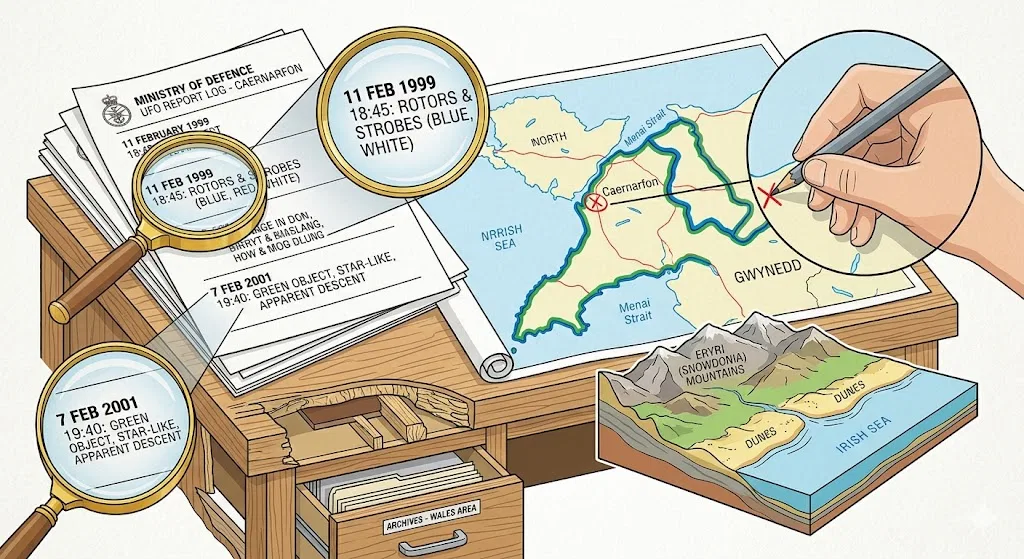
The Ministry of Defence records for Caernarfon are not dramatic case files. They are short log entries: one from February 1999 describing a rotor-bearing aircraft or object with blue, red and white strobes, and one from February 2001 describing a green object with red on the side that first looked like a star. Their value is not that they prove an extraordinary event over Caernarfonshire. Their value is that they show how the official UFO record often worked at ground level: brief public reports were logged, preserved and later released, but usually without witness interviews, radar evidence, photographs or a final identification.[GOV.UK]assets.publishing.service.gov.ukOpen source on service.gov.uk.
For Caernarfonshire, treated here as the historic county centred on Caernarfon and the north-west Wales coast, the two MoD entries sit in a place where ordinary sky events can be unusually confusing. Caernarfon lies close to the Menai Strait, the mountains of Eryri, Caernarfon Bay and the aviation setting of the former RAF Llandwrog, now Caernarfon Airport. The historic county frame matters because the MoD lists used modern labels such as “Gwynedd” and “North Wales”, while the local UFO-history question is about Caernarfonshire’s older county geography.[Wikishire]wikishire.co.ukOpen source on wikishire.co.uk.
Why the Caernarfon entries matter despite being so short
The GOV.UK release describes the national material as “Unidentified Flying Object reports 1997 to 2009” and says the documents show dates, times, locations and brief descriptions of sightings. That is exactly what the Caernarfon material is: not a polished investigation, not a verdict, and not a technical reconstruction, but a line in an official register.[GOV.UK]GOV.UKufo reports in the ukufo reports in the uk
This is easy to misunderstand. A sighting appearing in an MoD UFO list means that it was reported to, or recorded by, the Ministry of Defence. It does not mean the MoD confirmed that an unknown craft was present. The National Archives explains that UFO sightings were reported over UK skies for decades and that MoD records were kept, but the wider released material is a record of reports, correspondence and official handling rather than a catalogue of solved and unsolved aircraft tracks.[The National Archives]nationalarchives.gov.ukOpen source on nationalarchives.gov.uk.
The Caernarfon entries are therefore best read as evidence of reporting, not proof of the object. They tell us that witnesses, or those passing on witness reports, described something unusual enough to reach the official system. They also show what was not captured: no named witness, no bearing, no altitude, no duration, no weather, no distance estimate, no direction of travel, and no attached local investigation.
For a county-level UFO history, that limitation is important. Caernarfonshire’s MoD entries are useful because they are public, datable and official. They are weak as evidence for exotic claims because the official wording is too compressed to test those claims properly.
The 1999 rotor and strobe report
The first Caernarfon entry appears in the 1999 MoD report list. It records a sighting on 11 February 1999 at 18:45 at “Caernarvon, Gwynedd”. The brief description says: “Single aircraft/object, that had rotors. It had blue, red and white strobes.”[GOV.UK]assets.publishing.service.gov.ukOpen source on service.gov.uk.
That wording is striking because it contains its own ordinary explanation. A witness who reports “rotors” is already describing something with helicopter-like features. The coloured lights also fit a conventional aviation frame better than a mysterious one. Aircraft routinely use coloured navigation and anti-collision lights: UK rules require aircraft lighting at night, while aviation guidance commonly describes red, green, white and flashing anti-collision lights as part of how aircraft make themselves visible and indicate orientation.[Legislation.gov.uk]legislation.gov.ukOpen source on legislation.gov.uk.
The 1999 entry still belongs in a UFO history because “UFO” in the MoD context meant unidentified to the reporter, not necessarily alien, advanced or unearthly. The entry records uncertainty from the observer’s point of view. But the report’s own details lean strongly towards a helicopter or aircraft misidentified under night-time conditions.
Caernarfon’s local aviation setting strengthens that cautious reading. Caernarfon Airport’s own history says the site opened in 1941 as RAF Llandwrog and is now associated with scenic and training flights, an aviation museum, Wales Air Ambulance and HM Coastguard helicopters operated by Bristow. That does not prove a particular aircraft was responsible on 11 February 1999, but it makes rotorcraft and ordinary aviation activity a realistic local context rather than a remote possibility.[caernarfonairport.com]caernarfonairport.comOpen source on caernarfonairport.com.
The strongest conclusion is therefore modest: the 1999 report shows that a Caernarfon witness saw something unusual enough to report, but the details preserved by the MoD point towards a conventional aircraft explanation. The case is not “debunked” in the strict sense, because no matching flight record is cited in the released line. It is, however, a weak candidate for anything more unusual than aviation activity.
The 2001 coloured light report
The second Caernarfon entry is more ambiguous. The 2001 MoD report list records a sighting on 7 February 2001 at 19:40 at “Caernarfon, North Wales”. It says the object “initially looked like a star”, appeared as if it was “going to crash into the witness’s house”, and was “a green colour, with red on the side.”[GOV.UK]assets.publishing.service.gov.ukOpen source on service.gov.uk.
This report has a different feel from the 1999 rotor entry. There is no mention of rotors, wings, engine noise or strobes. Instead, the witness perception is dominated by brightness, colour and apparent approach. Those are exactly the features that can make night-sky events difficult for ordinary observers: a bright object can seem close when it is distant, a descending light can appear to be heading towards a house, and red-green colour can be read either as aircraft lighting or as an unusual luminous object.
The nearby timing is also important. Five minutes later, at 19:45, the same MoD list records an Amlwch, Anglesey report of one object with a blue glow that turned green, broke up and left smoke, and seemed very large. Amlwch is across the water from Caernarfonshire, not inside the historic county, but the closeness in time and region makes it relevant to interpreting the Caernarfon entry.[GOV.UK]assets.publishing.service.gov.ukOpen source on service.gov.uk.
The two reports are not identical. The Caernarfon entry describes a star-like object with green and red colouring; the Amlwch entry describes a blue-to-green glow, break-up and smoke. Still, their timing makes it plausible that north-west Wales was seeing either a shared regional sky event or several ordinary lights interpreted through the same evening conditions. It does not support treating the Caernarfon sighting as an isolated mystery detached from its wider North Wales context.
The MoD list also shows that the following evening, 8 February 2001, produced multiple UK reports with “fireball”, “burning up”, “shooting star”, “rocket” and green-light descriptions. These later entries cannot simply be folded into the Caernarfon case, because they occurred on a different date. But they do show that early February 2001 generated several reports in Britain of bright, coloured, apparently burning or fragmenting objects.[GOV.UK]assets.publishing.service.gov.ukOpen source on service.gov.uk.
What the colours and motion might mean
The red, green and white details in the Caernarfon entries are not trivial. They are among the best clues in the records, but they cut both ways.
In the 1999 case, blue, red and white strobes together with reported rotors make an aircraft or helicopter explanation highly plausible. Aircraft position and anti-collision lighting can create exactly the sort of flashing, multicoloured impression that prompts UFO reports from the ground, especially when the shape of the aircraft is hard to see.[Mendelssohn Pilot Supplies]gps.co.ukwhat aircraft lights are requiredwhat aircraft lights are required
In the 2001 case, green with red on the side could also fit aircraft lighting, because red and green lights are standard orientation cues on aircraft. But the “initially looked like a star” description leaves other possibilities open: a bright planet misread through haze, an aircraft approaching head-on, a meteor-like object, or another luminous event seen without enough distance cues. The available entry does not give direction, duration, sound, altitude, weather or whether other witnesses saw the same thing, so no single explanation can be assigned responsibly.
The “going to crash into the witness’s house” phrase should also be treated carefully. It tells us how alarming the event felt, not necessarily how close the object was. Human distance judgement at night is poor when an object has no visible background, no clear size and no sound. A distant aircraft, meteor or bright light descending behind terrain can appear to be coming down nearby.
That matters in Caernarfonshire because the landscape is not a flat observational laboratory. The historic county includes mountains, coast, open water and low-lying areas around the Menai Strait. Wikishire describes Caernarfonshire as bounded by the Irish Sea, Caernarfon Bay, the Menai Strait, Merionethshire and Denbighshire, with a largely mountainous surface and Snowdonia at its centre and south. In such terrain, lights can disappear behind ridges, appear to descend into cloud, or seem closer than they are.[Wikishire]wikishire.co.ukOpen source on wikishire.co.uk.
What the MoD probably did — and did not — investigate
The released Caernarfon entries give no sign of a detailed local investigation. That absence is consistent with how the MoD handled many public UFO reports in this period. The official GOV.UK page describes the released documents as report lists giving date, time, location and brief description, not as full case investigations.[GOV.UK]GOV.UKufo reports in the ukufo reports in the uk
The broader MoD position also helps explain why these records are so thin. Released material and later reporting on the closure of the MoD UFO desk show that the department’s core concern was defence significance, not providing an identification service for every unusual light. The 2009 MoD report PDF notes that from 1 December 2009 the department’s policy changed and UFO sighting reports were no longer recorded or investigated by the MoD.[GOV.UK]assets.publishing.service.gov.ukufo report 2009ufo report 2009
The National Archives’ final-tranche release said the files covered the final two years of the MoD UFO desk and explained why it was closed after decades of operation. It framed the released files as public records of government policy, correspondence and sighting handling, not as confirmation that unusual sightings were extraterrestrial or hostile.[National Archives]cdn.nationalarchives.gov.ukOpen source on nationalarchives.gov.uk.
This helps to put Caernarfon in proportion. The MoD preserved the two reports because they entered the reporting system. But there is no sign in the public entries that either report triggered an air-defence alert, a police search, a military scramble, a radar correlation or a formal conclusion. In evidence terms, that makes them low-resolution records.
What the two Caernarfon reports show together
Taken together, the 1999 and 2001 Caernarfon entries show three useful things about the UFO record in Caernarfonshire.
First, they show that the county appears in the official MoD reporting stream, but not as a major hotspot in the released 1997–2009 lists. The two Caernarfon reports are modest, short and separated by two years. They do not amount to a flap in the classic sense.
Second, they show how different UFO reports can be in evidential weight. The 1999 sighting is internally suggestive of a helicopter or aircraft because it mentions rotors and coloured strobes. The 2001 sighting is less easily pinned down because it is a star-like coloured light with an apparent descent, but it still lacks the details needed for a strong unresolved case.
Third, they show why official records are valuable even when they are frustrating. Without the MoD lists, these Caernarfon sightings might survive only as local anecdote or not at all. With the lists, readers can check dates, times, locations and wording. But the same official brevity prevents overclaiming.
A balanced county-level assessment would therefore treat the 1999 report as probably aviation-related, the 2001 report as genuinely ambiguous but weakly documented, and neither as strong evidence for an extraordinary craft over Caernarfonshire.
What short official entries can and cannot prove
Short MoD entries can prove that a report was logged. They can place a sighting in time and space. They can preserve the witness’s basic description. They can also reveal useful patterns, such as repeated descriptions of coloured lights, star-like objects, apparent descent and aircraft-like features.
They cannot, on their own, prove that an unusual object was physically present exactly as perceived. They cannot determine size or distance without corroborating evidence. They cannot distinguish reliably between a nearby small object and a distant large one. They cannot identify aircraft without flight data, or meteors without astronomical correlation, or balloons, lanterns and drones without local context.
Project Condign, the MoD’s late-1990s study of unidentified aerial phenomena in the UK air defence region, is relevant here because it underlines the same evidential problem at a national scale. A published extract of the study notes that UAP data was often inadequate, with few photographs, no close-up images and no instrumented measurements in many cases.[UFO Transparency]ufotransparency.comUFO Transparency Project Condign, Unidentified Aerial Phenomena in the UK AirUFO Transparency Project Condign, Unidentified Aerial Phenomena in the UK Air
That is exactly the problem with the Caernarfon reports. They are useful historical evidence for what was reported over Caernarfon, but poor evidence for what the object physically was. The proper reading is not “nothing happened” and not “something extraordinary happened”. The proper reading is: two unusual sightings were logged, one already sounds aircraft-like, the other remains under-described, and the official record is too thin to carry heavier claims.
Place, boundaries and the North Wales setting
The MoD entries use “Caernarvon, Gwynedd” in 1999 and “Caernarfon, North Wales” in 2001. This page treats them as Caernarfonshire evidence because Caernarfon is the historic county town and lies within the historic county frame used by the project. Wikishire places Caernarfonshire in north-west Wales, bounded by the Irish Sea, Menai Strait, Caernarfon Bay, Merionethshire and Denbighshire, while Wikimedia Commons’ historic-counties map identifies Caernarfonshire as one of Wales’s thirteen historic counties.[Wikishire]wikishire.co.ukOpen source on wikishire.co.uk.
Modern administrative wording still matters. “Gwynedd” in the 1999 entry reflects the post-1974 administrative setting rather than the historic-county label. “North Wales” in the 2001 entry is broader still, which is why the near-simultaneous Amlwch report can be discussed as regional context without being folded into Caernarfonshire as if it were the same place.
The aviation setting also belongs in the interpretation, but not as a catch-all explanation. Caernarfon Airport is at Dinas Dinlle, south-west of Caernarfon, on the former RAF Llandwrog site. Its official site describes scenic and training flights and the presence of Wales Air Ambulance and HM Coastguard helicopter operations.[caernarfonairport.com]caernarfonairport.comOpen source on caernarfonairport.com.
That makes aircraft and helicopters part of the normal sky environment around Caernarfon. It does not solve the 2001 report. It does, however, makes the 1999 “rotors” and “strobes” description far less mysterious than it would be in a place with no aviation context.

Best reading of the evidence
The Caernarfon MoD reports show a small, evidence-poor but historically useful slice of north-west Wales UFO reporting. The 1999 entry is most likely an aircraft or helicopter report preserved under the UFO label because the observer did not identify it at the time. The 2001 entry is more open-ended, especially because of the nearby Amlwch report, but it remains too brief to classify as a strong unknown.[GOV.UK]assets.publishing.service.gov.ukOpen source on service.gov.uk.
For readers interested in Caernarfonshire UFO history, the lesson is not that the MoD found something extraordinary over Caernarfon. It is that the official files preserve the early stage of the UFO process: a witness sees something odd, a short description is logged, and later researchers must work with both the value and the limits of that fragment.
That makes the Caernarfon entries useful as dataset evidence rather than landmark incidents. They point towards the ordinary causes that often sit behind UFO reports — aircraft lights, helicopters, bright sky objects, perception at night and regional sky events — while leaving enough uncertainty to remind us why the official record can be intriguing without being conclusive.
Amazon book picks
Further Reading
Books and field guides related to What Did the MoD Record Over Caernarfon?. Use these as the next step if you want deeper reading beyond the article.
Open Skies, Closed Minds
Most closely aligned with official British UFO reporting and government files.

UFOs : Generals, Pilots, and Government Officials Go on the R...
Focuses on documented reports and official sources rather than folklore.
eBay marketplace picks
Marketplace Samples
Example marketplace items related to this page. Use the search link to explore similar finds on eBay.


Endnotes
1.
Source: assets.publishing.service.gov.uk
Link:https://assets.publishing.service.gov.uk/media/5a79bcace5274a684690bbc2/UFOReport1999.pdf
2.
Source: assets.publishing.service.gov.uk
Link:https://assets.publishing.service.gov.uk/media/5a79dfc9ed915d042206ba86/UFOReport2001.pdf
3.
Source: caernarfonairport.com
Link:https://www.caernarfonairport.com/
4.
Source: GOV.UK
Title: ufo reports in the uk
Link:https://www.gov.uk/government/publications/ufo-reports-in-the-uk
5.
Source: nationalarchives.gov.uk
Link:https://www.nationalarchives.gov.uk/explore-the-collection/explore-by-time-period/postwar/ufo-reports/
6.
Source: legislation.gov.uk
Link:https://www.legislation.gov.uk/uksi/1991/2437/schedule/crossheading/lights-and-other-signals-to-be-shown-or-made-by-aircraft/made/data.xht?view=snippet&wrap=true
7.
Source: caernarfonairport.com
Title: the airport
Link:https://www.caernarfonairport.com/en/the-airport
8.
Source: assets.publishing.service.gov.uk
Title: ufo report 2009
Link:https://assets.publishing.service.gov.uk/media/5a7582c440f0b6397f35efcb/ufo_report_2009.pdf
9.
Source: cdn.nationalarchives.gov.uk
Link:https://cdn.nationalarchives.gov.uk/documents/final-tranche-of-UFO-files-released.pdf
10.
Source: commons.wikimedia.org
Link:https://commons.wikimedia.org/wiki/File%3AWales_Historic_Counties_map_Caernarfonshire.svg
11.
Source: datamap.gov.wales
Title: wales Historic County Boundaries of Wales
Link:https://datamap.gov.wales/layers/geonode%3Ahistoric_counties_bng_rcahmw_ply
12.
Source: cdn.nationalarchives.gov.uk
Link:https://cdn.nationalarchives.gov.uk/documents/aug-2009-research-guide.pdf
13.
Source: discovery.nationalarchives.gov.uk
Link:https://discovery.nationalarchives.gov.uk/details/r/C12738165
14.
Source: assets.publishing.service.gov.uk
Title: ufo report 1997
Link:https://assets.publishing.service.gov.uk/media/5a758d2fe5274a6faebebd11/ufo_report_1997.pdf
15.
Source: legislation.gov.uk
Link:https://www.legislation.gov.uk/uksi/2013/2870/schedule/4/crossheading/lights-and-other-signals-to-be-shown-or-made-by-aircraft/made/data.xht
16.
Source: news.sky.com
Title: ufo desk why mod shut real life x files 10442364
Link:https://news.sky.com/story/ufo-desk-why-mod-shut-real-life-x-files-10442364
17.
Source: ons.gov.uk
Link:https://www.ons.gov.uk/aboutus/transparencyandgovernance/freedomofinformationfoi/witnessesofunidentifiedaerialphenomena
18.
Source: wales.com
Title: netflix premieres ufo documentary featuring wales
Link:https://www.wales.com/news/united-kingdom/netflix-premieres-ufo-documentary-featuring-wales
19.
Source: wikishire.co.uk
Link:https://wikishire.co.uk/wiki/Caernarfonshire
20.
Source: gps.co.uk
Title: what aircraft lights are required
Link:https://www.gps.co.uk/ufaq/what-aircraft-lights-are-required/
21.
Source: ufotransparency.com
Title: UFO Transparency Project Condign, Unidentified Aerial Phenomena in the UK Air
Link:https://ufotransparency.com/files/intl-uk-project-condign-volume-1-uap-vol1-pgs14to34-ch2
22.
Source: Wikipedia
Title: RAF Llandwrog
Link:https://en.wikipedia.org/wiki/RAF_Llandwrog
23.
Source: Wikipedia
Title: Project Condign
Link:https://en.wikipedia.org/wiki/Project_Condign
24.
Source: wikishire.co.uk
Title: Historic Counties Standard
Link:https://wikishire.co.uk/wiki/Historic_Counties_Standard
25.
Source: epicflightacademy.com
Title: aircraft lights
Link:https://epicflightacademy.com/aircraft-lights/
26.
Source: controltowers.co.uk
Link:https://controltowers.co.uk/airfields/llandwrog/
Additional References
27.
Source: airworldmuseum.com
Link:https://www.airworldmuseum.com/
28.
Source: smartppr.co.uk
Link:https://www.smartppr.co.uk/airfields/caernarfon-airport-ppr-request/
29.
Source: abcounties.com
Link:https://abcounties.com/counties/county-profiles/caernarfonshire/
30.
Source: facebook.com
Link:https://www.facebook.com/groups/903879063054302/posts/25123648210650716/
31.
Source: wiki.ivao.aero
Link:https://wiki.ivao.aero/en/home/training/documentation/Helicopter_lights
32.
Source: instagram.com
Link:https://www.instagram.com/reel/DJURdWLzxOL/?hl=en-gb
33.
Source: caa.co.uk
Link:https://www.caa.co.uk/drones/open-category/getting-started-with-drones-and-model-aircraft/flying-at-night-in-the-open-category/
34.
Source: facebook.com
Link:https://www.facebook.com/welcometoourwoods/videos/heres-the-ufo-sighting-we-witnessed-at-the-end-of-last-nights-social-striders-wa/2200473923698185/
35.
Source: reddit.com
Link:https://www.reddit.com/r/UFOs/comments/17az93j/lost_and_found_project_condign_the_uk_mods_secret/
36.
Source: crosshop.eu
Link:https://www.crosshop.eu/?brand=4&format=cerca.php&lingua=EN&q=&qf=qf_app%3Atm%3Bmx%3B80
Topic Tree