Within Middlesex UFOs
Why the Acton light still matters
The Acton sighting shows how a modest local newspaper report can become one of a county's most useful UFO records.
On this page
- The patrol sighting and binocular observation
- Why local newspapers matter
- Plausible explanations and evidence limits
Page outline Jump by section
Introduction
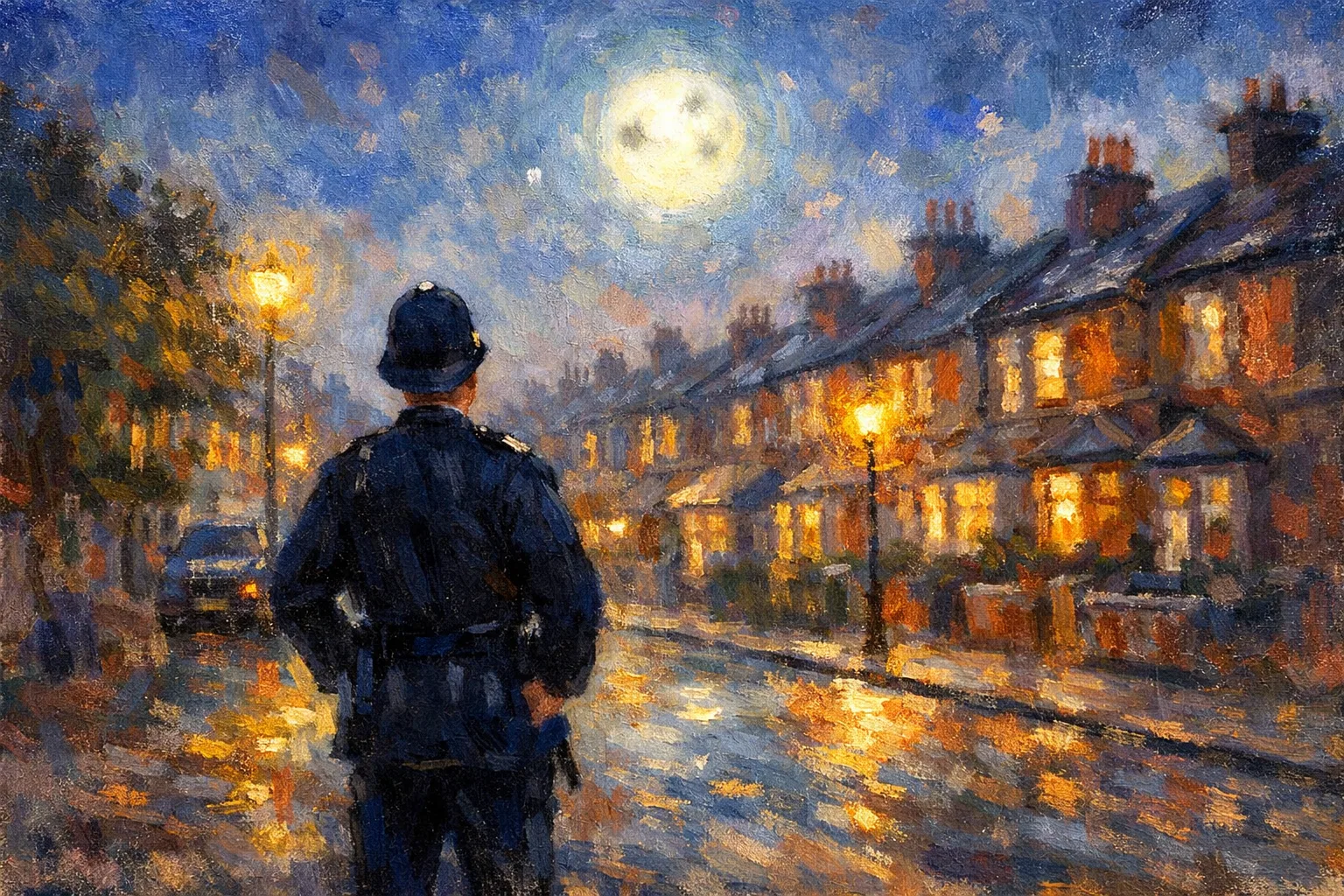
The Acton case matters because it is a small but unusually well-traced Middlesex UFO report: a bright light seen in the early hours over Acton, reported by a patrolling policeman, then observed through binoculars by two colleagues at Hounslow police station, and preserved through the local press rather than through a famous national UFO file. The Acton Gazette report of 17 August 1972, later summarised by the British Newspaper Archive, described a circular light with dark markings, brighter than the surrounding stars, apparently shifting position over the Acton and Chiswick direction. Night workers in central London were also said to have seen it. The case is not proof of an extraordinary object, but it is a good example of how local newspapers, police witnesses and later UFO catalogues can turn a fleeting nocturnal-light report into a useful county-level record.[British Newspaper Archive Blog]blog.britishnewspaperarchive.co.ukOpen source on britishnewspaperarchive.co.uk.
For this page, Acton is treated in its historic-county setting: Acton is a Middlesex town, now within the London Borough of Ealing and the wider Greater London administrative area. The Great Britain and Ireland gazetteer lists Acton as “Acton, Middlesex” and identifies its present council area as Ealing, while Wikishire also describes Acton as a suburban town and ancient parish in Middlesex.[Gazetteer]gazetteer.org.ukActon, Middlesex 330Acton, Middlesex 330
The patrol sighting and binocular observation
The core report is simple. In August 1972, in the early hours of a Wednesday morning, a patrolling policeman saw a bright light apparently hovering in the sky over Acton, west London. He reported the sighting to Hounslow police station, where two colleagues then looked at the object through binoculars. According to the British Newspaper Archive’s account of the Acton Gazette story, the officers saw the light in the direction of Acton and Chiswick and said it changed position while they were watching.[British Newspaper Archive Blog]blog.britishnewspaperarchive.co.ukOpen source on britishnewspaperarchive.co.uk.
The description contains the details that made the story memorable. The light was said to be brighter than any other star, circular in appearance, and marked by black spots. Another later catalogue, the PRUFOS Police Database, summarises the same case as an on-duty police sighting by three officers, classifies it as a “Nocturnal Light”, and gives the source as Acton Gazette, 17 August 1972. That database also preserves the comparison that the object was described as four times brighter than Venus.[British Newspaper Archive Blog]blog.britishnewspaperarchive.co.ukOpen source on britishnewspaperarchive.co.uk.
That does not make the sighting conclusive. The useful point is narrower: the Acton case has a better paper trail than many urban “light in the sky” anecdotes. It has a named local paper, a publication date, a police-station setting, multiple police observers, a binocular observation, and at least one official press-office confirmation. At the same time, the public version lacks the information that would normally be needed for a strong astronomical or aviation reconstruction: exact time, duration, elevation, compass bearing, weather, flight checks, and the original names or statements of the officers.
The local-police trail was also uneven. The Acton Gazette reportedly contacted Hounslow police station and was told by an official there that he knew nothing of the incident, while the Scotland Yard Press Bureau was more forthcoming and confirmed the sighting, although without naming the officers. That split is one reason the case remains interesting: it sits between everyday police-station uncertainty and a higher-level press confirmation, rather than being either a fully documented official investigation or a completely unsupported rumour.[British Newspaper Archive Blog]blog.britishnewspaperarchive.co.ukOpen source on britishnewspaperarchive.co.uk.

Why local newspapers matter
The Acton sighting shows why local newspapers are often central to county UFO history. National summaries tend to notice only the spectacular cases, but local papers caught the ordinary machinery of reporting: who rang the police, which station was involved, what a press bureau would confirm, and how nearby witnesses described the same object. In this case, the Acton Gazette is not merely a decorative source; it appears to be the originating public record for the details later reused by archives and UFO catalogues.[British Newspaper Archive Blog]blog.britishnewspaperarchive.co.ukOpen source on britishnewspaperarchive.co.uk.
That matters because the official UK UFO record is patchy for earlier decades. The National Archives briefing on UFO records explains that official reporting and analysis began in the early 1950s, but substantial surviving records begin in 1962; it also notes that until 1967 Ministry of Defence policy was to destroy UFO files after five years because they were considered of “transitory interest”. By the early 1970s, relevant records could appear in several file series, including reports and newspaper cuttings from 1972, but not every local police or press item is easy to locate in a clean, case-by-case official file.[National Archives]cdn.nationalarchives.gov.ukOpen source on nationalarchives.gov.uk.
The National Archives guide is also helpful because it shows what a full official report would ideally contain. The MoD proforma asked for date, time and duration, object description, observer position, method of observation, direction first seen, angle of sight, distance, movement, weather, nearby objects, who received the report, other witnesses, and receipt details. The Acton newspaper trail gives some of those elements — description, broad place, binocular observation, police involvement and other witnesses — but not enough to test the case with confidence.[National Archives]cdn.nationalarchives.gov.ukOpen source on nationalarchives.gov.uk.
This is why the Acton report should be read as a strong local-history record, not as a solved technical case. The local press preserved the observation while it was fresh, and later databases kept the story visible. But the survival of a newspaper account is not the same as the survival of the full investigative packet that would let a modern reader reconstruct the sky minute by minute.
What the witnesses add — and what they cannot settle
Police witnesses usually make a UFO case more interesting because they are accustomed to reporting incidents, separating observation from rumour, and dealing with public calls. The Acton story gains weight from that setting: one officer saw the light on patrol, two colleagues viewed it through binoculars, and the Scotland Yard Press Bureau reportedly confirmed that there had been sightings.[British Newspaper Archive Blog]blog.britishnewspaperarchive.co.ukOpen source on britishnewspaperarchive.co.uk.
Even so, police testimony does not remove the ordinary problems of night-sky identification. Bright lights seen in darkness can be difficult to judge for distance, size and motion, especially when there is no fixed reference point. The reported “black spots” might sound object-like, but without the original binocular type, atmospheric conditions, exact focus, and direction of view, that detail cannot be safely turned into a claim about surface markings. It is just as important as a witness description as it is weak as physical evidence.
The supporting central-London witnesses are also useful but limited. The Acton Gazette account says night workers in office blocks in the centre of London had seen the strange light and thought it nearer than the other stars and far brighter than Venus. That broadens the report beyond one patrol officer, but it also creates a question: if the object was visible from both Acton/Hounslow and central London, it may have been high, distant or astronomical rather than a low object specifically over Acton.[British Newspaper Archive Blog]blog.britishnewspaperarchive.co.ukOpen source on britishnewspaperarchive.co.uk.
A cautious reading therefore gives the witnesses credit for reporting something they could not identify, while avoiding the stronger claim that they saw a structured craft. The safest classification is the one later used by PRUFOS: a nocturnal light. That label is less dramatic than “flying saucer”, but it fits the surviving evidence better.[PRUFOS Police Database]prufospolicedatabase.co.ukPRUFOS Police Database ON DUTY SIGHTINGSPRUFOS Police Database ON DUTY SIGHTINGS
Plausible explanations and evidence limits
The most obvious natural comparison is Venus, because the original report itself used Venus as a brightness benchmark. Venus is not an obscure object: it is the brightest planet as seen from Earth and is a common source of mistaken UFO reports when it is prominent near dawn or dusk. In 1972, Venus moved from an evening apparition to inferior conjunction in June and then into a morning apparition for the rest of the year; an astronomical handbook for 1972 stated that Venus would be a morning star after 17 June, with greatest western elongation on 26 August and great brilliance in late July.[RASC]rasc.caObserversHandbook 1972ObserversHandbook 1972
That timing makes Venus relevant but not automatically decisive. The Acton report seems to concern the early hours of a Wednesday before the Acton Gazette article of 17 August 1972, placing it close to the period when Venus was a prominent morning object. If witnesses were looking before dawn, a bright planet low or rising in the morning sky would be a serious candidate. But the newspaper description says the light changed position and appeared circular with dark spots, and it involved binocular observation by officers who apparently thought it unusual. Those features do not rule out Venus, but they explain why the witnesses did not simply dismiss it as an ordinary planet.
Other conventional possibilities remain open. A distant aircraft approaching head-on can appear almost stationary before its bearing changes. Atmospheric haze can make a bright object seem to pulse, enlarge, acquire distortions, or move against cloud or building references. A balloon, flare, reflection, or distant light source can also create confusing impressions in urban night skies. The problem is not that one of these explanations is certainly correct; it is that the available public record is too thin to choose confidently between them.
The wider official record reinforces that caution. The National Archives describes many UK UFO records as reports of shapes, lights and flashes that can often be explained, while GOV.UK’s later MoD release of UFO reports from 1997 to 2009 shows how official files usually reduce sightings to date, time, location and brief descriptions rather than firm answers. That later release does not investigate Acton 1972 directly, but it shows the official habit of preserving reports without necessarily resolving them.[The National Archives]nationalarchives.gov.ukufo reportsufo reports
How the press trail changed the case’s value
Without the Acton Gazette, this case would probably be only a loose anecdote: “police saw a UFO over Acton”. With the press trail, it becomes a small but usable historical item. The newspaper gives a publication date, a police-station link, a quoted description, an indication of other witnesses, and the contradiction between Hounslow police station’s uncertainty and Scotland Yard’s confirmation. Later summaries by the British Newspaper Archive and PRUFOS then make the article discoverable to modern readers.[British Newspaper Archive Blog]blog.britishnewspaperarchive.co.ukOpen source on britishnewspaperarchive.co.uk.
The trail also shows how a case can become tidier as it is repeated. The original public account, as summarised by the British Newspaper Archive, begins with a patrolling policeman reporting a light to Hounslow police station. PRUFOS compresses the event into a database entry: August, early hours, Wednesday, Acton/Hounslow/London, two officers viewing through binoculars after a report to Hounslow police, three officers on duty, Scotland Yard confirmation, “Nocturnal Light”. That is useful for indexing, but it also smooths away the uncertainty and texture of the newspaper story.[British Newspaper Archive Blog]blog.britishnewspaperarchive.co.ukOpen source on britishnewspaperarchive.co.uk.
For Middlesex UFO history, this is exactly why the Acton report still matters. It is not one of Britain’s grand UFO mysteries, and it should not be inflated into one. Its value lies in showing how a modest urban sighting entered the record: first through a local newspaper, then through later archive rediscovery and police-UFO cataloguing. It also sits naturally alongside other Middlesex and west-London material where police stations, office workers, airports, local newspapers and official reporting systems overlap.
What would strengthen or weaken the case now?
The strongest upgrade would be the full original Acton Gazette page and any surviving police or MoD paperwork linked to the incident. A complete report would ideally give the exact time, weather, duration, direction, height above horizon, whether the object was seen before or after sunrise, whether flight or radar checks were made, and whether the officers produced written statements. The National Archives’ UFO-records guide shows that 1972 material may sit in Air Ministry or MoD report and newspaper-cutting series, including files covering reports and cuttings from 1972 and sighting reports running through 1973.[National Archives]cdn.nationalarchives.gov.ukOpen source on nationalarchives.gov.uk.
The case would be weakened if a precise astronomical reconstruction placed Venus, Jupiter, the Moon, a bright star, or another known object exactly where the officers were looking at the relevant time. It would also be weakened by local air-traffic or police records showing a known aircraft, flare, balloon, or searchlight activity. Conversely, it would be strengthened by independent dated reports from central London, Chiswick, Acton or Hounslow giving matching times, directions and motion.
At present, the fairest judgement is that Acton 1972 is an unresolved but modest nocturnal-light report with unusually good local press survival. It is stronger than a vague memory, weaker than a fully documented official investigation, and more valuable as evidence of how Middlesex UFO stories were recorded than as evidence for any extraordinary craft. The enduring lesson is not that something alien crossed Acton, but that a few lines in a local paper can preserve the shape, uncertainty and public afterlife of a sighting for more than fifty years.
Amazon book picks
Further Reading
Books and field guides related to Why the Acton light still matters. Use these as the next step if you want deeper reading beyond the article.
Open Skies, Closed Minds
Strong fit for a British police-witness UFO report preserved in local records and later discussed within UK UFO research traditions.
The UFO Experience
Provides a framework for evaluating unexplained aerial sightings like the Acton light while stressing evidence quality and witness testim...
Flying Saucers
Helps explain how brief sightings reported through newspapers can become lasting cultural stories.
Out of the Shadows
Focuses on British UFO reports, official records and investigative methods relevant to evaluating historical cases such as Acton.
eBay marketplace picks
Marketplace Samples
Example marketplace items related to this page. Use the search link to explore similar finds on eBay.


Endnotes
1.
Source: cdn.nationalarchives.gov.uk
Link:https://cdn.nationalarchives.gov.uk/documents/briefing-guide-12-07-12.pdf
2.
Source: rasc.ca
Title: ObserversHandbook 1972
Link:https://www.rasc.ca/sites/default/files/publications/ObserversHandbook-1972.pdf
3.
Source: nationalarchives.gov.uk
Title: ufo reports
Link:https://www.nationalarchives.gov.uk/explore-the-collection/explore-by-time-period/postwar/ufo-reports/
4.
Source: GOV.UK
Title: UF O reports in the UK
Link:https://www.gov.uk/government/publications/ufo-reports-in-the-uk
5.
Source: cdn.nationalarchives.gov.uk
Link:https://cdn.nationalarchives.gov.uk/documents/ufo-video-transcript.pdf
6.
Source: cdn.nationalarchives.gov.uk
Link:https://cdn.nationalarchives.gov.uk/documents/the-ufo-files-extract.pdf
7.
Source: assets.publishing.service.gov.uk
Title: ufo report 1997
Link:https://assets.publishing.service.gov.uk/media/5a758d2fe5274a6faebebd11/ufo_report_1997.pdf
8.
Source: assets.publishing.service.gov.uk
Title: ufo report 2009
Link:https://assets.publishing.service.gov.uk/media/5a7582c440f0b6397f35efcb/ufo_report_2009.pdf
9.
Source: in-the-sky.org
Link:https://in-the-sky.org/news.php?id=19720512
10.
Source: essex.police.uk
Title: ufo reports 2014 to 2024
Link:https://www.essex.police.uk/foi-ai/essex-police/other-information/previous-foi-requests/ufo-reports-2014-to-2024/
11.
Source: archives.gov
Link:https://www.archives.gov/research/topics/uaps
12.
Source: archive.org
Link:https://archive.org/download/b24886816/b24886816.pdf
13.
Source: ons.gov.uk
Link:https://www.ons.gov.uk/aboutus/transparencyandgovernance/freedomofinformationfoi/witnessesofunidentifiedaerialphenomena
14.
Source: ealing.gov.uk
Link:https://www.ealing.gov.uk/info/201130/area_history/792/acton_local_history
15.
Source: blog.britishnewspaperarchive.co.uk
Link:https://blog.britishnewspaperarchive.co.uk/2022/07/13/incredible-ufo-sightings/
16.
Source: prufospolicedatabase.co.uk
Title: PRUFOS Police Database ON DUTY SIGHTINGS
Link:https://www.prufospolicedatabase.co.uk/2.html
17.
Source: gazetteer.org.uk
Title: Acton, Middlesex 330
Link:https://gazetteer.org.uk/place/Acton%2C_Middlesex_330
18.
Source: wikishire.co.uk
Title: Acton, Middlesex
Link:https://wikishire.co.uk/wiki/Acton%2C_Middlesex
19.
Source: Wikipedia
Link:https://en.wikipedia.org/wiki/Venus
20.
Source: wikishire.co.uk
Title: Great Britain and Ireland
Link:https://wikishire.co.uk/map/
21.
Source: wikishire.co.uk
Link:https://wikishire.co.uk/wiki/Middlesex
22.
Source: britishnewspaperarchive.co.uk
Link:https://britishnewspaperarchive.co.uk/search/results/1950-01-01/1999-12-31?basicsearch=ufo&county=london%2C+england&page=4&retrievecountrycounts=false&somesearch=ufo&sortorder=score
23.
Source: britishnewspaperarchive.co.uk
Link:https://www.britishnewspaperarchive.co.uk/search/advanced
24.
Source: Wikipedia
Link:https://en.wikipedia.org/wiki/Middlesex
25.
Source: gazetteer.org.uk
Link:https://gazetteer.org.uk/place/North_Acton%2C_Middlesex_32975
26.
Source: familysearch.org
Title: Acton, Middlesex
Link:https://www.familysearch.org/en/wiki/Acton%2C_Middlesex
Additional References
27.
Source: youtube.com
Link:https://www.youtube.com/watch?v=_p9yTJaee6g
Source snippet
Brighton's UFOs: The Odd Sighting Spotted By A Policeman | Paranormal Files...
28.
Source: reddit.com
Link:https://www.reddit.com/r/london/comments/106jpjz/according_to_wikishire_the_city_of_london_is_in/
29.
Source: actonhistoricalsociety.org
Link:https://www.actonhistoricalsociety.org/history-resources
30.
Source: amazon.com
Link:https://www.amazon.com/Acton-History-Compiled-Middlesex-Classic/dp/033159272X?tag=searcht-20
31.
Source: newengland.com
Link:https://newengland.com/yankee/history/ufo-sightings-alien-sightings/
32.
Source: facebook.com
Link:https://www.facebook.com/BritishPowerboatRacingClub/posts/british-pathe-release-early-footage-of-a-ufo-seen-off-cowes-torquay-and-again-at/10157080527446961/
33.
Source: scribd.com
Link:https://www.scribd.com/document/55951253/UFO-Timeline-Chronology
34.
Source: facebook.com
Link:https://www.facebook.com/BeamishLivingMuseum/posts/if-you-spot-any-ufos-around-beamish-make-sure-to-report-any-sightings-to-our-pol/1243953641105434/
35.
Source: facebook.com
Link:https://www.facebook.com/cwealthforces/posts/rendlesham-forest-ufo-incidentthe-rendlesham-forest-incident-was-a-series-of-rep/979233021295195/
36.
Source: facebook.com
Link:https://www.facebook.com/TheBradyBunch/posts/the-bradys-show-a-policeman-photos-they-took-of-a-ufo/481308111167003/
Topic Tree