Within Banffshire UFOs
Did RAF Banff Shape Local UFO Stories?
RAF Banff gives the county a real aviation history, but not every airfield story makes a strong UFO case.
On this page
- Wartime Boyndie and Coastal Command
- Aircraft, patrol routes and unusual lights
- The limits of the base connection
Page outline Jump by section
Introduction
RAF Banff at Boyndie gives Banffshire’s UFO history a real aviation setting, but it does not turn the county into a strong military UFO hotspot. The former wartime airfield matters because it explains why aircraft, searchlights, training flights, coastal patrol routes and later RAF activity belong in any careful reading of unusual lights over the Moray Firth coast. What the evidence does not show is a well-documented chain of UFO incidents tied directly to the base. Boyndie’s value is mainly interpretive: it helps readers separate genuine local aviation history from weaker claims that simply borrow the authority of an RAF name. The strongest official Banffshire UFO material remains later Ministry of Defence sighting-table entries, especially the two Banff reports of 11 February 2000, rather than wartime RAF Banff case files.[Historic Environment Scotland]portal.historicenvironment.scotOpen source on historicenvironment.scot.
Wartime Boyndie and Coastal Command
RAF Banff, known locally as Boyndie, sat near the Banffshire coast between Banff and Portsoy. In historic-county terms, Boyndie belongs naturally in the Banffshire story: Wikishire describes Boyndie as a parish in northern Banffshire, three miles west of Banff, while modern administrative descriptions usually place the surviving site in Aberdeenshire. That boundary point matters because UFO records, local memory and airfield heritage may use different labels for the same landscape.[Wikishire]wikishire.co.ukWikishire BoyndieWikishire Boyndie
The airfield opened on 21 April 1943. Although built for Coastal Command, it first served under Flying Training Command, with No. 14 Pilots Advanced Flying Unit operating Airspeed Oxford training aircraft. The Airfields of Britain Conservation Trust says more than 1,500 pilots trained there in just over a year before the training unit disbanded at the beginning of September 1944. Historic Environment Scotland similarly describes the early period as dominated by twin-engined pilot training before the arrival of operational strike aircraft.[Airfields of Britain Conservation Trust]abct.org.ukAirfields of Britain Conservation Trust Banff (BoyndieAirfields of Britain Conservation Trust Banff (Boyndie
The wartime role changed sharply on 1 September 1944, when RAF Banff passed to No. 18 Group, Coastal Command, under Group Captain Max Aitken. From then until the end of the war, Boyndie became associated with the Banff Strike Wing, a mixed, multinational force using Mosquitoes and Beaufighters. Historic Environment Scotland lists the wing’s squadrons as 333 Squadron Royal Norwegian Air Force and RAF squadrons 143, 248, 404, 144 and 235, with operations directed mainly against German surface vessels and U-boats in the North Sea and along the Norwegian coast.[Historic Environment Scotland]portal.historicenvironment.scotOpen source on historicenvironment.scot.
That is the core aviation backdrop for UFO interpretation in Banffshire. The base was not a minor strip with a vague military association; it was a significant wartime airfield with training, strike, escort and coastal operations embedded in a busy North Sea war. The memorial tradition reflects that seriousness. The University of Aberdeen’s Banff and Buchan Arts Forum records the RAF Banff Strike Wing memorial as commemorating the men and women of the six multinational squadrons that operated from Banff between September 1944 and May 1945.[University of Aberdeen]abdn.ac.ukOpen source on abdn.ac.uk.
Aircraft, patrol routes and unusual lights
Aviation matters to UFO history because many honest reports begin as sky observations without enough detail to identify the source. RAF Banff’s wartime aircraft operated from a coastal setting where low cloud, sea haze, reflections, anti-aircraft fire, navigation lights and aircraft manoeuvres could all produce striking impressions. The Banff Strike Wing’s missions were not routine local circuits: they reached across the North Sea towards Norway, often with escort fighters and in demanding weather. The Airfields of Britain Conservation Trust notes that Mustangs from Peterhead were used as escorts when Luftwaffe defensive cover over Scandinavia increased, which shows that the region’s wartime air picture extended well beyond Boyndie itself.[Airfields of Britain Conservation Trust]abct.org.ukAirfields of Britain Conservation Trust Banff (BoyndieAirfields of Britain Conservation Trust Banff (Boyndie
This does not mean wartime air operations explain every later strange-light report in Banffshire. It means they form a useful caution. A county with a major wartime airfield, a North Sea coast, nearby RAF stations and clear views over water has many ordinary ways to generate unusual aerial impressions. Lights can appear to hover when an aircraft is moving towards the observer. A low object seen through mist can seem larger or closer than it is. Multiple lights may belong to separate aircraft, aircraft plus stars, aircraft plus reflections, or aircraft plus later memory effects.
The two official Banff entries in the MoD’s 2000 sighting table show why this matters. On 11 February 2000 at 18:05, a Banff witness reported a single object seen only as a light, “shrouded in a sort of mist”, with purple light for about five seconds and a very deep blue colour. At 18:20, another Banff entry described two star-like objects, one brighter than the other, with the larger one appearing to emit a cone-shaped pinkish light. These are intriguing local records, but they are brief witness-led entries rather than full investigations with aircraft checks, radar data, photographs or follow-up interviews.[GOV.UK]assets.publishing.service.gov.ukOpen source on service.gov.uk.
The timing of those two Banff reports makes a shared stimulus plausible, though not proven. They could have involved aircraft lighting seen through haze, an astronomical object, atmospheric effects, or two unrelated observations made in similar sky conditions. The important point for this Boyndie page is narrower: the existence of RAF Banff’s aviation history should make readers more alert to aircraft explanations, but it should not be used as a shortcut either to debunking or to mystery-making.
What survived after the airfield closed?
RAF Banff closed in the middle of 1946, but the site did not vanish from the landscape. Historic Environment Scotland records that Coastal Command continued operating after VE Day because of concern about enemy submarines, with Mosquitoes flying convoy escort sorties until 25 May 1945; after closure, the airfield was later used as a target for simulated bombing attacks by Royal Navy aircraft from Lossiemouth units.[Historic Environment Scotland]portal.historicenvironment.scotOpen source on historicenvironment.scot.
That post-war detail is useful because it shows a second stage in the aviation backdrop. Boyndie was no longer an active wartime strike base, but the wider north-east Scottish air environment remained active. The former airfield’s physical remains, its control tower and its local memory kept the RAF connection visible, while nearby operational aviation shifted elsewhere.
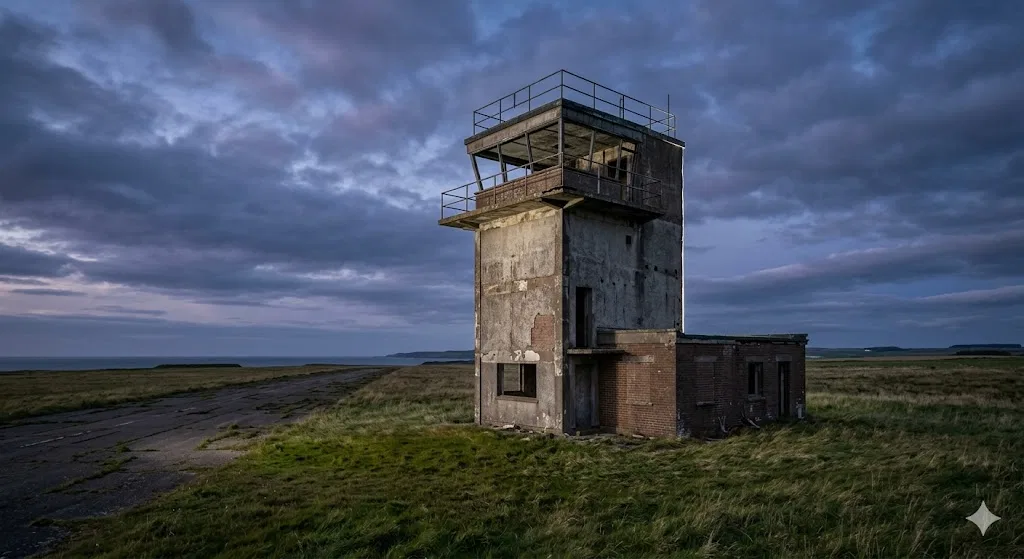
The surviving fabric is also unusually legible. Aberdeenshire Council’s Historic Environment Record notes remaining building footings, air-raid shelters, bomb-blast walls, substations and an essentially intact watch tower. It also records that Banff Flying Club reopened the airfield in 1976 with the old tower renovated and a runway cleared, although later development plans did not continue and the site became disused.[her.aberdeenshire.gov.uk]her.aberdeenshire.gov.ukOpen source on aberdeenshire.gov.uk.
This matters for local UFO stories because abandoned military places often attract speculation. A control tower, runways, memorials and blast walls can make a site feel charged with hidden history. In evidence terms, however, atmosphere is not documentation. The visible remains prove a substantial wartime aviation past; they do not by themselves prove secret aircraft, hidden UFO incidents or continuing military activity at Boyndie.
The modern aviation backdrop is not RAF Banff itself
For present-day unusual-light reports in and around Banffshire, the more relevant aviation context is usually wider north-east Scotland rather than RAF Banff alone. RAF Lossiemouth, in neighbouring Moray, is now one of the UK’s two Quick Reaction Alert stations, with Typhoon combat aircraft squadrons and Poseidon maritime patrol squadrons. The RAF says Lossiemouth aircraft support UK air defence, operations worldwide and national and international exercises.[Royal Air Force]raf.mod.ukRoyal Air Force RAF Lossiemouth | Royal Air ForceRoyal Air Force RAF Lossiemouth | Royal Air Force
Quick Reaction Alert activity can be dramatic when it occurs, but it should not be overused as an explanation. The RAF describes Typhoons from Lossiemouth launching to intercept aircraft at the edge of UK airspace, with pilots and engineers kept ready at all times. Such operations are real, but they are not automatically relevant to a brief light seen over Banff, Portsoy or inland Banffshire unless timing, direction, noise, flight tracking, official announcements or witness detail support the link.[Royal Air Force]raf.mod.ukRoyal Air Force Quick reaction alert | Royal Air ForceRoyal Air Force Quick reaction alert | Royal Air Force
Modern drones add another layer. The Civil Aviation Authority notes that night drone flying reduces the pilot’s ability to judge distance and direction, and from 1 January 2026 drones in the Open Category must show a green flashing light during night operations. For UFO readers, that is a practical reminder: small, quiet lights that seem to hover, change direction or flash oddly are not necessarily aircraft in the traditional sense. They may be drones, model aircraft, or other low-level aerial activity.[Civil Aviation Authority]caa.co.ukOpen source on caa.co.uk.
This is why RAF Banff should be treated as one piece of a layered aviation landscape. The wartime base explains local memory and historical flight activity. RAF Lossiemouth explains some modern military-aircraft possibilities. Civil aviation, drones, satellites, fishing vessels, offshore lights and astronomy may explain others. A strong case needs more than “there used to be an RAF base nearby”.
The limits of the base connection
The most important conclusion is a cautious one: RAF Banff strengthens Banffshire’s aviation context, but it does not create a strong UFO case on its own. The public record supports the airfield’s wartime significance very well. It supports the existence of later Banffshire UFO reports in MoD tables. It does not, from the available evidence, connect those later reports directly to hidden activity at Boyndie.
There are three common mistakes to avoid.
First, do not treat proximity as proof. A sighting near a former RAF site may be worth checking against aircraft activity, but the base connection is only meaningful if the timing, location and description line up. RAF Banff closed in 1946, while the clearer official Banff UFO entries date from 2000. That long gap weakens any simple “RAF base equals UFO hotspot” argument.[Historic Environment Scotland]portal.historicenvironment.scotOpen source on historicenvironment.scot.
Second, do not dismiss every report as aircraft just because aviation is plausible. The 2000 Banff entries are too brief to resolve confidently. A careful assessment can say that aircraft, atmospheric effects or astronomical objects are plausible without pretending the records contain enough detail for a firm identification.[GOV.UK]assets.publishing.service.gov.ukOpen source on service.gov.uk.
Third, separate heritage from investigation. Boyndie’s control tower, memorial and surviving wartime structures are historically important. They help explain why RAF Banff remains part of local memory. But UFO investigation needs dated reports, witness statements, direction of travel, duration, weather, astronomical checks, aircraft activity, photographs or radar data. A compelling airfield history is not the same thing as a compelling UFO case.
What RAF Banff adds to Banffshire’s UFO map
RAF Banff’s best contribution to Banffshire UFO history is not a dramatic incident but a framework for interpretation. It shows that this coastal county had a real wartime aviation footprint, linked to North Sea and Norwegian operations, and that later sky reports should be read with aircraft and maritime context in mind. It also shows why historic-county geography matters: Boyndie can be described through Banffshire identity, modern Aberdeenshire administration and regional Moray Firth aviation all at once.
For readers following the wider Banffshire branch, RAF Banff is therefore a bridge topic. It connects official MoD sighting entries, local wartime memory, neighbouring RAF Lossiemouth, and the everyday problem of identifying lights over a dark coast. The balanced reading is simple: Boyndie makes Banffshire’s UFO background more aviation-rich, but the current evidence does not justify turning the former airfield into a major UFO mystery.
Amazon book picks
Further Reading
Books and field guides related to Did RAF Banff Shape Local UFO Stories?. Use these as the next step if you want deeper reading beyond the article.
The Mammoth Book of UFOs
Provides context for assessing local sightings against wider UK and international UFO reporting.
In Plain Sight: an Investigation Into UFOs and Impossible Sci...
Explores how official investigations and witness testimony are evaluated, complementing local case studies such as Banffshire.
The UFO Files
Directly supports discussion of Ministry of Defence UFO reports and careful evaluation of British UFO claims.
The Defence of the Realm
Helps readers understand how official records, intelligence assessment and government reporting interact with unusual-phenomena claims.
eBay marketplace picks
Marketplace Samples
Live-tested eBay searches with available results related to this page.




Endnotes
1.
Source: assets.publishing.service.gov.uk
Link:https://assets.publishing.service.gov.uk/media/5a78cd1d40f0b6324769a45e/UFOReport2000.pdf
2.
Source: her.aberdeenshire.gov.uk
Link:https://her.aberdeenshire.gov.uk/Monument/MAB17645
3.
Source: raf.mod.uk
Title: Royal Air Force RAF Lossiemouth | Royal Air Force
Link:https://www.raf.mod.uk/our-organisation/stations/raf-lossiemouth/
4.
Source: raf.mod.uk
Title: Royal Air Force Quick reaction alert | Royal Air Force
Link:https://www.raf.mod.uk/what-we-do/overview/quick-reaction-alert/
5.
Source: raf.mod.uk
Link:https://www.raf.mod.uk/our-organisation/stations/raf-lossiemouth/flying-info/
6.
Source: assets.publishing.service.gov.uk
Title: 20201111 Redacted reply to 11901 re UFO Reports O
Link:https://assets.publishing.service.gov.uk/media/5fdb4f88e90e071beab9d39e/20201111-Redacted_reply_to_11901_re_UFO_Reports-O.pdf
7.
Source: wm.awm.gov.au
Title: norways skies
Link:https://wm.awm.gov.au/watch/norways-skies
8.
Source: cdn.nationalarchives.gov.uk
Title: briefing guide 12 07 12
Link:https://cdn.nationalarchives.gov.uk/documents/briefing-guide-12-07-12.pdf
9.
Source: find-and-update.company-information.service.gov.uk
Title: company-information.service.gov.uk BANF F AIRFIELD TRUST people
Link:https://find-and-update.company-information.service.gov.uk/company/SC375395/officers
10.
Source: data.jncc.gov.uk
Title: SpeciesStatus 1 Coleoptera WEB 2010
Link:https://data.jncc.gov.uk/data/e80beaf2-456c-4178-8f91-16c2ef01368d/SpeciesStatus-1-Coleoptera-WEB-2010.pdf
11.
Source: GOV.UK
Title: raf typhoon jets intercept russian bombers flying north of scotland
Link:https://www.gov.uk/government/news/raf-typhoon-jets-intercept-russian-bombers-flying-north-of-scotland
12.
Source: lossiemouth.org
Link:https://www.lossiemouth.org/inspire/itineraries/a-fine-day-out/spotters-day-out/
13.
Source: youtube.com
Title: The Last Mosquito
Link:https://www.youtube.com/watch?v=r1PVg1CjfVU
Source snippet
Airfields of Britain Conservation Trust...
14.
Source: portal.historicenvironment.scot
Link:https://portal.historicenvironment.scot/apex/f?p=1505%3A300%3A%3A%3A%3A%3AVIEWTYPE%2CVIEWREF%3Adesignation%2CLB49835
15.
Source: wikishire.co.uk
Title: Wikishire Boyndie
Link:https://wikishire.co.uk/wiki/Boyndie
16.
Source: abct.org.uk
Title: Airfields of Britain Conservation Trust Banff (Boyndie)
Link:https://www.abct.org.uk/airfields/banff-boyndie/
17.
Source: abdn.ac.uk
Link:https://www.abdn.ac.uk/elphinstone/resources/bbaf/category/14/111/
18.
Source: caa.co.uk
Link:https://www.caa.co.uk/drones/open-category/getting-started-with-drones-and-model-aircraft/flying-at-night-in-the-open-category/
19.
Source: Wikipedia
Title: RAF Banff
Link:https://en.wikipedia.org/wiki/RAF_Banff
20.
Source: Wikipedia
Title: Quick Reaction Alert
Link:https://en.wikipedia.org/wiki/Quick_Reaction_Alert
21.
Source: Wikipedia
Title: RAF Lossiemouth
Link:https://en.wikipedia.org/wiki/RAF_Lossiemouth
22.
Source: rafbanfftrust.org
Title: Strike Wing Memorial
Link:https://rafbanfftrust.org/memorial/index.html
23.
Source: portal.historicenvironment.scot
Link:https://portal.historicenvironment.scot/apex/f?p=1505%3A300%3A%3A%3A%3A%3AVIEWTYPE%2CVIEWREF%3Adesignation%2CLB49836
24.
Source: youtube.com
Link:https://www.youtube.com/watch?v=Yin-y7ZXX2I
Additional References
25.
Source: youtube.com
Title: Exploring Scotlands Hidden History RAF-Banff: Forgotten Airfields of the, UK
Link:https://www.youtube.com/watch?v=CcFuSf_AjFs
Source snippet
The Last Mosquito - Banff Flying Club Opening June 2 1976...
26.
Source: facebook.com
Link:https://www.facebook.com/royalairforce/videos/a-poseidon-from-raf-lossiemouth-conducts-torpedo-training-off-the-coast-of-scotl/1745506605883038/
27.
Source: iwm.org.uk
Link:https://www.iwm.org.uk/memorials/item/memorial/13403
28.
Source: trove.scot
Link:https://www.trove.scot/designation/LB49836
29.
Source: facebook.com
Link:https://www.facebook.com/groups/903879063054302/posts/25845547301794133/
30.
Source: worldnavalships.com
Link:https://www.worldnavalships.com/forums/thread.php?threadid=1098
31.
Source: met.police.uk
Link:https://www.met.police.uk/advice/advice-and-information/drones/drones/
32.
Source: instagram.com
Link:https://www.instagram.com/p/DM5E4BHObnG/
33.
Source: facebook.com
Link:https://www.facebook.com/groups/398876754339166/posts/1665001964393299/
34.
Source: facebook.com
Link:https://www.facebook.com/RAFLossiemouth/videos/heres-some-footage-from-the-cockpit-of-our-quick-reaction-alert-typhoons-taken-t/560274324839801/
Topic Tree