Within Shetland UFOs
What Do Official Records Really Say?
The 1997 Lerwick entry shows how official UFO tables can preserve a sighting while leaving most questions unanswered.
On this page
- The 1997 Lerwick light report
- How Mo D tables help and mislead
- Why thin records need careful reading
Page outline Jump by section
Introduction
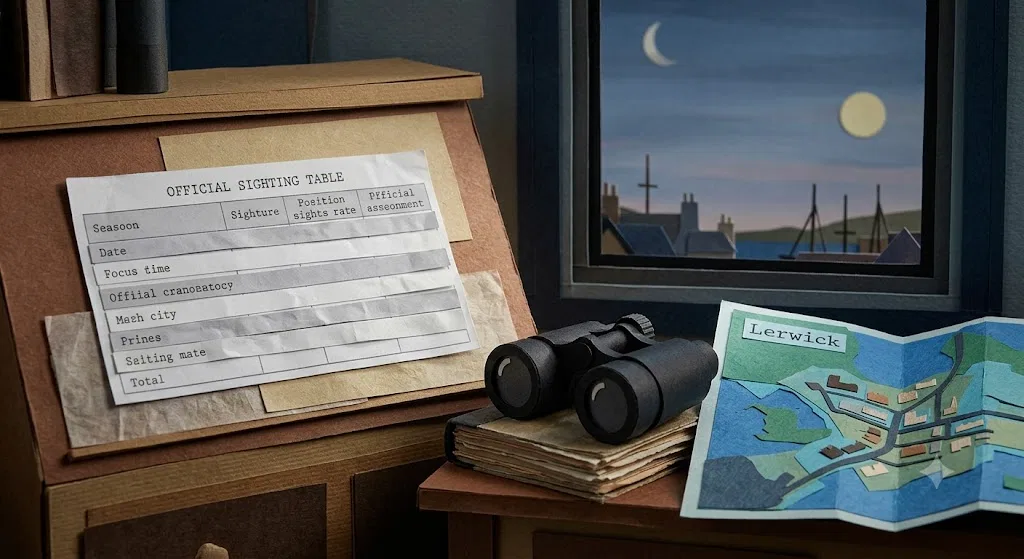
The Ministry of Defence’s published UFO tables contain one clear Lerwick entry for 1997: at 23:45 on 8 July, someone reported “a round light” over Lerwick, described as about the size of a five pence piece when seen through binoculars and moving east. That is the whole public entry. It matters for Shetland’s UFO history not because it proves an extraordinary event, but because it shows the strength and weakness of official records at the same time: the sighting was preserved by the state, yet the surviving table gives no named witness, no exact viewing position, no duration, no weather, no aircraft check, no astronomical analysis and no conclusion.[GOV.UK]assets.publishing.service.gov.ukufo report 1997ufo report 1997
For readers trying to understand “what really happened”, the honest answer is modest. The Lerwick report is a documented sighting, but not a documented investigation in any meaningful public sense. It is best treated as a thin official data point: useful for mapping reported UFO activity in Shetland, but too sparse to carry much weight on its own.
The 1997 Lerwick light report
The Lerwick entry appears in the Ministry of Defence’s “UFO Reports 1997” table, one of the annual sighting lists later made available through GOV.UK. The GOV.UK page describes the collection as UFO reports from 1997 to 2009, giving dates, times, locations and brief descriptions of sightings. The 1997 PDF itself is a nine-page table with columns for date, time, town or village, county, occupation of reporter where known, and a short description.[GOV.UK]GOV.UKUF O reports in the UKUF O reports in the UK
The relevant row reads: 8 July 1997, 23:45, Lerwick, Shetland Islands. The description says the witness saw “a round light, the size of a five pence piece through binoculars” moving east. The “occupation of reporter” field is blank, which means the public table does not tell us whether the report came from a member of the public, a professional observer, a police contact, aviation staff, coastguard personnel, military personnel or someone else.[GOV.UK]assets.publishing.service.gov.ukufo report 1997ufo report 1997
That small wording matters. “A round light” is a visual description, not a physical identification. The comparison with a five pence piece is also not a true size estimate. It tells us only how large the light appeared through binoculars, and even that depends on the binocular magnification, the witness’s steadiness, the distance to the object and whether the light was sharply focused. Without those details, the entry cannot tell us whether the object was close and small, distant and bright, or an ordinary object made ambiguous by optics and low light.
The timing also deserves care. Lerwick in early July sits within Shetland’s long summer twilight period, often called the “simmer dim”, when light lingers after sunset and full darkness can be limited or absent around midsummer. Local visitor material describes this as an extended in-between light rather than normal night, and Shetland’s northerly position makes that relevant to any late-evening sky report.[Shetland.org]shetland.orgOpen source on shetland.org.
The Moon was a waxing crescent on 8 July 1997, with roughly 12 per cent illumination according to astronomy date references. That does not solve the Lerwick report, but it helps frame the observing conditions: this was not a bright full-Moon night, and the object was described as moving east rather than as a static lunar object.[The Sky Live]theskylive.comOpen source on theskylive.com.
How MoD tables help and mislead
Official tables are valuable because they stop a sighting from vanishing completely. In this case, the Lerwick entry gives a date, time, place and minimal description. That is enough to show that Shetland was not absent from the MoD’s late-1990s UFO paperwork, and it gives local researchers a fixed point to compare with weather logs, newspaper archives, airport movements, astronomical data or other witness accounts.
The same table, however, can mislead if read too confidently. A row in an MoD UFO list does not mean the Ministry confirmed an unknown craft. It means a report was received and entered. The GOV.UK summary is careful: these are reports of UFO sightings, not determinations that the events were unexplained after deep inquiry.[GOV.UK]GOV.UKUF O reports in the UKUF O reports in the UK
The 1997 list itself shows why caution is needed. Nearby entries in the same table include many brief descriptions that sound dramatic but are still raw reports: orange balls, triangular lights, star-like objects, balloon-shaped objects, comet-like lights and fast-moving shapes. One 9 February entry is already summarised as “a very bright meteorite or space debris”, showing that at least some reports in the tables were compatible with ordinary sky phenomena rather than exotic craft.[GOV.UK]assets.publishing.service.gov.ukufo report 1997ufo report 1997
For Lerwick, the table gives no such suggested explanation. That absence should not be overread. It may mean the public summary did not include an assessment; it does not mean the object defeated all explanation. A proper assessment would need details the table lacks: direction measured in degrees, elevation above the horizon, speed, duration, sound, colour, weather, cloud, visibility, binocular type, whether the object crossed known flight paths, and whether any other witnesses reported the same thing.
This is the central lesson of the Lerwick MoD record. Official preservation is not the same as evidential richness. A sighting can be real as a report, genuinely puzzling to the witness, and still too thin to support a strong conclusion.
Why Lerwick is a useful Shetland example
Lerwick is not just any dot on a map. It is the chief town of Shetland, the islands’ main port, and it sits on Bressay Sound on the east coast of Mainland. Gazetteer records place Lerwick in the historic county of Shetland and in the modern Shetland Islands council area, which is a close fit for this project’s historic-county framing.[Gazetteer of British Place Names]gazetteer.org.ukLerwick, Shetland 26061Lerwick, Shetland 26061
That local setting matters because Shetland sightings often sit between sea, sky and aviation. Modern Shetland has air links through Sumburgh and inter-island services connected with Tingwall, while the islands’ northern position also makes them a strong place for unusual sky viewing, including aurorae in winter. Current travel and transport sources describe year-round flights to Sumburgh from Scottish cities and inter-island aircraft operating from Tingwall, which is only a few miles from Lerwick.[shetland.org]shetland.orgOpen source on shetland.org.
That does not mean the 1997 object was an aircraft. The table gives no flight correlation, and the report was at 23:45. But it does mean the first explanations to test would be ordinary ones: aircraft lights, maritime activity, a bright astronomical object, a meteor or re-entering debris, an optical effect through binoculars, or a distant light misjudged against Shetland’s summer twilight.
Shetland’s aurora reputation is also relevant in the wider county pattern, though probably less directly for this July case. Local and national tourism sources describe the northern lights, known in Shetland as the “Mirrie Dancers”, as a winter attraction, and VisitScotland notes Shetland’s position as the part of Scotland closest to the Arctic Circle. That helps explain why Shetland can produce striking sky experiences, but a July round light moving east is not, on the face of the MoD wording alone, a strong aurora description.[Shetland.org]shetland.orgOpen source on shetland.org.
The 1997 Lerwick entry therefore belongs in Shetland’s UFO history as a cautionary anchor. It is less dramatic than the better-known 1992 fast-moving object reported off Shetland, but it is cleaner as a dataset example: a single official row that shows exactly how little a public table can preserve.
What the MoD was, and was not, trying to do
The Ministry of Defence did not operate its UFO records as a public mystery-solving service. The best way to read the Lerwick entry is through the MoD’s defence-interest lens: reports were historically assessed for possible implications for UK air defence or national security, not for the purpose of satisfying local curiosity or producing a full civilian case file.
The National Archives’ material on the final release of UFO files says the UFO desk was staffed by civil servants from the Air Staff Secretariat, with scientific and technical advice from DI55, a Defence Intelligence Staff branch responsible for assessing reports for intelligence interest. It also notes that from 2000 reports were no longer copied to DI55, and that the UFO desk closed in November 2009.[National Archives]cdn.nationalarchives.gov.ukfinal tranche of UFO files releasedfinal tranche of UFO files released
Later government answers make the same limitation explicit. In 2024, the Ministry of Defence’s parliamentary answer stated that its position remained unchanged: in more than 50 years, no sighting reported to the department had indicated a military threat to the United Kingdom. It also said the MoD ceased investigating UFO or UAP reports in 2009 and had no current plan to create a dedicated team for alleged sightings.[UK Parliament]questions-statements.parliament.ukOpen source on parliament.uk.
That policy context weakens any claim that the Lerwick table row represents a hidden official endorsement of an extraordinary event. It is more accurate to say that the report entered an official intake system. If nothing in the report suggested a defence threat, the public record might never have been expanded into a detailed case study.
The closure of the UFO desk also matters for later readers. In 2021, a House of Lords exchange recorded the government position that all relevant material created and held by the UFO desk had been passed to The National Archives. That makes the surviving public record important, but it also suggests that, unless a more detailed file is identified in the archive, the short 1997 table row may be all that is easily available for this Lerwick sighting.[Hansard]hansard.parliament.ukHansard Unidentified Flying ObjectsHansard Unidentified Flying Objects
Why thin records need careful reading
The biggest risk with the Lerwick entry is that readers may mistake official form for official certainty. The table looks authoritative because it is an MoD publication, but its content is closer to an index than an investigation report. It is a lead, not a verdict.
A careful reading should separate three questions. First, was there a reported sighting? Yes: the MoD table records one at Lerwick on 8 July 1997. Second, is there enough information to identify it? No: the public entry is too short. Third, does “unidentified” mean extraordinary? No: in a thin record, unidentified often means simply that the available public data is inadequate.
This is especially important for Shetland, where the landscape encourages big-sky stories. A moving light seen through binoculars from Lerwick might sound intriguing because of the islands’ remoteness and military-adjacent northern geography. But the evidence itself does not support a leap to secret aircraft, extraterrestrial craft or a major defence incident. The record contains no radar trace, no named official witness, no aircraft scramble, no police log, no photograph and no second independent testimony.
There is also a useful contrast within the same MoD source. Some 1997 entries are more descriptive than Lerwick’s, mentioning shapes, colours, sounds, sudden movements, heights or multiple lights. Others are as thin or thinner. Lerwick’s value is precisely that it sits near the low-information end of the spectrum: enough to mark a reported UFO in Shetland, not enough to build a confident narrative.[GOV.UK]assets.publishing.service.gov.ukufo report 1997ufo report 1997
For a local UFO map, that distinction is healthy. It prevents the Shetland record from being inflated while still preserving what the archive actually says. The Lerwick report should remain in the county-level history, but labelled carefully: an official 1997 sighting record of a moving round light, unresolved in the public table, and evidentially weak because the surviving public details are minimal.
What would strengthen or weaken the case
The Lerwick entry could become more useful if matched with independent material from the same night. A local newspaper report, a police or coastguard log, a weather observation, an airport movement record, a ferry or maritime report, or another witness statement from a different location could turn a bare line into a testable case. Without those, the report remains a single-row sighting.
The most helpful strengthening evidence would be independent timing and direction. For example, a second observer elsewhere in Shetland reporting a round light moving east at roughly 23:45 would allow triangulation, or at least a better estimate of track. A contemporaneous log from an aviation, coastguard or police source would matter more than a later retelling because it would reduce memory distortion.
The strongest weakening evidence would be a mundane correlation: a known aircraft, a satellite or debris event, a bright astronomical object, a maritime light, or a local optical effect matching the time, direction and apparent motion. The current public table does not provide enough information to test those explanations properly, which is why the case should not be classed as debunked. It is better described as unresolved but weakly evidenced.
This is the practical takeaway for “MoD Records” in Shetland. The official table confirms that a Lerwick sighting was reported. It does not confirm that something extraordinary happened over Lerwick. The record’s real value is methodological: it teaches readers how to handle small official UFO entries without either dismissing them out of hand or turning them into more than the evidence can bear.
Amazon book picks
Further Reading
Books and field guides related to What Do Official Records Really Say?. Use these as the next step if you want deeper reading beyond the article.
Open Skies, Closed Minds
Directly relevant to interpreting an MoD-listed Lerwick report.
The Report on Unidentified Flying Objects
Demonstrates how official records can be informative yet limited.

UFOs : Generals, Pilots, and Government Officials Go on the R...
Provides broader context for official sighting reports.
eBay marketplace picks
Marketplace Samples
Example marketplace items related to this page. Use the search link to explore similar finds on eBay.




Endnotes
1.
Source: assets.publishing.service.gov.uk
Title: ufo report 1997
Link:https://assets.publishing.service.gov.uk/media/5a758d2fe5274a6faebebd11/ufo_report_1997.pdf
2.
Source: GOV.UK
Title: UF O reports in the UK
Link:https://www.gov.uk/government/publications/ufo-reports-in-the-uk
3.
Source: shetland.org
Link:https://www.shetland.org/blog/midsummer-in-shetland
4.
Source: shetland.org
Link:https://www.shetland.org/videos/summer-is-a-magical-time-in-shetland
5.
Source: shetland.org
Link:https://www.shetland.org/visit/plan/getting-to-shetland/flight
6.
Source: shetland.gov.uk
Link:https://www.shetland.gov.uk/transport/tingwall-airport
7.
Source: shetland.org
Link:https://www.shetland.org/visit/do/wildlife/northern-lights
8.
Source: visitscotland.com
Link:https://www.visitscotland.com/things-to-do/landscapes-nature/northern-lights
9.
Source: cdn.nationalarchives.gov.uk
Title: final tranche of UFO files released
Link:https://cdn.nationalarchives.gov.uk/documents/final-tranche-of-UFO-files-released.pdf
10.
Source: questions-statements.parliament.uk
Link:https://questions-statements.parliament.uk/written-questions/detail/2024-12-05/18321/
11.
Source: hansard.parliament.uk
Title: Hansard Unidentified Flying Objects
Link:https://hansard.parliament.uk/lords/2021-06-30/debates/C3B3E127-A168-4315-A1C9-B4D7CC80895D/UnidentifiedFlyingObjects
12.
Source: assets.publishing.service.gov.uk
Title: ufo report 2009
Link:https://assets.publishing.service.gov.uk/media/5a7582c440f0b6397f35efcb/ufo_report_2009.pdf
13.
Source: assets.publishing.service.gov.uk
Title: 20140804 FOI Bentwaters
Link:https://assets.publishing.service.gov.uk/media/5a7eb69a40f0b6230268b102/20140804_FOI_Bentwaters.pdf
14.
Source: nationalarchives.gov.uk
Link:https://www.nationalarchives.gov.uk/explore-the-collection/explore-by-time-period/postwar/ufo-reports/
15.
Source: media.nationalarchives.gov.uk
Link:https://media.nationalarchives.gov.uk/index.php/ufo-files-from-the-uk-government/
16.
Source: shetland.org
Title: Place Names
Link:https://www.shetland.org/blog/place-names-to-past
17.
Source: data.gov.uk
Title: Place Name Gazetteer
Link:https://www.data.gov.uk/dataset/4b656c40-af07-49f3-8960-42bf1b05cd44/place-name-gazetteer-scotland
18.
Source: news.sky.com
Title: ufo desk why mod shut real life x files 10442364
Link:https://news.sky.com/story/ufo-desk-why-mod-shut-real-life-x-files-10442364
19.
Source: data.jncc.gov.uk
Title: pubs csuk region 02
Link:https://data.jncc.gov.uk/data/6473ed35-d1cb-428e-ad69-eb81d6c52045/pubs-csuk-region-02.pdf
20.
Source: theskylive.com
Link:https://theskylive.com/moon/1997
21.
Source: gazetteer.org.uk
Title: Lerwick, Shetland 26061
Link:https://gazetteer.org.uk/place/Lerwick%2C_Shetland_26061
22.
Source: timeanddate.com
Link:https://www.timeanddate.com/moon/uk/lerwick?month=12
23.
Source: timeanddate.com
Link:https://www.timeanddate.com/moon/uk/lerwick?month=8
24.
Source: timeanddate.com
Link:https://www.timeanddate.com/sun/uk/lerwick?month=10
25.
Source: gazetteer.org.uk
Title: The Flaeshins, Shetland 279523
Link:https://gazetteer.org.uk/place/The_Flaeshins%2C_Shetland_279523
26.
Source: gazetteer.org.uk
Link:https://gazetteer.org.uk/search?place=Shetland&type=em
27.
Source: gazetteer.org.uk
Title: The Vadills, Shetland 267691
Link:https://gazetteer.org.uk/place/The_Vadills%2C_Shetland_267691
28.
Source: Wikipedia
Link:https://en.wikipedia.org/wiki/Shetland
29.
Source: theskylive.com
Link:https://theskylive.com/guide?geoid=8299621
Additional References
30.
Source: youtube.com
Title: UK Controversial UAP Report (Project Condign)
Link:https://www.youtube.com/watch?v=LvGm_JWhKw4
Source snippet
UFO'S IN THE UNITED KINGDOM Full Exclusive Sci-Fi Documentary Premiere English HD 2025...
31.
Source: youtube.com
Title: Britain Releases Secret UFO Sighting Documents
Link:https://www.youtube.com/watch?v=dsphnSLHCos
Source snippet
UK Controversial UAP Report (Project Condign) - Dr. David Clarke...
32.
Source: bellona.org
Link:https://bellona.org/news/nuclear-issues/nuclear-uk/2009-04-british-subs-reported-to-have-been-leaking-radioactive-materials-for-at-least-three-years
33.
Source: facebook.com
Link:https://www.facebook.com/NewsNationNow/posts/a-former-ufo-investigator-for-the-uks-ministry-of-defense-nick-pope-admits-that-/584881447252210/
34.
Source: facebook.com
Link:https://www.facebook.com/eveningtele/posts/a-photo-of-an-alleged-perthshire-ufo-sighting-has-been-revealed-after-32-years/5313705302011840/
35.
Source: shetlandamenity.org
Link:https://www.shetlandamenity.org/about-place-names
36.
Source: facebook.com
Link:https://www.facebook.com/anncleeves/posts/back-in-shetland-mainland-got-the-front-seat-next-to-the-pilot/1320582612765026/
37.
Source: skyscanner.net
Link:https://www.skyscanner.net/routes/lsi/ema/sumburgh-shetland-to-east-midlands.html
38.
Source: zeitverschiebung.net
Link:https://www.zeitverschiebung.net/en/city/2644605
39.
Source: flightsfrom.com
Link:https://www.flightsfrom.com/LSI
Topic Tree