Within Berkshire UFOs
How a Berkshire Saucer Hoax Fooled Officials
The 1967 planted saucers show how a prank near Welford and Winkfield briefly triggered serious police, military and MoD attention.
On this page
- What appeared at Welford and Winkfield
- How police, military and Mo D teams responded
- Why the prank still matters for UFO history
Page outline Jump by section
Introduction
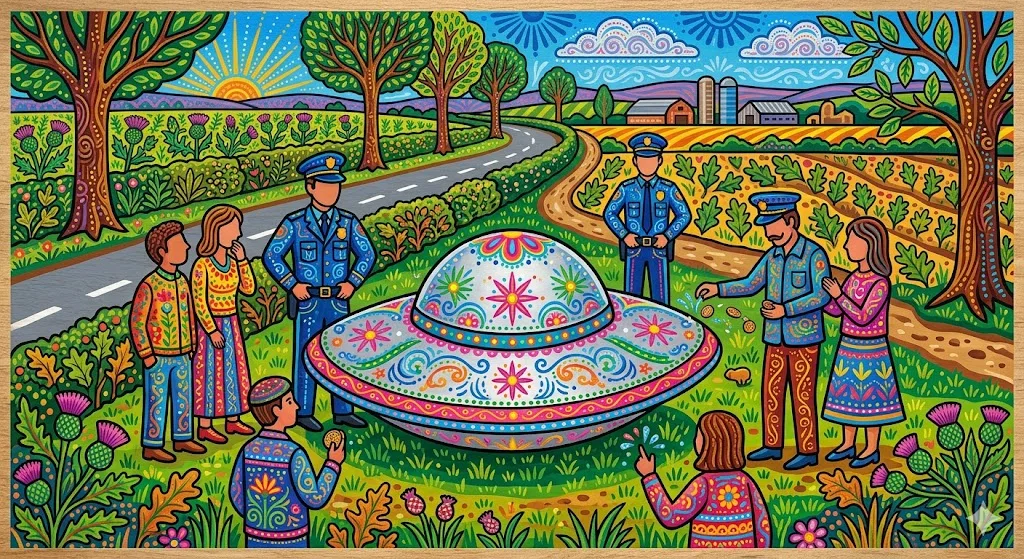
In September 1967, Berkshire briefly became part of one of Britain’s best-documented UFO pranks. Two fake “flying saucers” were planted in the historic county, one at Welford near Newbury and another at Winkfield near Ascot, as part of a wider line of six objects placed across southern England. The objects were not unexplained craft: they were fibreglass hoax devices made by aircraft engineering apprentices connected with the Royal Aircraft Establishment at Farnborough and Farnborough Technical College for Rag Week publicity. What makes the Berkshire episode worth remembering is the response. Police, military personnel, bomb-disposal teams, RAF helicopters and Ministry of Defence officials treated the objects seriously until the hoax was exposed the same day.[The Guardian]theguardian.comOpen source on theguardian.com.
For Berkshire UFO history, the case is a useful warning against simple storytelling. It was a “landed saucer” incident with objects, witnesses, police involvement and official alarm, yet it was also a planned practical joke. Its value lies in showing how quickly an impressive object, placed in the right Cold War and space-age setting, could move from local curiosity to national security concern.
What appeared at Welford and Winkfield
The Berkshire part of the hoax involved two sites separated within the county’s wider southern-England line of planted saucers. The Welford object was found by postal worker Eva Rood while she was on her delivery round. According to later reporting drawing on contemporary accounts, police took the object to the station, Ministry of Defence officials were called, and United States Air Force military police from a nearby base arrived to photograph it.[Smithsonian Magazine]smithsonianmag.comOpen source on smithsonianmag.com.
The Winkfield object was found near Ascot, close to NASA’s UK satellite tracking presence. That location mattered because it gave the prank an extra layer of plausibility: a strange silver object near a space-tracking facility looked more suggestive than the same object would have looked in an ordinary back garden. One station engineer, Roger Kenyon, reportedly tested the object cautiously by throwing pennies at it to see whether it would explode before it was handed over to police.[Smithsonian Magazine]smithsonianmag.comOpen source on smithsonianmag.com.
The objects themselves were designed to look convincing at first glance. The saucers were silver, domed and roughly the size of a small industrial object rather than a full-scale aircraft. Later accounts describe them as fibreglass constructions made from moulded halves, coated to resemble dull aluminium, with a battery-powered sound device and a foul-smelling flour-and-water mixture inside. The effect was theatrical but practical: a smooth metallic-looking shell, an eerie noise, weight, smell and the possibility that careless handling might reveal an unpleasant “alien” interior.[Smithsonian Magazine]smithsonianmag.comOpen source on smithsonianmag.com.
The Berkshire discoveries were not isolated. Six objects appeared on the same morning along a broadly straight line from the Bristol Channel side of southern England towards the Thames Estuary. The known sites included Clevedon in Somerset, Chippenham in Wiltshire, Welford and Winkfield in Berkshire, Bromley in south London, and Sheppey in Kent. That geometry was part of the trick: the objects were arranged to look like a pattern rather than a random prank.[The Guardian]theguardian.comOpen source on theguardian.com.
How police, military and MoD teams responded
The alarm was not irrational in the narrow sense that officials had to deal with unknown objects in public places. In 1967, an unexplained metal-looking device could mean a hoax, a dangerous package, military debris, a downed instrument, a Soviet-related object, a scientific payload or something else requiring caution. The police and military could not simply assume it was harmless because it looked absurd.
The official response grew quickly. The Guardian’s account of the released Ministry of Defence papers states that the army’s southern command, four police forces, bomb-disposal units, RAF helicopters and the MoD’s intelligence branch were mobilised after reports came in from the public and police. One object was sent to Home Office scientists at Aldermaston, another was inspected by the guided-weapons division of the British Aircraft Corporation, and the Chippenham saucer in Wiltshire was destroyed in a controlled explosion.[The Guardian]theguardian.comOpen source on theguardian.com.
Berkshire’s role in that response was especially revealing because of the local defence and space-age geography. Welford sat close enough to a United States Air Force presence for military police to become involved, while Winkfield’s proximity to satellite tracking made the “saucer” feel less like a village joke and more like something that might have a technical or security dimension.[Smithsonian Magazine]smithsonianmag.comOpen source on smithsonianmag.com.
The hoax was uncovered not by a dramatic scientific breakthrough but by ordinary clues. At Bromley police station, a Scotland Yard bomb-disposal squad arrived with portable X-ray equipment, but the presence of Ever Ready batteries helped reveal the mundane construction of the device. That detail is important because it shows how official caution and practical inspection worked together: the response was serious, but the explanation was not hidden once the objects were examined properly.[The Guardian]theguardian.comOpen source on theguardian.com.
The Ministry of Defence later treated the episode as an embarrassingly effective practical joke. The released papers described the “1967 flying saucer hoax” as an “obviously very successful practical joke”, but they also show why officials cared about how much detail emerged publicly. A retired RAF intelligence officer who had dealt with UFO sightings and had attended the Bromley investigation later sought clearance to talk about the case; internal concern centred less on proving aliens than on avoiding disclosure of sensitive procedures and previous UFO-related work.[The Guardian]theguardian.comOpen source on theguardian.com.
Why the prank worked
The Berkshire saucers worked because they combined several features that often make UFO reports persuasive before they are solved. They were physical objects, not just lights in the sky. They were found by ordinary people going about normal routines. They appeared in multiple places on the same morning. They were placed near locations that seemed to fit a Cold War or space-race story. And they arrived at a time when “flying saucer” imagery was already familiar in newspapers, science fiction and public discussion.
The pranksters also understood official caution. A device that might be a bomb, a military instrument or an unknown payload has to be handled carefully even if it later proves silly. The same feature that made the stunt funny in retrospect made it serious in the moment: nobody at Welford or Winkfield could know at first inspection whether the object was safe. That is why the cautious response of police, technical staff and military personnel should not be dismissed simply as gullibility.
The timing also helped. British official interest in UFOs had already gone through cycles by the 1960s. The National Archives briefing on UFO records notes that official British interest began in earnest in 1950, that the 1951 Flying Saucer Working Party concluded sightings could be explained by misidentifications, illusions, psychological causes or hoaxes, and that the report recommended no further investigation unless “material evidence” appeared. A landed physical object was exactly the sort of thing that could not be ignored at the scene, even by an institution inclined to scepticism.[National Archives]cdn.nationalarchives.gov.ukOpen source on nationalarchives.gov.uk.
The hoaxers had technical credibility too. They were not children throwing hubcaps into fields; they were aircraft engineering apprentices and students connected with Farnborough, a major aviation research environment. Work reportedly began months before the stunt, with moulds, fibreglass shells, metallic coatings, sound devices and planned locations. That preparation explains why the saucers looked good enough to produce a real response before their construction was identified.[Smithsonian Magazine]smithsonianmag.comOpen source on smithsonianmag.com.
What the evidence proves and what it does not
The strongest evidence in this case supports the hoax explanation. The objects were recovered, inspected and traced to the Farnborough Rag Week stunt. The perpetrators revealed the prank on the same day, and later reporting has added named witnesses, institutional context and accounts from those involved. This is not a case where sceptics proposed a possible hoax decades later to explain an ambiguous sighting; it was exposed almost immediately.[The Guardian]theguardian.comOpen source on theguardian.com.
There are still small uncertainties around the edges, but they do not revive the Berkshire saucers as unexplained objects. Later accounts mention other reports made on or around the same day, including claims by people who believed they saw something in the sky rather than merely finding a planted object. Those reports are interesting as examples of how a hoax can stimulate or frame other observations, but they do not change the status of the Welford and Winkfield devices themselves.[Smithsonian Magazine]smithsonianmag.comOpen source on smithsonianmag.com.
The most sensible classification is therefore clear: the 1967 Berkshire saucers were a confirmed hoax that generated a genuine official response. That combination is what gives the incident its historical value. It is not evidence of alien visitation, but it is evidence of how a persuasive UFO-like event could move through police, military and media systems in late-1960s Britain.
The case also warns against treating official involvement as proof of mystery. Police attendance, military photographs, bomb-disposal caution or MoD interest can all be real while the underlying incident is still mundane. In Berkshire’s 1967 case, the official paperwork and alarm strengthen the historical record of the event, but they do not strengthen the extraterrestrial interpretation.
Why it still matters for Berkshire UFO history
The Welford and Winkfield saucers matter because they are among Berkshire’s clearest “object on the ground” UFO stories, yet they are also among its clearest debunked cases. That makes them unusually useful for readers trying to understand the county’s UFO record. They show what strong evidence can look like when a case is solved: named places, recovered objects, official response, press coverage, later archival release and a known chain back to the makers.
They also help separate Berkshire’s UFO history from more ambiguous cases. A later pilot report, a light in the sky, or an MoD sighting entry may remain unresolved because the evidence is limited. The 1967 hoax is different: the evidence is rich, but it points to a prank. That contrast is important for any county-level UFO history, because “well documented” does not always mean “unexplained”.
The incident also belongs specifically to Berkshire rather than just to a national list of UFO oddities. Welford placed the prank near Newbury and the military landscape of west Berkshire, while Winkfield placed it near Ascot and early space-tracking activity. The two Berkshire sites show how local geography shaped official perception: an object near a military or space-related setting was easier to treat as potentially significant, at least until inspection proved otherwise.
Finally, the hoax remains a compact lesson in public alarm. A few convincing objects, spread across several counties, briefly created the appearance of a coordinated “landing”. The authorities responded because they had to; the press amplified the drama because the imagery was irresistible; and the public remembered the story because it looked like science fiction had landed in ordinary English fields. For Berkshire, the lasting point is not that officials were foolish, but that UFO history often turns on the gap between first response and final explanation.
Amazon book picks
Further Reading
Books and field guides related to How a Berkshire Saucer Hoax Fooled Officials. Use these as the next step if you want deeper reading beyond the article.
The UFO Files
Directly covers British UFO history, official responses, and the culture that made incidents like the 1967 saucer hoax plausible.
The Report on Unidentified Flying Objects
Provides historical context for how military and official bodies evaluated UFO reports, echoing the response seen in the Berkshire hoax.
Watch the Skies!
Examines the development of flying-saucer beliefs and hoaxes, making it highly relevant to a celebrated British UFO prank.
The Flying Saucers are Real
Helps explain the flying-saucer era mindset that allowed planted objects to generate serious official concern.
eBay marketplace picks
Marketplace Samples
Example marketplace items related to this page. Use the search link to explore similar finds on eBay.
Endnotes
1.
Source: cdscc.nasa.gov
Title: other history
Link:https://www.cdscc.nasa.gov/Pages/other_history.html
2.
Source: ntrs.nasa.gov
Link:https://ntrs.nasa.gov/api/citations/19720012595/downloads/19720012595.pdf
3.
Source: theguardian.com
Link:https://www.theguardian.com/world/2011/mar/03/alien-invasion-hoax-fooled-ministry
4.
Source: smithsonianmag.com
Link:https://www.smithsonianmag.com/history/how-british-college-students-convinced-authorities-that-flying-saucers-were-invading-the-uk-180985442/
5.
Source: cdn.nationalarchives.gov.uk
Link:https://cdn.nationalarchives.gov.uk/documents/briefing-guide-12-07-12.pdf
6.
Source: cdn.nationalarchives.gov.uk
Link:https://cdn.nationalarchives.gov.uk/documents/the-ufo-files-extract.pdf
7.
Source: drdavidclarke.co.uk
Title: National Archives UFO Files
Link:https://drdavidclarke.co.uk/national-archives-ufo-files-7/
8.
Source: museum.qld.gov.au
Title: Cooby Creek Tracking Station model
Link:https://www.museum.qld.gov.au/learn-and-discover/queensland-stories/cooby-creek-tracking-station-model/
Additional References
9.
Source: facebook.com
Link:https://www.facebook.com/groups/779220482206901/posts/8085631941565682/
10.
Source: studylib.net
Link:https://studylib.net/doc/26160565/ada084225
11.
Source: fourcornersbooks.co.uk
Link:https://www.fourcornersbooks.co.uk/articles/david-clarke-interview-on-ufo-drawings/
12.
Source: worldradiohistory.com
Link:https://www.worldradiohistory.com/Archive-Electronics-World/60s/1964/Electronics-World-1964-06.pdf
13.
Source: facebook.com
Link:https://www.facebook.com/groups/syladg/posts/7888983197820391/
14.
Source: facebook.com
Link:https://www.facebook.com/groups/505496528355706/posts/1022282483343772/
15.
Source: collectspace.com
Link:https://www.collectspace.com/ubb/Forum20/HTML/001989.html
16.
Source: scispace.com
Link:https://scispace.com/pdf/a-unified-set-of-tracking-station-coordinates-derived-from-5gdvgom0jr.pdf
17.
Source: discovered.ed.ac.uk
Link:https://discovered.ed.ac.uk/discovery/fulldisplay?context=L&docid=alma9924432585002466&lang=en&query=sub%2Cexact%2CIntention+%28Logic%29&tab=Everything&vid=44UOE_INST%3A44UOE_VU2
18.
Source: svn.greenstone.org
Link:https://svn.greenstone.org/flax/trunk/flaxmain/web/WEB-INF/classes/flax/opennlp/models/parser/tagdict
Topic Tree