Within Caernarfonshire Skies
Were the 2001 Lights a Regional Sky Event?
The February 2001 Caernarfon report sits near other North Wales and UK fireball descriptions, making natural explanations worth testing.
On this page
- Caernarfon and Amlwch reports side by side
- Fireball clues in the wider UK pattern
- Why distance and direction matter at night
Page outline Jump by section
Introduction
The 2001 North Wales lights are best understood as a small case family, not as a single isolated mystery over Caernarfon. The key official entries are two Ministry of Defence reports five minutes apart on 7 February 2001: one from Caernarfon describing a star-like green object with red on the side, apparently descending towards the witness’s house, and one from Amlwch on Anglesey describing a blue glow turning green, breaking up and leaving smoke. The reports matter because they sit just before a documented UK fireball run on 8 and 9 February 2001, when the Society for Popular Astronomy received multi-site reports of bright, colourful meteors over Wales, northern England and Scotland. That does not prove the Caernarfon sighting was a meteor, but it makes a regional sky-event explanation much more plausible than a purely local craft or object.[GOV.UK]assets.publishing.service.gov.ukOpen source on service.gov.uk.
This page treats Caernarfonshire in its historic-county sense: Caernarfon is inside the county, while Amlwch is across the water on Anglesey. The cross-county comparison is still useful because sky events do not respect county lines, and a bright object high in the atmosphere can be reported from widely separated places. The Wikimedia historic-counties map identifies Caernarfonshire as one of Wales’s thirteen historic counties, while Wikishire describes it as a north-west Welsh shire dominated by mountain and coastal geography.[Wikimedia Commons]commons.wikimedia.orgCommons File:Wales Historic Counties map Caernarfonshire.svgCommons File:Wales Historic Counties map Caernarfonshire.svg
Caernarfon and Amlwch reports side by side
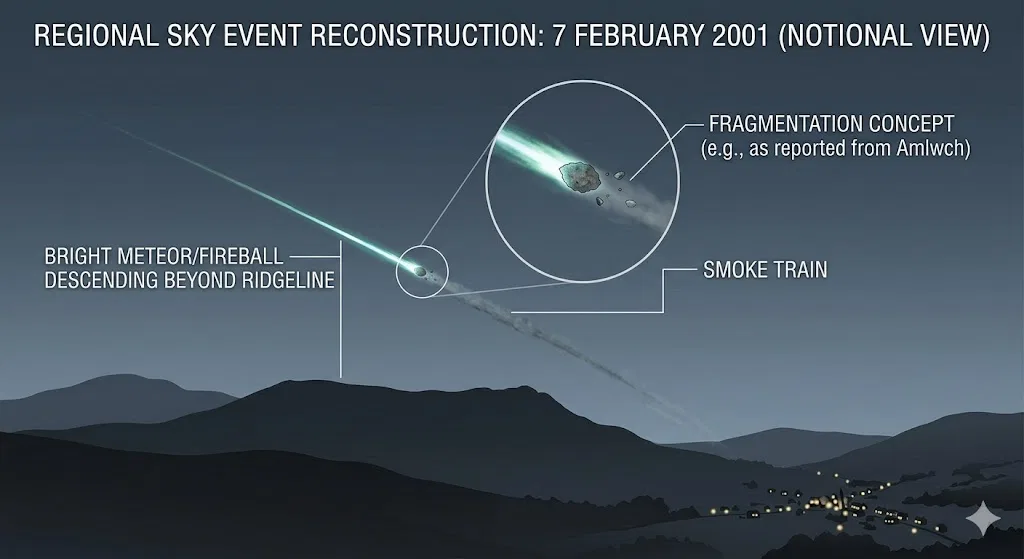
The official MoD list is brief, but the timing is the first clue. At 19:40 on 7 February 2001, the Caernarfon entry says the object “initially looked like a star”, appeared as if it was going to crash into the witness’s house, and was green with red on the side. At 19:45, the Amlwch entry describes one object with a blue glow that turned green, broke up and left smoke, and seemed very large. These are not full witness statements, radar files or investigation notes; GOV.UK describes the published series as UFO reports from 1997 to 2009 giving dates, times, locations and brief descriptions.[GOV.UK]assets.publishing.service.gov.ukOpen source on service.gov.uk.
Placed side by side, the two reports have three overlapping features: a bright point-like or glowing object, green colouring, and a sense of descent or breakup. The Amlwch wording is especially meteor-like because “broke up” and “left smoke” are common fireball clues. The Caernarfon wording is more ambiguous: a star-like object that seems to approach a house could be a meteor seen on a shallow path, an aircraft or helicopter seen head-on, or a perspective effect in which a distant object appears much closer than it is.
The five-minute gap cuts both ways. It may indicate two separate reports of the same broad sky event with imprecise public reporting times, or it may indicate two different objects seen during a short period of active skywatching or heightened attention. The MoD table does not give azimuth, elevation, duration, sound, weather, exact witness location, or whether either report was made immediately. Without those details, a firm reconstruction is not possible.
The fireball clues in the wider UK pattern
The strongest reason to test a natural explanation is what happened immediately afterwards. On 8 February 2001, the MoD list includes several entries that sound like fireballs: a Staffordshire object “burning up in the sky” and breaking into pieces, a Preston orange ball “on fire”, a Lincoln object like a rocket, a Wrangle object with a bright ball and long tail, and a West Yorkshire report of a “huge fireball”. On 9 February, there are further descriptions of multi-coloured or orange objects with tapered or structured appearances.[GOV.UK]assets.publishing.service.gov.ukOpen source on service.gov.uk.
The Society for Popular Astronomy’s Meteor Section separately recorded four fireballs across 8–9 and 9–10 February 2001. Its special report says the 8 February 19:42 UT event generated 25 sightings from Scotland down to Greater Manchester, Cheshire and North Wales, and estimated a shallow atmospheric track beginning over Cumbria and ending over County Durham. The same report notes colour reports including blue, green, yellow-red and orange, and says several witnesses saw fragmentation.[SkyWatchers]popastro.combright fireballs from the uk february 8 andbright fireballs from the uk february 8 and
That 8 February fireball was not the Caernarfon event, because it was a day later. Its value is comparative. It shows that, in the same narrow early-February window, witnesses across Britain were seeing bright, colourful, fragmenting objects that entered both astronomy logs and UFO-style report lists. The SPA’s annual 2001 fireball summary also records the 8 February event as at least magnitude -5 or -6 with 25 reports from Wales, northern England and Scotland, plus a 9 February 20:21 event that may have reached between magnitude -5 and -9 and fragmented.[SkyWatchers]popastro.comfireball sightings from 2001fireball sightings from 2001
For the Caernarfonshire case, that wider pattern weakens an exotic reading. It does not close the case, because the documented SPA fireball with a reconstructed trajectory is dated 8 February, not 7 February. But it shows that “green object, apparent descent, breakup, smoke, fireball-like appearance” was not an isolated North Wales motif that week. It was part of a short-lived pattern of bright meteor and meteor-like reports across the UK.
Why distance and direction matter at night
A bright meteor can look local even when it is tens of kilometres high. NASA’s Center for Near Earth Object Studies describes meteors as the visible paths of small asteroid or comet fragments entering the atmosphere at high speed, and defines a fireball as an unusually bright meteor. The SPA similarly defines a fireball as an especially bright meteor and notes that, when reports come from more than one location, they can be combined to estimate a trajectory.[cneos.jpl.nasa.gov]cneos.jpl.nasa.govOpen source on nasa.gov.
This is why the Caernarfon report’s “going to crash into the witness’s house” phrase should be handled carefully. It is an honest perception, not a measured distance. At night, with no clear scale, a high object descending behind a roofline, hill, cloud bank or mountain ridge can appear dangerously close. Caernarfonshire’s geography adds to the problem: historic Caernarfonshire is coastal and mountainous, and most settlement lies around coastal land and valleys rather than on an open plain.[Wikishire]wikishire.co.ukOpen source on wikishire.co.uk.
The colour clues are also suggestive but not decisive. Fireballs can be reported as green, blue, orange, red or white, depending on composition, brightness, speed, atmospheric effects and witness perception. The SPA’s 8 February 2001 report recorded exactly that kind of colour spread, while the MoD list records green in the Caernarfon entry, blue-to-green in the Amlwch entry, and green again in the Staffordshire report the following evening.[SkyWatchers]popastro.combright fireballs from the uk february 8 andbright fireballs from the uk february 8 and
Smoke is stronger evidence than colour, but even that needs care. The International Meteor Organization explains that large meteoroids can leave material distributed along their path, producing a smoke train or visible train after the bright meteor itself has gone. The Amlwch report’s “left smoke” line therefore fits a fireball scenario better than an aircraft-light scenario, though the MoD table does not say whether the smoke was seen clearly, how long it lasted, or whether it was actually a luminous train interpreted as smoke.[International Meteor Organization]imo.netOpen source on imo.net.

What the MoD record can and cannot prove
The MoD entry is valuable because it anchors the case in an official public record rather than later folklore. It gives a date, time, place and concise description. It also allows comparison with adjacent entries in the same national list. That is enough to show that the Caernarfon report belongs in Caernarfonshire’s UFO history, but it is not enough to make it a strong unexplained case.[GOV.UK]GOV.UKUF O reports in the UKUF O reports in the UK
The missing evidence is just as important as the recorded evidence. A stronger case would need exact viewing direction, angle above the horizon, duration, weather, number of witnesses, whether the object was silent, whether any aircraft were nearby, and whether the Caernarfon and Amlwch witnesses were describing the same track. There is no radar confirmation in the published entry, no pilot report tied to this incident, and no official conclusion saying the object remained unexplained after investigation.
The broader history of the MoD UFO desk also warns against over-reading these short entries. The National Archives transcript of the 2013 final file release says the MoD closed its UFO desk and hotline in November 2009 after decades of collecting and sometimes investigating reports, and that many later reports were simply filed away because resources were limited. That does not invalidate the 2001 reports, but it reminds readers that the presence of an item in an MoD UFO list means “reported to the MoD”, not “verified as extraordinary”.[National Archives]cdn.nationalarchives.gov.ukNational Archives UFO file release video transcriptNational Archives UFO file release video transcript
A cautious reading for Caernarfonshire’s UFO history
The fairest assessment is that the 7 February 2001 Caernarfon report remains unresolved in the narrow sense that the published data do not identify a specific object. But it is not a high-strangeness case. Its most distinctive details — star-like brightness, green and red colouring, apparent descent, and proximity to the Amlwch blue-green breakup report — are all compatible with a meteor or fireball-style event, especially when read against the documented 8–9 February UK fireball pattern.[service.gov.uk]assets.publishing.service.gov.ukOpen source on service.gov.uk.
For the Caernarfonshire branch, the case is useful less as proof of a strange craft than as a lesson in regional interpretation. A report centred on Caernarfon cannot be judged only by drawing a tight circle around the town. The nearby Amlwch entry, the following night’s fireball reports, and the known difficulty of estimating distance and direction at night all change the reading. The most evidence-led position is therefore modest: the 2001 North Wales lights are a credible local UFO report in the archival sense, but the balance of clues points towards a regional sky event or a cluster of fireball-like sightings rather than a confirmed unexplained vehicle over Caernarfonshire.
Amazon book picks
Further Reading
Books and field guides related to Were the 2001 Lights a Regional Sky Event?. Use these as the next step if you want deeper reading beyond the article.
The UFO Experience
Especially relevant to light sightings, meteors and observational errors.
Open Skies, Closed Minds
Relevant to official reporting and interpretation of unusual lights.
Meteor Science and Engineering
Supports the page's discussion of possible meteor and fireball explanations.
UFO Investigations Manual
Covers how to analyse regional sightings and compare witness reports.
eBay marketplace picks
Marketplace Samples
Example marketplace items related to this page. Use the search link to explore similar finds on eBay.



Endnotes
1.
Source: assets.publishing.service.gov.uk
Link:https://assets.publishing.service.gov.uk/media/5a79dfc9ed915d042206ba86/UFOReport2001.pdf
2.
Source: commons.wikimedia.org
Title: Commons File:Wales Historic Counties map Caernarfonshire.svg
Link:https://commons.wikimedia.org/wiki/File%3AWales_Historic_Counties_map_Caernarfonshire.svg
3.
Source: GOV.UK
Title: UF O reports in the UK
Link:https://www.gov.uk/government/publications/ufo-reports-in-the-uk
4.
Source: cneos.jpl.nasa.gov
Link:https://cneos.jpl.nasa.gov/fireballs/intro.html
5.
Source: cdn.nationalarchives.gov.uk
Title: National Archives UFO file release video transcript
Link:https://cdn.nationalarchives.gov.uk/documents/ufo-video-transcript.pdf
6.
Source: assets.publishing.service.gov.uk
Title: ufo report 2009
Link:https://assets.publishing.service.gov.uk/media/5a7582c440f0b6397f35efcb/ufo_report_2009.pdf
7.
Source: assets.publishing.service.gov.uk
Title: ufo report 1997
Link:https://assets.publishing.service.gov.uk/media/5a758d2fe5274a6faebebd11/ufo_report_1997.pdf
8.
Source: nationalarchives.gov.uk
Link:https://www.nationalarchives.gov.uk/explore-the-collection/explore-by-time-period/postwar/ufo-reports/
9.
Source: cdn.nationalarchives.gov.uk
Link:https://cdn.nationalarchives.gov.uk/documents/aug-2009-research-guide.pdf
10.
Source: cdn.nationalarchives.gov.uk
Link:https://cdn.nationalarchives.gov.uk/documents/the-ufo-files-extract.pdf
11.
Source: cdn.nationalarchives.gov.uk
Link:https://cdn.nationalarchives.gov.uk/documents/final-tranche-of-UFO-files-released.pdf
12.
Source: docs.house.gov
Title: HHRG 118 GO12 Wstate ShellenbergerM 20241113
Link:https://docs.house.gov/meetings/GO/GO12/20241113/117721/HHRG-118-GO12-Wstate-ShellenbergerM-20241113.pdf
13.
Source: datamap.gov.wales
Title: wales Historic County Boundaries of Wales
Link:https://datamap.gov.wales/layers/geonode%3Ahistoric_counties_bng_rcahmw_ply
14.
Source: popastro.com
Title: bright fireballs from the uk february 8 and 9 2001
Link:https://www.popastro.com/meteor/2001/02/10/bright-fireballs-from-the-uk-february-8-and-9-2001/
15.
Source: wikishire.co.uk
Link:https://wikishire.co.uk/wiki/Caernarfonshire
16.
Source: popastro.com
Title: fireball sightings from 2001
Link:https://www.popastro.com/meteor/2001/12/31/fireball-sightings-from-2001/
17.
Source: popastro.com
Title: Sky Watchers
Link:https://www.popastro.com/meteor/fireball-sightings/
18.
Source: imo.net
Link:https://www.imo.net/observations/fireballs/observations/
19.
Source: popastro.com
Link:https://www.popastro.com/meteor/2001/
20.
Source: popastro.com
Title: annual review 2001
Link:https://www.popastro.com/meteor/annual-review-2001/
21.
Source: popastro.com
Title: section reports 1998 2010
Link:https://www.popastro.com/meteor/section-reports-1998-2010/
22.
Source: popastro.com
Title: Welcome to the Society for Popular Astronomy
Link:https://www.popastro.com/
23.
Source: popastro.com
Title: leonids 2000
Link:https://www.popastro.com/meteor/2000/11/30/leonids-2000/
24.
Source: Wikipedia
Link:https://en.wikipedia.org/wiki/Caernarfon
25.
Source: imo.net
Link:https://www.imo.net/docs/04trains.pdf
26.
Source: fireball.imo.net
Title: browse events
Link:https://fireball.imo.net/members/imo_view/browse_events
27.
Source: ebsco.com
Link:https://www.ebsco.com/research-starters/astronomy-and-astrophysics/fireball
28.
Source: wikishire.co.uk
Link:https://wikishire.co.uk/wiki/Caernarfon
Additional References
29.
Source: youtube.com
Link:https://www.youtube.com/watch?v=FD6dCwx6tpg
Source snippet
"North Wales" UFO MoD files 2001 Not Alone Up There — UFO Caught on Parachute Cam #UFOs #ufo #UAP #UAPs #ovni UFONOMENON...
Published: August 2011
30.
Source: youtube.com
Link:https://www.youtube.com/watch?v=62tr8fZ-02Q
Source snippet
UFO file release May 2008 Part 2 (audio with slides)...
Published: May 2008
31.
Source: onelook.com
Link:https://www.onelook.com/?loc=olthes1&w=Caernarfonshire
32.
Source: facebook.com
Link:https://www.facebook.com/wilphotographer/posts/a-fireball-was-seen-and-caught-on-camera-early-hours-of-this-morning-with-witnes/1489144646164035/
33.
Source: instagram.com
Link:https://www.instagram.com/reel/DPi58JyCXYe/
34.
Source: facebook.com
Link:https://www.facebook.com/WIS10/posts/look-a-green-fireball-captured-on-dashcam-video-as-a-meteor-streaks-across-the-s/1388483719974190/
35.
Source: instagram.com
Link:https://www.instagram.com/reel/DVrchTblAGd/?hl=en
36.
Source: facebook.com
Link:https://www.facebook.com/groups/aussiehistory/posts/3798180143650686/
37.
Source: facebook.com
Link:https://www.facebook.com/TheStraitsTimes/posts/bolides-are-fireballs-that-explode-in-a-bright-flash-often-with-visible-fragment/975627508057743/
38.
Source: abcounties.com
Link:https://abcounties.com/counties/county-profiles/caernarfonshire/
Topic Tree