Within Roxburghshire UFOs
Could Border Aircraft Explain Local UFO Reports?
Military low flying and valley acoustics make aircraft explanations important for Roxburghshire sightings.
On this page
- Low flying training in the Borders
- Why hills and valleys distort sightings
- Where aircraft explanations fall short
Page outline Jump by section
Introduction
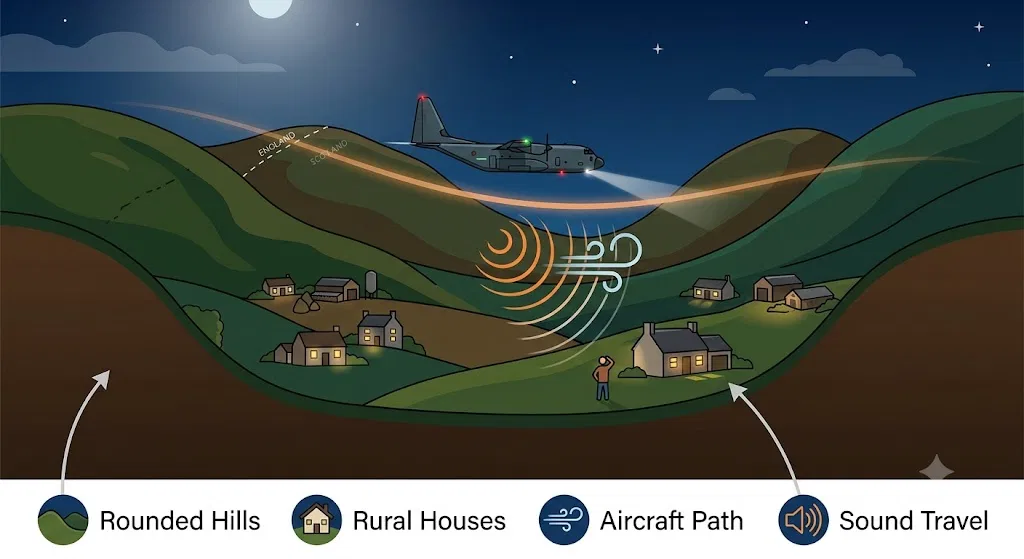
Low-flying aircraft are one of the most useful explanations to test against Roxburghshire UFO reports, not because they explain everything, but because they fit the county’s setting especially well. Historic Roxburghshire sits in the Border country of south-east Scotland, with towns such as Kelso, Jedburgh and Hawick set among valleys, hills and open rural skies. The Ministry of Defence’s clearest published Roxburghshire UFO entry is the Kelso report of 17 August 1997: an oval orange object with a green central light, a rushing-wind sound, and apparent speed “faster than a jet”. That description is intriguing, but it is also exactly the kind of report where low-level aviation, night perception and valley acoustics have to be checked before reaching for a stranger explanation.[GOV.UK]assets.publishing.service.gov.ukufo report 1997ufo report 1997
The key point is simple: the Borders are not empty sky. The Ministry of Defence identifies the Borders area of southern Scotland and northern England as one of the UK’s tactical low-flying training areas, and low-level military flying can be sudden, loud, brief and difficult to identify from the ground.[GOV.UK]GOV.UKRA F operational low flying training timetableRA F operational low flying training timetable
Why the Borders matter for aircraft explanations
Roxburghshire is a historic county, not a modern council area. It now lies within the Scottish Borders, but for older reports and county-based UFO mapping it is more useful to treat it as the Border shire centred on Kelso, Jedburgh, Hawick, Teviotdale, Liddesdale and the Tweed. The geography matters because aircraft are not experienced from a map: they are experienced from a field, a street, a farm track, a bedroom window or a hillside road, often with only seconds to judge what has passed overhead. Roxburghshire stretches from the Tweed and Teviot valleys towards the Cheviot Hills and Liddesdale, giving it the broken terrain that can make low-level flight look and sound more dramatic than it would over flat ground.[Encyclopedia Britannica]britannica.comEncyclopedia Britannica Roxburghshire | Location, History & FactsEncyclopedia Britannica Roxburghshire | Location, History & Facts
The official low-flying context is important. GOV.UK explains that UK military low flying is used to train aircrew for roles including reconnaissance, search and rescue, troop transport and humanitarian aid. The UK low flying system covers open airspace from the surface to 2,000 feet above ground level or mean sea level, subject to exclusions and rules. The Borders area is specifically named as one of three tactical training areas, alongside central Wales and northern Scotland.[GOV.UK]GOV.UKMilitary low flyingMilitary low flying
For a UFO report, this does not mean “it was definitely the RAF”. It means that low-flying aircraft are a locally plausible control explanation. In a county with thin UFO documentation, the right question is not “could an aircraft ever be mistaken for a UFO?” but “does the local airspace and terrain make aircraft misidentification likely enough to test first?” For Roxburghshire, the answer is yes.

Low-flying training in the Borders
The Ministry of Defence divides the UK into low flying areas, and its current public guidance states that three are also tactical training areas: central Wales, northern Scotland, and the Borders area of southern Scotland and northern England. Separate RAF operational low-flying timetables are published for these tactical areas, including LFA 20(T), the Borders area. The same guidance warns that the published timetable does not cover all low-flying activity, because weather and training needs can change quickly.[GOV.UK]GOV.UKRA F operational low flying training timetableRA F operational low flying training timetable
That last point is vital for interpreting local reports. A witness may check later and find no obvious public timetable entry matching what they saw. That absence is not, by itself, proof that the object was not an aircraft. The MOD explicitly says that when the tactical training area is not in use, there may still be other flying activity in the area, and that it cannot provide a timetable for all low flying.[GOV.UK]GOV.UKRA F operational low flying training timetableRA F operational low flying training timetable
The height ranges also matter. GOV.UK’s public overview says fixed-wing aircraft can fly down to 250 feet from the ground, while helicopters can fly down to 100 feet, and rotary-wing aircraft may be authorised to go lower. A withdrawn but still useful MOD explanatory leaflet gave the same broad picture and added that fast jets, Hercules aircraft and helicopters also fly low level at night, while operational tactical training can take fast jets lower in the designated tactical training areas.[GOV.UK]GOV.UKOpen source on gov.uk.
For a person on the ground in Roxburghshire, 250 feet is not an abstract aviation figure. It is low enough for a fast aircraft to appear abruptly above a ridge, cross a valley in seconds, and disappear before the observer has time to orientate themselves. At night, the witness may see only lights, a glow, a silhouette, or the effect of sound arriving in a confusing direction.
The Kelso report through a low-flying lens
The Kelso sighting on 17 August 1997 is the best single official anchor for this discussion. The MOD’s published 1997 UFO list records the sighting at 02:30 in Kelso, Roxburghshire. The object was described as oval, glowing orange, with a green light in the centre, accompanied by a rushing-wind sound, and travelling “faster than a jet”.[GOV.UK]assets.publishing.service.gov.ukufo report 1997ufo report 1997
Several features make an aircraft explanation worth considering. The sound is one. A “rushing wind” noise is not the same as a clearly identified engine note, but it is compatible with a fast low-level pass, especially if the aircraft was heard only briefly or partly masked by terrain. The apparent speed is another. Witnesses often estimate speed by comparison with familiar aircraft, but at night and without a known distance, speed and size are extremely hard to judge. A small object close by can seem large and fast; a larger aircraft farther away can seem oddly slow or silent; a light moving across a dark valley can seem to accelerate as it changes angle.
The colour description is less decisive. Aircraft navigation and anti-collision lighting can produce red, green, white or flashing impressions, while atmospheric haze, angle, cloud, reflections and partial viewing can alter perceived colour. The Kelso report’s orange glow with a green central light is not a neat match to a standard aircraft lighting diagram, but witness colour descriptions in short night sightings are rarely exact enough to rule aircraft in or out on their own. The official entry gives no direction, duration, elevation, number of witnesses, radar trace, weather record or investigation conclusion, so the aircraft hypothesis remains plausible rather than proven.[GOV.UK]assets.publishing.service.gov.ukufo report 1997ufo report 1997
Why hills and valleys distort sightings
Roxburghshire’s valleys can change both the sound and the visual drama of an aircraft sighting. The county’s towns sit in and around river corridors: Hawick in Teviotdale, Kelso on the Tweed, Jedburgh near the Jed Water and Teviot, and Liddesdale in the south-west. This matters because a low aircraft may be screened by hills until it is already close. A witness can therefore experience the event as sudden appearance, rapid transit and sudden disappearance, even when the aircraft is flying normally.[Wikishire]wikishire.co.ukOpen source on wikishire.co.uk.
Sound can be especially deceptive. Aircraft noise is strongly affected by altitude: lower aircraft produce much greater noise at ground level than aircraft at cruising altitude, and the sound signature depends on engines, airframe and configuration. Even civilian noise studies note that altitude has a major effect on perceived aircraft noise, while technical aviation sources identify engines, aerodynamic flow, landing gear and control surfaces as contributors to what people hear.[Gatwick Airport]gatwickairport.comGatwick Airport Factors Affecting Aircraft NoiseGatwick Airport Factors Affecting Aircraft Noise
In hill country, the problem is not just loudness. Reflections from slopes, masking by ridges, wind direction and delayed echoes can separate the apparent source of the sound from the visible object. A witness may hear a rush after the lights have passed, or hear the sound from a direction that does not seem to match the movement. That mismatch can make an ordinary aircraft feel uncanny. It can also make a report sound more exotic when written down later: “it made a rushing noise but did not look like a plane” is a fair witness impression, but it is not automatically evidence of an exotic object.
Night viewing adds another layer. Transport Canada’s night-flying guidance notes that speed and distance are harder to judge in darkness because the usual ground references are missing, and lights can appear nearer than they are. That principle applies to pilots, but it is just as relevant to ground witnesses trying to identify an unfamiliar light over a dark rural landscape.[Transport Canada]tc.canada.caTransport Canada Hazards Associated with Flying at NightTransport Canada Hazards Associated with Flying at Night
What aircraft can explain well
Aircraft explanations are strongest when a Roxburghshire report has several ordinary aviation markers: a short duration, a straight or gently curving path, a sudden loud noise, navigation-like lights, a low apparent altitude, and a disappearance behind hills or cloud. A low-level military or transport aircraft does not need to hover, land or perform impossible manoeuvres to be misread. It only needs to be seen briefly from a poor angle in an unfamiliar context.
The Borders setting strengthens that possibility in three practical ways.
First, low flight is officially expected in the wider region. The MOD’s own guidance identifies the Borders tactical training area and publishes operational low-flying timetables for it, while also warning that not every flight can be publicly timetabled in advance.[GOV.UK]GOV.UKRA F operational low flying training timetableRA F operational low flying training timetable
Second, the terrain can make a normal pass feel abrupt. In a valley, an aircraft may appear from behind a ridge, cross the observer’s view quickly, and vanish behind another slope. To the witness, that can look like a sudden arrival and disappearance rather than a continuous flight path.
Third, rural darkness removes scale. Without visible buildings, roads, horizon detail or cloud height, a witness may not know whether a light is a small object nearby, an aircraft at low level, a distant aircraft on approach elsewhere, or a high object moving at ordinary speed.
This makes low-flying aircraft a particularly important explanation for the Kelso case. The report’s “rushing wind sound” and “faster than a jet” wording sound dramatic, but they are also consistent with how a surprised witness might describe a very fast, low or acoustically distorted aircraft pass.[GOV.UK]assets.publishing.service.gov.ukufo report 1997ufo report 1997
Where aircraft explanations fall short
A good sceptical explanation must have limits. “Aircraft” should not be used as a catch-all label for every Border sighting, especially when the available evidence is too thin to test. In the Kelso report, the aircraft explanation is plausible, but the official record lacks the details needed to confirm it: there is no direction of travel, no duration, no bearing, no weather, no aircraft track, no radar note, no witness interview and no named investigator’s conclusion.[GOV.UK]assets.publishing.service.gov.ukufo report 1997ufo report 1997
Some reported features can also strain a simple aircraft explanation. Hovering for a long time, repeated sharp right-angle turns, silent motion at close range, physical traces, multiple independent witnesses from different locations, or radar correlation would all demand more than a casual “probably a plane”. The Kelso entry does not provide that level of corroboration, but neither does it provide enough data to eliminate an aircraft. Its strength is that it is officially listed; its weakness is that the listing is brief.
There is also a difference between explaining a report and explaining an experience. A witness who saw a low, bright, fast object at 02:30 may have had a genuinely startling experience. Saying “this may have been an aircraft” is not the same as saying the witness invented it or was foolish. In UFO history, many sincere reports arise when ordinary aerial activity is seen under unusual viewing conditions. The MOD and National Archives record collections show how broad the reporting stream was, from possible aircraft and meteors to stranger claims that were never resolved in public files.[The National Archives]nationalarchives.gov.ukOpen source on nationalarchives.gov.uk.
How to judge future Roxburghshire reports
For Roxburghshire, the best use of the low-flying explanation is not to close cases automatically, but to improve the questions asked at the start. A useful local UFO report should try to record:
- the exact time and location;
- the direction first seen and last seen;
- duration in seconds or minutes;
- whether the object crossed a ridge, valley, road, river or known landmark;
- colour and flashing pattern of lights;
- sound, including whether it came before, during or after the visual sighting;
- weather, cloud and visibility;
- whether other witnesses saw it from different places;
- whether any aircraft tracking, local aviation notice, MOD timetable or police report can be checked.
This kind of detail matters more in Roxburghshire than a dramatic label. A report from Kelso, Hawick, Jedburgh or Liddesdale that includes a clear track, multiple witnesses and independent timing would be much stronger than a short description of a strange light. Conversely, a report that matches a low, fast, noisy pass through the Borders should be treated cautiously before being added to the county’s unexplained UFO history.

The balanced reading
Border low-flying aircraft are not a universal answer to Roxburghshire UFO reports, but they are one of the first explanations that should be tested. The county’s historic geography places it in hilly Border terrain, and official MOD material confirms that the wider Borders area is part of the UK’s low-flying training structure. Those facts make aircraft misidentification especially relevant to reports involving sudden lights, rushing sound, rapid movement and short viewing time.[britannica.com]britannica.comEncyclopedia Britannica Roxburghshire | Location, History & FactsEncyclopedia Britannica Roxburghshire | Location, History & Facts
The Kelso 1997 report remains unresolved on the public record. It is not strong enough to prove an extraordinary object, but it is not detailed enough to debunk with confidence either. The most responsible conclusion is that a low-flying aircraft is a serious and locally grounded possibility, especially given the sound and apparent speed, while the lack of follow-up data prevents a firm identification. That makes the case useful not as a dramatic mystery, but as a reminder of how Border terrain, night skies and military flying can turn a brief aerial event into a lasting UFO report.
Amazon book picks
Further Reading
Books and field guides related to Could Border Aircraft Explain Local UFO Reports?. Use these as the next step if you want deeper reading beyond the article.
Area 51
Useful background on military aviation and why unusual aircraft generate UFO reports.

UFOs : Generals, Pilots, and Government Officials Go on the R...
Includes aviation-related testimony and discussion of identification challenges.
The Mammoth Book of UFOs
Provides many comparison cases involving aircraft and misidentifications.
Skunk Works
Helps readers understand how advanced aircraft can be mistaken for unusual aerial objects.
eBay marketplace picks
Marketplace Samples
Example marketplace items related to this page. Use the search link to explore similar finds on eBay.

Endnotes
1.
Source: assets.publishing.service.gov.uk
Title: ufo report 1997
Link:https://assets.publishing.service.gov.uk/media/5a758d2fe5274a6faebebd11/ufo_report_1997.pdf
2.
Source: GOV.UK
Title: RA F operational low flying training timetable
Link:https://www.gov.uk/government/publications/military-low-flying-raf-operational-low-flying-training-timetable
3.
Source: GOV.UK
Link:https://www.gov.uk/low-flying-in-your-area/where-and-when-low-flying-happens
4.
Source: britannica.com
Title: Encyclopedia Britannica Roxburghshire | Location, History & Facts
Link:https://www.britannica.com/place/Roxburghshire
5.
Source: GOV.UK
Title: Military low flying
Link:https://www.gov.uk/guidance/military-low-flying
6.
Source: GOV.UK
Link:https://www.gov.uk/low-flying-in-your-area
7.
Source: assets.publishing.service.gov.uk
Link:https://assets.publishing.service.gov.uk/media/5a81c50340f0b623026990fd/UK_Military_Low_Flying-withdrawn.pdf
8.
Source: britannica.com
Link:https://www.britannica.com/place/Liddesdale
9.
Source: tc.canada.ca
Title: Transport Canada Hazards Associated with Flying at Night
Link:https://tc.canada.ca/en/aviation/publications/system-safety-summer-briefing-kit-tp-14112/hazards-associated-flying-night-powerpoint-presentation
10.
Source: nationalarchives.gov.uk
Link:https://www.nationalarchives.gov.uk/explore-the-collection/explore-by-time-period/postwar/ufo-reports/
11.
Source: GOV.UK
Title: ufo reports in the uk
Link:https://www.gov.uk/government/publications/ufo-reports-in-the-uk
12.
Source: assets.publishing.service.gov.uk
Link:https://assets.publishing.service.gov.uk/media/62cc1146e90e07748a619131/20220526-Pattern-of-low-flying-across-the-UK-20-21-tables.xlsx
13.
Source: assets.publishing.service.gov.uk
Link:https://assets.publishing.service.gov.uk/media/5a78a34ee5274a277e68e4ab/POMLFAppendix20102011.pdf
14.
Source: assets.publishing.service.gov.uk
Link:https://assets.publishing.service.gov.uk/media/69258c3d9fd433badebc311b/The_pattern_of_military_low_flying_across_the_UK_2024-2025.xlsx
15.
Source: assets.publishing.service.gov.uk
Title: ZA557 si 1 3 narrative of events
Link:https://assets.publishing.service.gov.uk/media/5a79d533ed915d042206b5cf/ZA557_si_1_3_narrative_of_events.pdf
16.
Source: assets.publishing.service.gov.uk
Link:https://assets.publishing.service.gov.uk/media/5a757b41e5274a1622e2221e/acronyms_and_abbreviations_dec08.pdf
17.
Source: assets.publishing.service.gov.uk
Link:https://assets.publishing.service.gov.uk/media/5a807c8740f0b62302693cb1/20170215-Low_Flying_Leaflet_-_Master_v3_Final.pdf
18.
Source: assets.publishing.service.gov.uk
Title: RA2330 Issue 10
Link:https://assets.publishing.service.gov.uk/media/6970ee49011505255b2d42fb/RA2330_Issue_10.pdf
19.
Source: cdn.nationalarchives.gov.uk
Title: podcast transcript
Link:https://cdn.nationalarchives.gov.uk/documents/podcast-transcript.pdf
20.
Source: cdn.nationalarchives.gov.uk
Link:https://cdn.nationalarchives.gov.uk/documents/the-ufo-files-extract.pdf
21.
Source: cdn.nationalarchives.gov.uk
Title: aug 2009 research guide
Link:https://cdn.nationalarchives.gov.uk/documents/aug-2009-research-guide.pdf
22.
Source: GOV.UK
Link:https://www.gov.uk/government/publications/military-low-flying-mod-sponsored-air-exercises
23.
Source: GOV.UK
Link:https://www.gov.uk/low-flying-in-your-area/find-out-about-low-flying-in-your-area
24.
Source: GOV.UK
Title: the pattern of military low flying across the uk 20242025
Link:https://www.gov.uk/government/statistics/the-pattern-of-military-low-flying-across-the-uk-20242025/the-pattern-of-military-low-flying-across-the-uk-20242025
25.
Source: archives.gov
Link:https://www.archives.gov/research/topics/uaps/rg-collections
26.
Source: raf.mod.uk
Link:https://www.raf.mod.uk/our-organisation/stations/raf-lossiemouth/flying-info/
27.
Source: raf.mod.uk
Link:https://www.raf.mod.uk/aircraft/current-aircraft/typhoon-fgr41/
28.
Source: raf.mod.uk
Link:https://www.raf.mod.uk/our-organisation/stations/leuchars-station/flying-info/
29.
Source: aidu.mod.uk
Title: uk U K MIL AIP ENR 5
Link:https://www.aidu.mod.uk/aip/pdf/enr/ENR-5-2.pdf
30.
Source: scotborders.gov.uk
Link:https://www.scotborders.gov.uk/council-2/teviot-liddesdale-area-partnership
31.
Source: data.jncc.gov.uk
Link:https://data.jncc.gov.uk/data/35ee1457-11d5-4e03-a151-28cae856df5e/JNCC-Report-319-FINAL-WEB.pdf
32.
Source: aims.niassembly.gov.uk
Link:https://aims.niassembly.gov.uk/terms/PrintResults.aspx?cb1=&cb2=&fd=&itn1=Eek7thqY2umjMzkosusKMA%3D%3D&itn2=jc7icOHu4kg%3D&itn3=jc7icOHu4kg%3D&ito2=&ito3=&ks=jc7icOHu4kg%3D&m=0&mn=All+Questions&per=&pg=2&pi=0&pid=4&pm=&se=&so=Ascending&sp=&st=1&tb=&td=&tn=1
33.
Source: nsip-documents.planninginspectorate.gov.uk
Title: EN0210010 000042 Scoping Opinion
Link:https://nsip-documents.planninginspectorate.gov.uk/published-documents/EN0210010-000042-Scoping%20Opinion.pdf
34.
Source: nsip-documents.planninginspectorate.gov.uk
Title: EN0110038 000002 Scoping Report
Link:https://nsip-documents.planninginspectorate.gov.uk/published-documents/EN0110038-000002-Scoping%20Report.pdf
35.
Source: wikishire.co.uk
Link:https://wikishire.co.uk/wiki/Roxburghshire
36.
Source: gatwickairport.com
Title: Gatwick Airport Factors Affecting Aircraft Noise
Link:https://www.gatwickairport.com/on/demandware.static/-/Sites-Gatwick-Library/en_GB/v1776481900708/images/Corporate-PDFs/Noise%20%26%20Airspace/NMB/Factors%20Affecting%20Aircraft%20Noise%20Final%20Report.pdf
37.
Source: realcounties.com
Link:https://realcounties.com/county/roxburghshire/
38.
Source: Wikipedia
Link:https://en.wikipedia.org/wiki/Roxburghshire
39.
Source: wikishire.co.uk
Link:https://wikishire.co.uk/wiki/Jedburgh
Additional References
40.
Source: youtube.com
Link:http://www.youtube.com/watch?v=_D-tJnO_4uA
Source snippet
What is the Mach Loop and why is it ideal for fighter jet training?...
41.
Source: youtube.com
Title: Flying the Typhoon Through the Mach Loop at Low Level
Link:http://www.youtube.com/watch?v=kT7qrYi8R_M
Source snippet
Mach Loop 2022 Highlights!! USAF F-15Eagle V F35Lightning Low Level through the Mountains of Wales...
42.
Source: youtube.com
Title: RAF F35 Lightning low level training along Ullswater in the Lake District UK
Link:http://www.youtube.com/watch?v=Bsi-3vsYQVU
Source snippet
Flying the Typhoon Through the Mach Loop at Low Level...
43.
Source: faa.gov
Link:https://www.faa.gov/sites/faa.gov/files/Night_Ops_Ch13.pdf
44.
Source: war.gov
Link:https://www.war.gov/medialink/ufo/release_1/255_413270_ufo%27s_and_defense_what_should_we_prepare_for.pdf
45.
Source: nonoise.org
Link:https://www.nonoise.org/epa%20index/roll17/roll17doc7.pdf
46.
Source: banthebomb.org
Link:https://www.banthebomb.org/militaryscotland/appendixc.html
47.
Source: researchgate.net
Link:https://www.researchgate.net/publication/261455719_Acoustic_Detection_of_Low_Flying_Aircraft
48.
Source: facebook.com
Link:https://www.facebook.com/61581918080948/videos/anyone-else-see-this-low-flying-aircraft-over-the-borders-today-scottishborders-/1309658704387220/
49.
Source: jgios.com
Link:https://www.jgios.com/aviation
Topic Tree